
The tensile test is used to determine the behavior of a given material when subjected to stress due to traction. The purpose of the test is to determine the material’s resistance to breakage and its main mechanical properties; it examines the state of a body subjected to the action of forces that stretch it. Prueba de tensión is also the title chosen by Luciana Lamothe (Buenos Aires, 975) for her most recent solo exhibition, presented at Ruth Benzacar Gallery. The show featured three works, all sculptures built using scaffolds representing various investigations in the resistance of materials.
A scaffold is an auxiliary yet central structure in the construction of a building. Perhaps for its provisional nature, scaffolds are easily forgotten, and when present are often take to be an obstacle, an encumbrance. While Lamothe’s scaffolds are similar to those commonly found on the outside of construction projects, the young artist moves away from the gaze from afar typical of city passers-by, and invites visitors to use their bodies and climb her flimsy structures built with metal rafters and weighty wood planks. The sculptures in this exhibitions form a grid of lines and geometric planes balances between formal compositions and architectural needs. It is a sequence of horizontals and verticals that project and divide the gallery space.
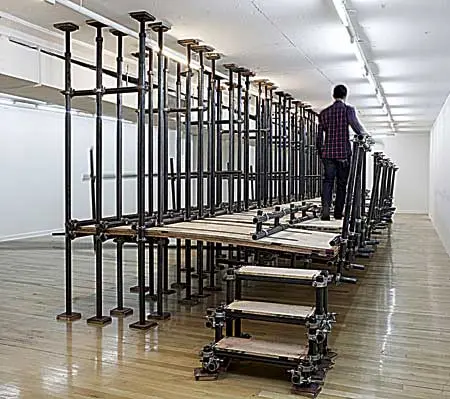
Entering the exhibition, a small construction offers the first evidence: two projecting crosspieces prod visitors to step into the work and exert pressure with their own bodies. Weight works as an active force to test the material resistance and expose the mechanics of its work. The traction stress caused by the visitor causes the wood to bend, surprisingly pliable like a piece of paper, without breaking. As the old saying about reeds go, Lamothe’s sculptures bend, but don’t break. In fact, in some Asian countries, bamboo reeds are used for scaffolding in construction projects.
After this presentation of the functioning of the structure, the second device demands greater commitment on the part of the viewer, inviting us to ascend to and walk through a scaffolding walkway that shifts and arches under our weight as we advance. While a section of this scaffold is attached to the ceiling and the floor, the section where the public walks—the wooden planks—sway in the air without a point of support. Added to this instability is the detail that the counterweights are not homogeneous, so that each plank moves in a different way. Only an austere handrail provides users with the safety needed to continue on.
In a way, the tensile test is also practiced upon the viewer who, in order to try out the work’s mechanism must climb onto the structure at a potential risk. It is indeed a test, a situation that generates tension in the user. While there is no real risk, a sensation of unmooring and instability is generated which, in some way, produces vertigo. It is a calculated risk—being inside an institution, the work is surrounded by the necessary safety measures, the material is resistant, and it was made in consultation with a specialist (Guillermo Mirochnic)— but the impression of imbalance remains. The sculptures are centered around a contained instability that allows Lamothe to play with the sensation of vertigo. This effect is carried to the limit in the last mechanism, where users are suspended in mid-air over an oscillating wooden plank.
It is worth noting that this exhibition derives from a series of works still in progress about such industrial skeletons, such as Contacto, presented at MAMBA in late 2013, where Lamothe built a runway of oscillating scaffolds and invited viewers to walk along it. A few years before that, she created Función (2011), featuring a scaffolding device user to “attack” the gallery walls. In this case there was no active participation on the part of viewers, but the work focused o n the notions of causality and effect. It also bears mentioning that Lamothe’s earliest works were acts of urban vandalism with herself as protagonist, center stage. Her own body was subject to risk and vertigo. The body remains in the foreground in her latest works, but Lamothe has ceded her central place to the viewer.
AYELÉN VÁZQUEZ