
By this time there should be very little doubt
regarding the solid contributions made by the Brazilian-born artist Lygia
Clark, who was one of the essential figures reshaping the role of art and the
international status of Brazilian art in the postwar era. Unfortunately, there
still seem to be far too many art historians and scholars who are largely
unfamiliar with both the artist and the range of her works, particularly among
Brazil’s neighbors to the north. Random gallery exhibitions and teases from
larger group shows like the Guggenheim Museum’s overreaching survey of
Brazilian art have been most of what American audiences have been exposed to.
It is therefore fitting and timely to finally be treated to a more
comprehensive examination of Clark’s expansive career.
Lygia Clark: The Abandonment of Art, 1948–1988,
which
comprises
nearly 300 works, ranging from the late 1940s to the early 1980s and is
accompanied by a full program of her films, seeks to draw a more cohesive
American attention to her work.
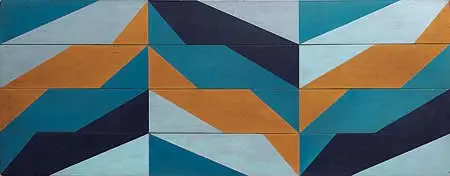
Principal curators Luis Pérez-Oramas, The Estrellita Brodsky Curator of Latin American Art, MoMA; and Connie Butler, Chief Curator, Hammer Museum, attempt to make a clear sense of order out of Clark’s expansive career and therefore the exhibition is organized around three key themes: abstraction, Neo-Concretism, and the “abandonment” of art. The first section of the exhibition features dozens of Clark’s abstract paintings. On the whole, these tend to be chromatically limited and showcase hard-edged geometries. Clark’s experiments with geometric abstraction led her to a new set of explorations of space. This would result in Clark’s discovery of what she called the linhas orgânicas (“organic lines”). This was her way of expressing the space, either imagined or in fact actual, between planes as indicated by a line. Initially drawn, this line eventually became actual as of the space between edges within the surface of her work. As seen in her paintings of 1956–57, mainly her series Superficies moduladas (Modulated surfaces), juxtaposed planes are separated by very tight gaps, the only “lines” in their compositions; these are Clark’s linhas orgânicas (organic lines).
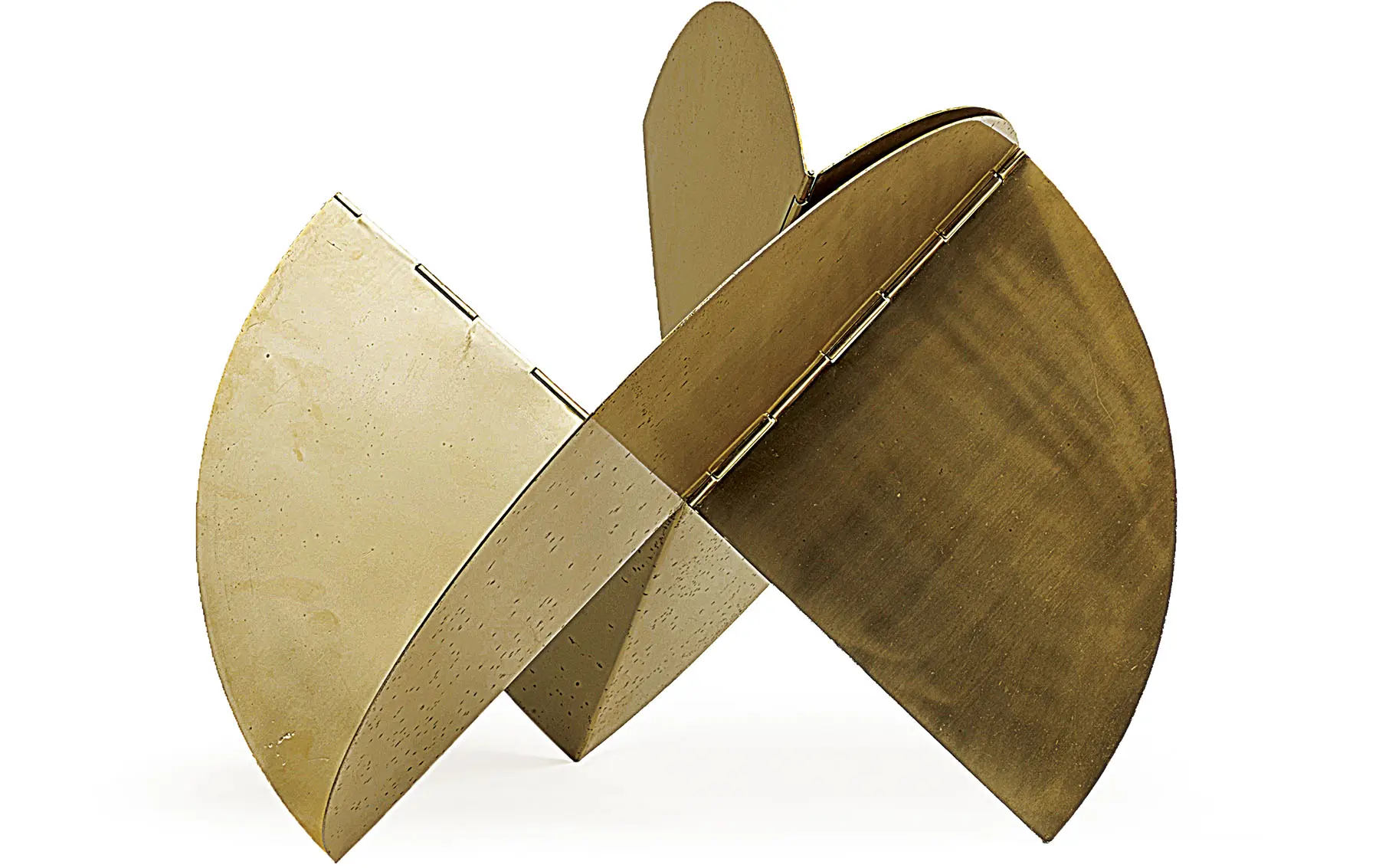
Around 1960, Clark developed her series of sculptures known as Bichos (Critters). These were the first participatory works by Clark meant to be fully and endlessly reshaped by their interaction with the beholders. In the Bichos the organic lines become hinges between panels, allowing the sculpture to be transformed from flat forms into a variety of unexpected three-dimensional configurations. Some Bichos bear strong resemblance to living organisms while others explore the geometric propositions of her paintings. This section also features O dentro é o fora (The inside is the outside) (1963) and O antes é o depois (The before is the after) (1963), the only two works from the Bichos series featuring a continuous and intertwined metal strip without hinges. These works engage in the proposition that the artwork, once displayed, is not interred but rather still has life and variation within it. The Museum has made this variability more clear by displaying replicas of some of the bichos for the visitors to readjust into different compositions.
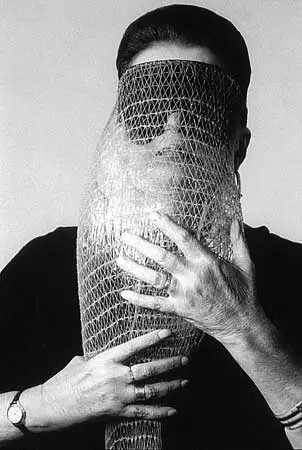
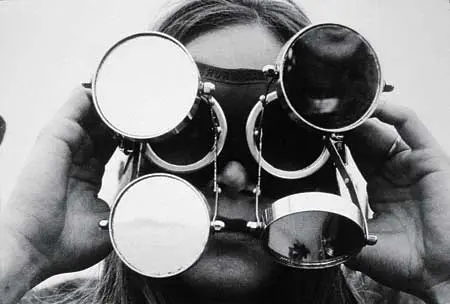
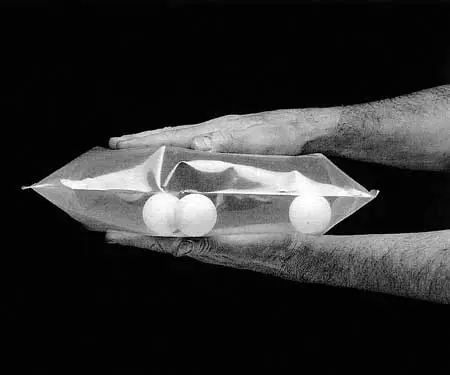
In 1963, Clark made a work titled Caminhando (Walking) by twisting a strip of paper 180 degrees, gluing its ends together to create a Möbius strip (a circular form that appears to have two sides but actually has only one), and cutting around and around its length until it was too thin to cut further. This was the first of Clark’s “propositions” works that spectators were invited to take part in creating, thus becoming more than simply spectators. In the words of the artist, “the work is the act.” With the establishment of the military dictatorship, in 1966 Clark began a long sojourn of exile in Europe, teaching at the Sorbonne among other things. During this period she more fully developed the concepts and practices that she had confronted during the 1960s, especially with the “proposition” works. During this time, she made very simple objects out of ordinary things such as gloves, plastic bags, stones, seashells, water, elastics, and fabric, almost exclusively in the form of found objects. Like with the performance sculptures by Rebecca Horn from the same period these “sensorial objects” often acted as extensions of and were designed to make possible a different awareness of our bodies, our perceptual capabilities, and our mental and physical constraints. Throughout her career she sought to redefine the relationship between art and society as the Neo-Concretists looked to push the limits of what art represented. In other words, Clark discovered ways for museum-goers (who would later be referred to as “participants”) to interact with her artworks so that the art is the actual process and the spectator, in essence, becomes the artist. For example, with Oculus (1968) Clark fashioned a viewing device from found fabrics, metal, and lenses that allowed for two viewers to look through it while facing one another. The device contained mirrors and inverted lenses and was adjustable so the viewer encountered different viewing possibilities as well as the unusual physical experience of being in close physical proximity with another person not yet really engaging visually. Many of these works involved an interaction between two people and would come to be regarded by Clark as a form of therapy.
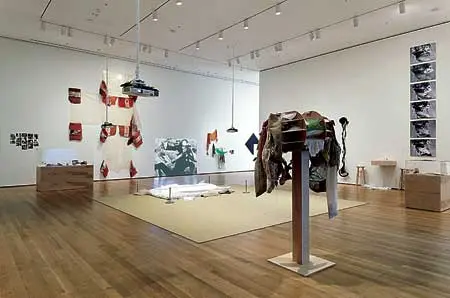
Given Clark’s initial anti-institutional stance and the truism that her work cannot be adequately enjoyed at a museum, there is some degree of irony that her first American retrospective would be at The Museum of Modern Art, a museum that has epitomized the idea of the authoritative art institution with its white cube galleries and reputation for global hegemony. Indeed there are times when the exhibition can look very sterile and more like a lab. In a way, even the gestures made by the museum to allow for a fuller experience of the art tend to reinforce this institutional authority. The replicas of the bichos call into question the notion of authorship and authenticity—why can only the replicants be adjusted and who determined the “official” composition of the “real” ones? Likewise, the interactive works can be engaged only during certain hours under the direct supervision of a museum “facilitator.” Of course, initially, this art was designed to put a museum’s two primary functions—the display of art and its preservation—at odds with each other and one of the interesting aspects of the exhibition is how the institutional art world has managed to accommodate artists such as Clark, Helio Oiticica, and Felix Gonzales-Torres, who are just a few that challenged the norms of art and its reception. In this respect then perhaps the Lygia Clark retrospective is not so much overdue as right on time.
JOHN ANGELINE
Earned his Ph.D. in Art History from the Graduate Center of the City University of New York. He currently teaches at John Jay College of Criminal Justice and his most recent book was Hard Light: the Art of Emilio Sanchez.