
Magaly Sánchez presents her tenth solo exhibition, titled Circular because Sánchez “had previously developed circular canvases and based on them she wanted to explore geometry, Op Art, and the history of art.”1 This exhibition is comprised of nine acrylic on canvas works, including a polyptych, three diptychs, and five medium-format works. The theme is the circle as a base; thus, 11 of the 15 paintings on exhibit are circular, two are rectangular, and one is of fused circles. Sánchez intended to present the circle as seen from a variety of angles and to include images by other artists, something that has been always present in her work, such as Leonardo da Vinci, Botticelli, François Clouet, Henri Rousseau, and Roy Lichtenstein.
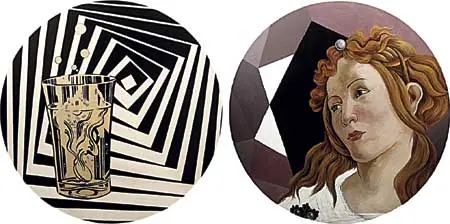
Sánchez, known as a practitioner of Pop Art, always switches themes, ideas, and shapes in her paintings, and each show is different from the previous one. Sánchez challenges viewers with shapes and ideas, using stenciled graphic patterns with universal optical effects like those featured in the work of Bridget Riley or Victor Vasarely. Sánchez’s work is Pop Art, now combined with Op Art “as a complement of geometry applied with the intention of generating an aesthetic conversation.”2 She uses famous Renaissance images such as Botticelli’s Venus and Mars. In her Círculo Cromático we see and recognize part of Mars’ body, but in the foreground, we encounter two large chromatic circles with almost 109 different colors. Since the chromatic circles are in the foreground and the title indicates it, the work is about color circles and Mars is only a reference and piece of décor for greater aesthetic harmony. But the imposition of these images of colors with Botticelli’s image generates a dialog with the viewer. In her diptych Buenos Días Roy, Sánchez used Lichtenstein’s Alka Seltzer. In the circular painting to the left, the glass of Alka-Seltzer is identical to Lichtenstein’s, but Sánchez has added bubbles of different sizes above the glass to make it seem more real. In another circular painting, we see the face of a woman: Botticelli’s Spring; Sánchez mixes the past with the contemporary. The Alka Seltzer painting has a square Op Art background that generates the sensation of motion, while in the painting with the Botticelli image there are three geometric shapes, two white and one black, against a dark purple ground. Obviously, this makes the latter painting more static and gives the former a greater sense of life and dynamism.
In other series, Sánchez has painted James Dean, Elvis, Yma Sumac, and over three years she painted Marilyn Monroe with candies, cats, roses, pearls, flowers, etc. With this exhibition, Sánchez demonstrates that art remains fresh and that her work is an experiment every time she brings it out for display.
NOTES
1. Interview with the artist.
2. Idem.
AUGUSTO CHIMPEN