
The exhibition titled Mechanically presents the most recent work by young Colombian artist Manuel Calderón (Bogota, 1985). Mechanically implied overcoming initial budgets for the creation of a group of works that formed a sophisticated and complex whole—strategically and thematically speaking. From his earliest works, Calderón has unleashed his obsessions, first withdrawing, approached in a classical manner but translated into a contemporary language. Recently Calderón has been focusing on drawing individuals, often in large-scale works, with a perfection of details that bring to mind both a microscopic hyperrealism as well as the visual language of the great advertising posters that invade the cities of the world; textures that are touched with the eyes and casual characters that are as familiar as they are unknown. Because of their anonymity, these subjects are so distant that the obsession that characterizes Calderón’s work was lost in the distant subject. Nonetheless, in this latest exhibition, Calderón presents us with the depths of another of his obsessions: the perpetuated self-portrait, the artist repeated endlessly until this infinite multiplication has the effect of dissolving him into the whole of an anonymous and uniform mass.
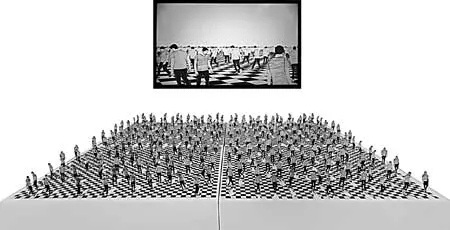
Mechanically derives from the image unceasingly repeated and combines the arduous technique of drawing—as the base for digital animation—and digital printing a contrasting mode of production and “mechanical” reproduction of the image. Both approaches confront the analog with the digital. It is then the amount of time spent in the more handcrafted approach versus the supposed ease of digital technology. This results in works that appear to be fast execution while they actually hide the hand of Calderón who spent hours producing them. This duality runs through the exhibition and is the key to the curatorship headed by Luis Fernando Pradilla.
The exhibition has its origins in a work from 2011 that places the viewer behind a subjective camera. It is a rotoscoping animation titled Infinito (Infinitum) constructed from two hundred ink drawings on paper following the above-mentioned millenary animation technique. Upon entering the small dark room we found ourselves by the edge of a staircase that we used repeatedly to go down. It is the entrance to an illusory space in which moving forward was not of our own doing. Infinito functions as an invitation to the rest of the exhibition and is the first of many sets of steps that Calderón relies on to go up and down. It signals the starting point—and the absence of a final destination—and informs us of the rest of the individuals who are always one and the same. At the edge of these steps we briefly enter Calderón’s skin to then see ourselves replicated ad infinitum. The rest of the show exhibits the multimedia works Complejo de Escaleras (Stair Complex, 2014), an India ink drawing on paper and digital animation), Mecanicamente Divergentes (Mechanically Divergent, 2014), ink drawing and silkscreen on steel, plus digital animation), and two screen prints on paper En Proceso de Expansión (In Process of Expansion, 2014), measuring 12 x 2 m and 180 x 100 cm, respectively.
The great constant of these works is a wandering army of self-portraits. They can be found on a checkered floor or while on the way up or down the stairs without really reaching a final destination. We are confronted with mankind abandoned to an absurd destiny with no other purpose than repeating the already done. In Mecanicamente Divergente we immerse ourselves in a digital animation based on hand drawings and, near it, a silkscreen with cutout figures that stand on their feet. This work contrasts the same repetitive motion in video and in the static “muckup.” Wherever we look we always see the same character who, upon reaching the end it begins again by the power of loop, trapped in a sort of Sisyphus’s punishment: existence and absurdity.
The overwhelming feeling that invades us when observing these works is that of being surrounded by the punishment of an endless destination. While the infinitely repeated self may indicate an excess of faith in an individual’s identity, it has the opposite effect here: identity dissolves until disappearing and acquiring a dystopian character. Is it possible that we are all inevitably like that being? Beyond the ontological, this monotonous bicolor landscape underscores the loss of the “aura” of the image in general: surrounded by images of all kinds, they gradually lose their value. The reiterated self-portrait thus becomes a metaphor for an image without aura. This idea is key for understanding the importance of Calderón’s work within a contemporary context. In an adjacent room awaits En Proceso de Expansión, a 12 x 2 meters silkscreen that, although it shows us the same self-portrait again, acts almost as a way to escape, as the epilogue of hope: another army moves but in this case it moves forward with steady steps, clenched fists and the head looking ahead as if the subject’s identity had finally found its way. In these walls, finally, the individual has found the power of the group.
CARIDAD BOTELLA