
María Bonomi can be said to be a
standard-bearer in the visual arts of today’s Brazil, both for her trajectory
over time—her career spans six decades—and for the importance of her oeuvre.
Among her badges of honor is the conquest of an artistic status for
printmaking, unjustly considered the “poor cousin” to the fine arts. Her
greatest achievement is the place she occupied among the highest figures of
Brazil’s national culture. María has talent in abundance, a talent for life.
Her artistic disposition was once again on display at the fourth edition of the project Vão, at the Sesc Belenzinho. The project invites artists devoted to aesthetic investigations beyond the object to redesign the central area of the unit’s tower on the basis of proposals for on-site works. María Bonomi was invited to occupy the tower’s atrium. For her ephemeral installation, titled Circumstantiam, she created 15 xylographs printed on 21 4m x 4m quadrants, placed between cables and suspended mirrors. These works were made on recyclable paper and degradable aluminum sheets.
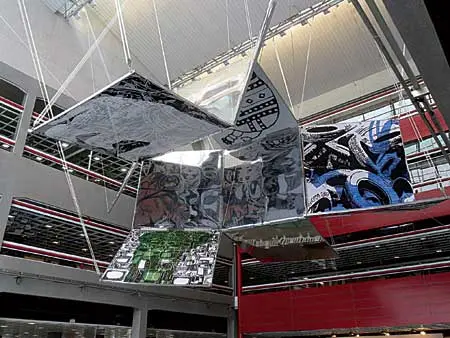
The artist created for the site an enveloping, with supports that rose almost to the ceiling. Arranged in several levels, the prints form a unit with the mirrors, offering viewers, with their reflection, a generous sensation of spatial amplitude. Despite the figurative images, such as cellular phones, the repetition of motifs, printmaking modules, and mirrors transform the work into a large-scale arabesque, enlivened by the superposition of colors and the interplay of artificial lights. With Circumstantiam, María Bonomi demonstrates the large degree to which collective space is her place.
Bonomi is a veritable artistic landmark in São Paulo. The city’s urban landscape is punctuated by public-art works that bear her authorship. Her proposal is not to create an aesthetic refuge in the midst of the city’s chaos; her outsize concrete panels seem to confirm the weight of the integration of so many differences and suggest the city’s poetic viability, promoting human coexistence. Bonomi’s works multiply and appear in public and private buildings, as well as in the city’s metro system. For the artist, creating public art means to salvage the history of a given site and to transform the citizen.
The most indelible sign of her ideas have been her large collective projects. Her giant panel Epopéia paulista, unveiled in 2004 at Estação da Luz, for example, was the result of an open workshop at the Museu de Arte Contemporânea da Universidade de São Paulo (MAC USP). Hundreds of people participated in the making of this work. Bonomi also created the project Etnias - Do Primeiro e Sempre Brasil, at the Memorial da América Latina, with the collaboration of artists, technicians, resisting indigenous persons, volunteers, students, and others. The process was clearly collective and open, with the artist providing solely its spine; the rest of the body was composed with the participation of everyone involved in the project.
Starting with her unusual desire of becoming a carpenter and the practice of drawing compulsively, María could not have arrive at a different destination: xylography. Born in Italy, the daughter of a Brazilian mother, she had as her first stop after moving to the tropics the workshop of another illustrious immigrant, Lasar Segall (1891-1957), who guided her to study with the painter Yolanda Mohaly (1909-1978). After exploring several techniques, she knocked on the door of master printmaker Livio Abramo (1903-1992). Xylography then became the most important aspect of her extensive production. From her hands, known by their strength in carving wood, come myriad things such as drawings, paintings, sculptures, public-art works, installations, figurines, stages, and more.
With independence of the social aspect, María’s works suggest an expressive lyrical force, with watered down brushstrokes on wood that are immediately carved and printed in infinite colors and transparencies. This exercise punctuates one of her best-known prints, her Medusa, an image of tangled threads that refer to the shape of the animal (jellyfish) with “tentacles” that seem to jump to the surface. María has an affectionate style, born from a slow, subtle, gesture-based process devoted to the perceptions of others. Her poetic vision is concerned with the boundary line where her creation ends and the gaze of others begins. María is a generous artist.
In her career, the artist has valued the idea of the matrix as a final aesthetic. This is visible in several of her works, as it is in her public panels, which remind us of immense carved plaques. The original mage with its graphic shapes and the resulting texture of the grooves on the wood, acquires a particular force. She also repeatedly expanded the format of her prints, in a process that arrived naturally at the giant panels.
This is precisely what takes place in her recent installation at the Sesc, where physical amplitude is an intrinsic part of the work. As the artist puts it: “Circumstantiam means that a only a single instant is captured, but it speaks of the whole, of our destiny. It shows that there is no outside and that it is impossible to take our eyes away from what surrounds us and what is born in us”.
ALESSADRA SIMÕES