
Presenting a solo show of works by
Brazilian artist Nazareth Pacheco always requires a dense theoretical
reflection. With this in mind, considering the selection of works conceived for
the show, which closed last June at Casa Triângulo in São Paulo, can serve as a
guide for our immersion in an acrylic scene that imbued the senses, inundated
the supposedly safe site of quick perception, and inaugurated an unsettling
field of investigation.
Nazareth Pacheco. Mercurial proposed a tour of the artist’s recent production and presented a creative project somewhat distinct from what the audience may have seen by Pacheco in the 1990s and 2000s. For this occasion, the artist had mercury as her protagonist, with a new purpose.
Mercury, a reinvented sculptural element—deposited in small transparent acrylic boxes, placed inside thick, hermetically closed glass jars, reconstituted into an intense radiance, dispersed in drops—was fixed by means of photographic light, almost as a counterpoint to its own metallic status.
Cold and luminous, metallic mercury in its hardened, rigid, resistant presentation was incorporated into her sensorial attachment, as was acrylic, a recurrent element in Pacheco, whose work never lends itself to reductive, superficial interpretations.
Along with the objects in various materials such as acrylic, glass, and bronze, Pacheco presented photographic registers, in methacrylate, of the behavior of mercury as it spills on flat surfaces. Associated to glass, between jars of different sizes, mercury composed a scene of spatial asepsis proposed as a forceful investigative experiment as though part of a laboratory process.
Walking through the gallery’s various levels, visitors encountered a series of works proposed by the materiality of just that “lab” of ideas, connected to the silence of a biological experiment as the scientists await the results.
Each work on exhibit represented, in fact, one investigation, and each involved an immersion in places of biological exposure, destined for the understanding of the behavior of mercury, a potentially toxic element that revealed here aspects of its unique temperament.
As in other occasions and other proposals, Nazareth Pacheco launched the viewer into a zone of contact that is open to investigation. Exposed to the temporality of their aesthetic concerns, prepared for sensorial alternations, visitors were potential accomplices in every experiment, all of them conceived to destabilize standard perceptions.
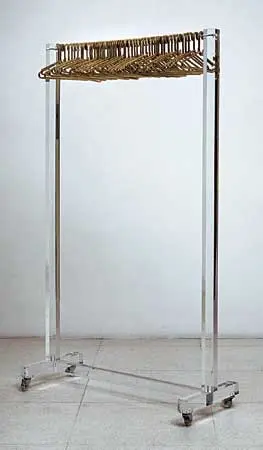
Among the works featured in the exhibition, Arara, from 2014, a mobile structure in translucent acrylic, highly polished in its atmospheric resistance and luminous in its transparency, held the weight of several bronze hangers placed along its entire length. The empty hangers, arranged in a series without fulfilling their original purpose, existed only in their metallic dimensions, like the mercury and the glass did in the remaining works.
There was a protocol of asepsis, re-thought by the artist to operate concepts of a different nature, of an experience that directed attention towards strategies generated by an encounter that prompted the participation of the visitor’s senses. Confronted with the works, moving along the gallery’s two spaces, viewers apprehended the gleam of each element, sensing the gelid presence of bronze and mercury, and reaching in that way an almost tactile awareness of the acrylic composition, with all the wrappings of each work.
Different from her previous incursion in the lacerating space of her seductive objects—creations of the last two decades—distant from the female outfits, the shaving blades, the stainless steel, the suture needles, all of which revealed sensorial clashes, the works on exhibit here established a different rote towards a dialog inaugurated by a cold feeling of estrangement, always activated towards the excessively human.
With all that, and regardless of that distancing, the need for the viewer’s senses to participate was again acknowledged; taken to a plurisensorial awareness, they lightened the distance and admitted an aseptic environment recreated in order to prod the rethinking of the pathways followed by a mediating material condition.
As we know, this mediating material dimension has been a constant, experienced by the artist as a battlefield that resists and remains firm in their purpose of confronting our transversal sensations, our sensorial dilemmas, our uncertainties. It is we viewers who, carried forth by Nazareth Pacheco’s strategies, actuate a visual poetics whose resources are not exhausted by formulas or schemata.
Nazareth Pacheco once again proved, as she has throughout her career, the conviction of a project that does not follow the susceptibilities of the season, fashion, or the temperament of the art system. In her visual poetics, a restless voice resists and remains active; it is the insistent record of an artist who, committed to her own interrogations, seeks a path to access human nature, the alteration of the pattern, and the encounter with the many idiosyncrasies that shape us as human beings.
With the excrescence of the mercury image’s porous surfaces, the cold bronze sheets, the light-related uses of glass and acrylic—those artificial skins we so often encounter in our own artificial everyday life—Nazareth Pacheco reminds us that we can still encounter an art appropriate for our dilemmas and questions.
CLAUDIA FAZZOLARI