
Speaking of sound art should be evident in our
context. Yet, little is known about it, including who are its greatest
practitioners. There is a need for serious historical studies of this
experience of art in our country, since, as we know well, this history has
already gone through several years in the international context: since the avant
garde experiences of the first half of the Twentieth Century with Dada and
the Futurists, through the 1960s and 1970s experience of Luigi Nono, Gordon
Numma, Pierre Henry, and Iannis Xenakis, and of course John Cage, and in the
local context this is not an exception.
Art historians in our context seem to have forgotten that a good portion of modern and contemporary art is based on an experimental premise where sound, which is our first perception of the world as often happens with infants in the womb who begin to hear before they are able to see, constitutes the essence of many artistic practices in the Twentieth Century. The emergence of radio as a medium for the diffusion and experimentation of sound poetry existed in the 1940s when Antonin Artaud already reminded us of the importance of sound. The sound and concrete and electronic music labs of the 1960 and 1970s by scientists such as Robert Moog, who undoubtedly was an inspiration for Colombian artist Gustavo Sorzano, the pioneer of conceptual art in Colombia and of sound art, was demonstrated by a recently published investigation by historian María Mercedes Herrera. 1
Thus, this text attempts to lay the ground for a short history of sound art in Colombia, a genre that is fortunately still active, as we will demonstrate. We have carried out a series of interviews with some of its protagonists. Not of all, they are included, and we haven’t covered the entirety of the nation’s territory. However, in our research we have established a roster that lists the most salient representatives of the practice, headed by Gustavo Sorzano, Mauricio Bejarano, Beatriz Eugenia Díaz, Leonel Vázquez, Jaidy Díaz, Hader Cartagena, Sebastian Suanca, Carlos Bonil, Juan Reyes, Luisa Roa, Fabian Cano, Oswaldo Maciá, and Ricardo Arias. Let’s start then with a look at some of these artists’ works, though, for reasons of space, we will not be able to comment on all of them.
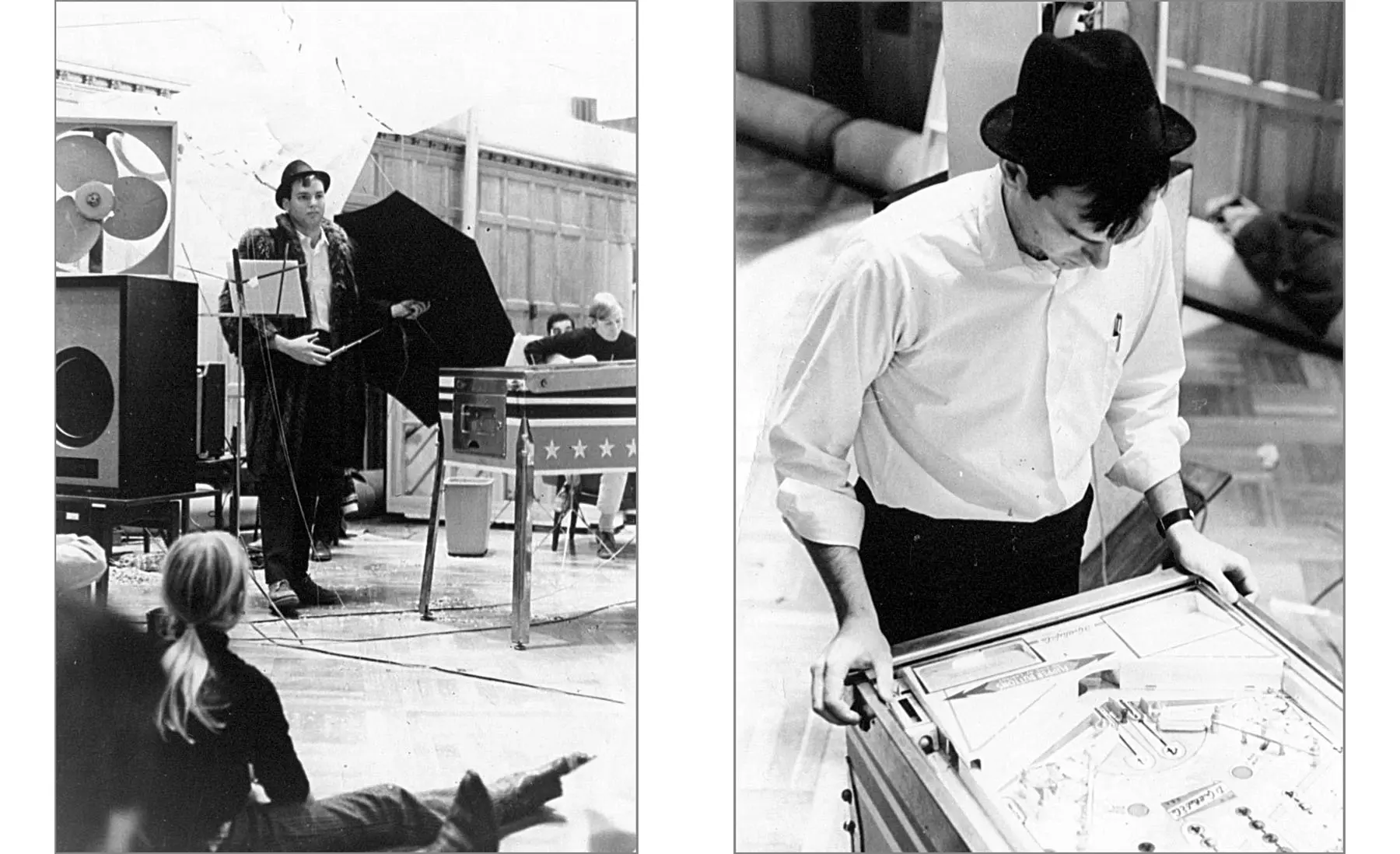
Gustavo Sorzano / Momentum I. In memoriam Marcel Duchamp. Musika Viva Ensemble. New York. 1968.
Gustavo Sorzano, a pioneer of conceptual and sound art, was for many years left in oblivion and it is only recently that he has been given his deserved place in the history of Colombian art thanks to academic contributions that help consolidate the ever-shifting art field. His graphic and pictorial work was influenced by Pop Art as well as by his experience as a musician at a time when, in the United States and Europe, the experience of music was traversed by happenings and performances. His father was the founder of Radio Bucaramanga, and his earliest explorations were playful experiences using a great number of electronic machines that years later he would be able to confront and enrich during his stay in New York, where John Cage’s experiences were already exerting influence on the young artist who befriended Jasper Johns.
This musical composition, performative in essence, showed us how students of the School of Fine Arts, Architecture, and Music at Cornell University, among them Sorzano, assumed the avant-garde at the time. The tribute to Duchamp, developed a few months after his death, was structured into five acts with the participation of artists Ted Gulik and Kent Hubell. This composition used a variety of devices and machines such as pinball tables, inflatable balloons, umbrellas, among other elements. For the first act, Sorzano executed an intervention titled Beethovenianas III and IV, where the music of the classical composer left some spaces of silence where improvisation was a fundamental element. A piano prepared in the style of Cage, an electronic organ, and some recording equipment made way for the second act, interpreted by Gulik, who musicalized the electric organ, sound tapes, and a harpsichord. The third moment alluded directly to Duchamp’s Grand Glass and was titled The Bride Stripped Bare by Her Bachelors Even. Here, Sorzano includes percussion by various performers, wave oscillators, and the pinball machine that generated an electronic sound that harmonized with the other “instruments.” In the fourth act, titled Tears, he intervenes with inflatable balloons and compact sound blocks. At the end of the fifth act, all the members of the group intervene with visual improvisations. These interdisciplinary sound experiences where the artist becomes a true performer and the body another instrument blazed a trail for future experiences of Paisajes sonoros launched by Sorzano after his return to Colombia.
Mauricio Bejarano / Malacate, 2006 and Absencia, 2009. Bogotá.
Another artist surely to be taken into account in this historiographic sketch is Mauricio Bejarano, active since the late 1980s, who insists that “I am not a performer.” 2 With this, Bejarano creates a distance with respect to artists such as Sorzano, for whom being present was essential. For Bejarano, who is an architect by profession, space is essential and the notion of a sound landscape is important, but the body must not be present in his sound compositions. The instruments are the true mediators between the artist and his audience.
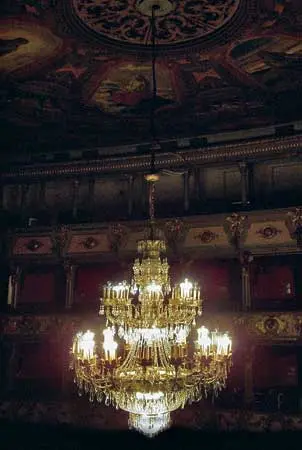
For example, Concierto para Lámpara o Lamacate (2006) is a “noise action” that was presented at Teatro Colón in Bogotá during the 40th National Artists Salon. In this historical stage for music and opera in the country, Bejarano decided to work with the central Murano glass candelabra that hangs on the plank that falls over the theater seating area. I remember that the seated audience had to crouch and raise our gaze at the same time in order to see the candelabra descend to a certain height and then ascend at the same speed with the help of a capstan, for half an hour. An amplification device repeated throughout the space the sound produced by the friction of the steel cable that supported the candelabra with the capstan. Here, it is the space itself and its object that produces the ephemeral musical composition. In that sense, this is a “noise action” and also a sculpture action, as described by the artist, who uses Edgar Varèse’s concept of furnishing to create a sound event where architectural space in itself is an instrument or, literally, an echo chamber.

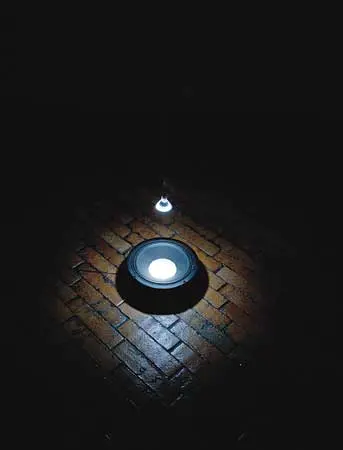
Another work that deserves mention is Ausencia (2009), presented at the Museo de Arte Moderno de Bogotá during the group exhibit TRANz (TRANSPOSICIÓN). This work is a visual reflection based on The Island of the Dead, by Arnold Böcklin, and a reference to André Breton’s sound poem “Île”, published in the book Claire de Terre (1923). The work is a sound device (black speaker) containing a handful of sea salt that emerged, luminous, from the darkness of the speaker thanks to high, focused light. As a viewer of this work, I was able to observe for several minutes and notice that nothing was happening, and suddenly one heard the word “Isla” (“Island”), which made the salt crystals vibrate for a few seconds.
This work possesses an indubitable poetic charge, and for the artist, it is a major work despite its proportions. Its greatness resides in its very minimalism that brings to mind in one way or another two important referents: the first is Erik Satie with Vexations (1893), a 1’30” work that according to the composer must be played 840 times, to be heard for 14 hours; the second, Pierre Henry, with works like The Well-Tempered Microphone and Variations for a Door and a Sigh (1963), whose electro-acoustic and concrete explorations are also an important point of reference for the development of Mauricio Bejarano’s oeuvre.
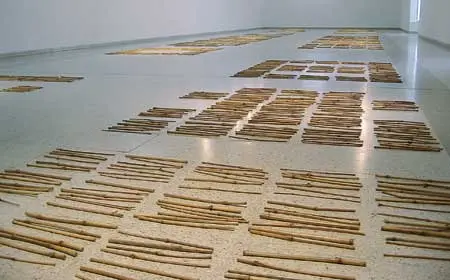
Beatriz Eugenia Díaz / 77 x 14. Museo de Arte de la Universidad Nacional. Bogotá. 2006.
Beatriz Eugenia Díaz proposes an artistic exploration that conjoins the visual arts, mathematics and science, and music, things that in principle are expressed as separate and isolated. As she puts it, “in the beginning, it was a question of bringing together what was separate. It was then that I used mathematics and verbal language to create a system of composition where words, set in connection with numbers and later inscribed in screentone formed by two heptagrams, became points of reference for the spatial and musical configuration. 3 Indeed, her entire artistic quest, extended already over two decades, is posited as an exploration of the matter of relationship and union: between artistic practices, between concepts, and between materials.
Indeed, visuality has much to do with Díaz’s process of artistic exploration, and in her works drawing appears as an essential element. But drawing is not in a classical way; rather a kind of spatial drawing that involves the entire area and materials such as paper and bamboo, among others. For instance, in 77 x 14 (2006), the notion of sound projection becomes the central axis. A significant number of bamboo shoots installed on the floor of the gallery harmonized with the sound projection composed by the artist. The relationship between mathematics, music, and visual art is forceful here, and the space conditioned the work and dialogued with it. This work revisits the number 7, which has been key in Díaz’s work. As critic Marta Rodríguez noted in ArtNexus #63, in 2007, the work was exhibited in “a square space, the dimensions of which are, by chance, related to the number 7. The length of the gallery is formed by 77 pieces, and its width by 14 square tiles the physical characteristics of the space, says Beatriz Eugenia Díaz, transform the number 7 into an organizing principle for the creation of an image that is at once synthesis and opposites. Seventy-seven and fourteen years duplicate sevens. One next to the other, and one that adds to the other. The image is the union and separation at the same time. In front of, as a complement. Movement, stability. Diachrony and synchrony. Each visual instant in space is the memory of what was an instant of acoustic silence.” 4
Indeed, as Rodríguez observes, the work of this artist touches on matters of numerology and the mystery of chance, insisting that things and circumstances exist for a reason that materializes in sounds and silences.
Jaidy Díaz /Somos los que no están muertos. I II III IV. Paisaje con figuras. 2012-2013. Universidad Nacional. Bogotá.
Jaidy Díaz began to develop her work in the second half of the 1990s. She has worked in drawing and sculpture and began to explore body actions in a domain of experience where the sound comes from the body. “Voice,” the artist says, “as a testimony of the body and witness of the gesture, ideas of the human landscape as an event in space, among others.” (5) These aesthetic/bodily experiences make direct reference to “Jean Dubuffet’s musical experiences, Kurt Schwitters’ phonetic poetry, the extravagances of Fluxus and of the Futurists, the anarchic notion of musical form in John Cage, Duchamp’s sound experiments, the writings of Jean Luc Nancy, Michel Chion, Pierre Schaeffer, and many others, as well as the febrile singing of Bogotá’s sparrows, the incessant traffic of turbine jets right above my home, the gurgling of unknown voices, the tongues and accents of the Colombian human landscape, breathing becoming flesh, my mind that is seldom quiet… etc.” 6
From this perspective, the artist has been developing a new work with playwright Víctor Viviescas: Ausencia, silencio, acontecimiento: tres gestos sonoros, which proposed a response to the ceaseless violence afflicting the country, with instances of disappearance, loss, and absence. Somos los que no están muertos. I, II, III, IV. Paisaje con figuras (2013) is the action that translates this process, positing such questions as, What is the sound of absence? What is its matter? How can we hear it? In that sense, the voice becomes an invaluable plastic material.
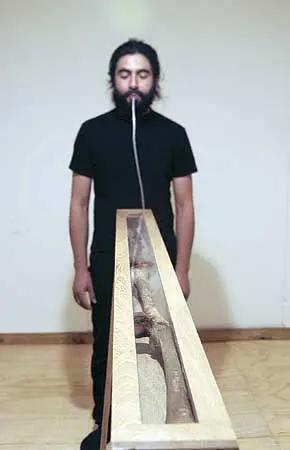
Leonel Vázquez / Muertes Vivas. Installation and sound action. Universidad Nacional de Colombia. Bogotá, 2010.
Leonel Vázquez works in two spaces of sound agency: one at Tolima, with the “Experimentation Creation of Sound Territories Lab,” and SONEMA. With them, the work has focused on “the exploration of sound from a geographic, social, and patrimonial perspective, combining its experimental potential with its impact in the relationship and interpretation of living environments.” 7
His work speaks of resistance of memory, of bodies that resist and have not been buried in the violent political war that grips the country. His work is the result of an artistic investigation “about the living bodies and the dead bodies,” the artist says, “that are not left to die in peace; I speak of unburied bodies and the bodies of the living that suffer through postponed grief.” 8
These “bodies that resist” investigate the sound vibration of corporeal matter, of living bodies that do not allow themselves to die, of corporeal expressions of resistance to death, expressed through chants, screams, or, simply, expressive movements of bodies and matter.
In that work, the artist created a space of resonance and an urn that include some bones; the artist approached it and blew through a small plastic hose. That breath of life made the bones vibrate, and the entire space vibrated. The carefully placed platform worked as a resonance chamber and the vibration found an echo in our own bones. A unique experience between life and death that the artist’s work highlighted. The funereal chants, which are also an essential part of Vázquez’s work, become a kind of extension of those who no longer have a voice and have been unable to express their grief. This is why the living insists on this memorializing relationship.
Nothing to see? In truth, sound art still has much to tell us and show us. All we need is to tune our ears and sharpen our gaze.
NOTES
1. Herrera, María Mercedes. Gustavo Sorzano. Pionero del arte conceptual en Colombia. Bogotá: IDARTES-La Silueta. 2013.
2. From an interview with Mauricio Bejarano on April 15th, 2013, in the Leon de Greiff Auditorium of the Universidad Nacional de Colombia.
3. From a letter exchange between Beatriz Eugenia Díaz and the author of this article, April-May, 2013.
4. Rodriguez, Marta. Beatriz Eugenia Díaz. ArtNexus No. 63, 2007. http://www.artnexus.com/Notice_View.aspx?DocumentID=17539
5. From a letter exchange between Jaidy Díaz and the author of this article, April-May, 2013
6. Idem.
7. From a letter exchange between Leonel Álvarez and the author of this article, April-May, 2013.
8. Idem.
RICARDO ARCOS PALMA
Art Science Ph.D. Professor at Universidad Nacional de Colombia.