
The solo exhibition by Octavio Schipper
at the Galería Milan in São Paulo was given the compelling title of Small Landscape. Let us, then, use those
two words as a starting point as we establish a dialogue with the images proposed
by the artist.
Different from another solo exhibition in which the white cube is fully occupied by objects easily sold in the tradition of the fine arts—such as paintings, sculptures, and drawings—Schipper chooses to tear the sacred space of the commercial gallery. This is not an unusual attitude, as it can be traced back to the approach used in site-specific projects like, for instance, some recent works by Renata Lucas. However, in the current reality where art fairs and the optimistic international projection of a multicultural Brazil leave many artists in a hysterical state, a proposal that deals with the gallery—that shopping mall— through another perspective becomes truly admirable.
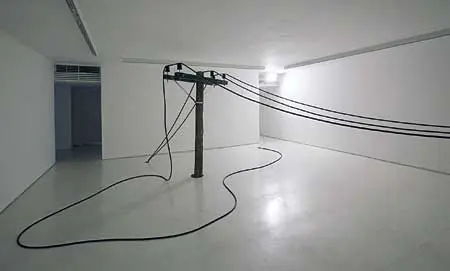
It seems important, therefore, to think about the use of the word “small” for the work shown there. It is possible to consider the exhibition as dialogic with latent themes associated with sculpture and installation proposals in which surveying the body is essential. And emerging within the enclosed space, there was a large wooden post, almost flush with the floor, full of concavities and irregularly cut, but not rustic as result, that expanded until it reached two straight lines in which two electric cables went through.
There is a formal consideration worth mentioning: there is nothing “small” about this installation. One of the clues given to viewers consisted of providing them with physical proximity to something which they would otherwise never dialogue with in the same configuration. There was the impact of observing an element that refers to the external environment but is enclosed within an architectural body; a fusion of spaces that explained the fictional and artistic nature of the proposal.
When moving around inside the gallery, the artist facilitated a change in the point of view. If before we would look at that post—now transformed into an object—from bottom to top, as we enjoyed the tiny place we occupied by comparison, on the second floor of the exhibition, it was possible to observe at eye level the top part of a second pole. The bird perches were at the same height as our arms.
Unlike the poles usually found on the streets of São Paulo, that is to say, those made of concrete and iron and complemented with a large number of cables, here their structure was more natural and remitted to stereotyped landscapes that pointed to distant lands of Brazil. Recent research shows that these wood posts are, besides being also visually less aggressive, more environmentally friendly and have greater insulating capacity. To the understanding of a Brazilian—or at least to my understanding—those posts can be interpreted as belonging to another culture.
Through this data associated with the geographical and cultural enjoyment of this work, we could think about the idea of landscape. By appropriating objects generally used outdoors, Schipper creates, for a period of time, an artificial landscape within the gallery. Although the monumentality of the material of these posts is present, the exhibition can still be considered small compared to its dissemination across the urban space. By contributing to the discussion on this transplantation between public and private spaces, the public also had in front of them the “legs” of the second post addressed here; the ground that allowed us to stand on the structure that stood over the post, was the same that transformed into a roof when we stood in front of its connection to the gallery floor. There, unlike the first post, two new elements extended our landscape: railroad tracks.
We could then associate this work with ideals about public transportation and movement and progress that are so valued in Brazil and that are related to the industrial boom in São Paulo during the Twentieth Century. Literally, by connecting the electrical system of the gallery with the banal poles in which the street of the gallery is located, it is possible to visualize a willingness to connect the field fanciful creation through images with the entropic pulse of a metropolis like São Paulo.
But at the end of the day, reflecting on this monument and on mankind’s relationship with electricity, I chose to leave out the historic and contextual data and instead concentrate on the so-called smallness proclaimed. If this data concerning scale is not verifiable, then it is not possible to affirm the same about the functionality and usefulness of these rails and posts. Thus, a stronghold was created that enabled man to acquire an almost devotional posture before the technological device.
Rather than be guided by the concept of “small landscape,” it would perhaps be best to turn to Tom Jobim and take the idea to the landing of the “useless landscape” in the best sense of the phrase, given that the futility of an invitation to contemplate the ordinary can lead to that which is human.
RAPHAEL FONSECA