
Pavel Acosta has been working
with the concept of ‘theft’ since 2005. Back then he based his exploration on
the photographs of objects. One of the most complete series from this line of
inquiry was Stolen Painting, which he developed from 2008 to
2010. Stolen from the Met is the logical continuation of that.
The method used to make the pieces was very clever and literally consisted of
“recycling paint.” He picked paint chips from walls or cars and used them to
compose his images. These “collages” reproduced seemingly mundane scenes of
everyday life. However, the title Stolen Paintings indicated
something else. The process by which material Acosta obtained the material for
his work was a direct reflection of the modus operandi of
‘stealing to survive.” At the time materials were very important to him as they
introduced other levels of interpretation beyond the image itself. His was a
very subtle social criticism that was disguised in the process of
manufacturing.
This new series The Theft focuses, not on materials, but rather on the appropriation of images, in this case, of important works from the Metropolitan Museum of Art in New York, hence the title Stolen from the Met. When Acosta arrived in New York, one of the must-see places was the Metropolitan Museum of Art, known as the Met. His impressions on seeing the originals of works that he had for years contemplated in art books, made him rethink his ideas about certain artists that, until that point, he had only known through reproductions, some of which were not even good quality prints. The impact led him to “steal” certain images—that are anyway in the public domain—and to incorporate them in his works.
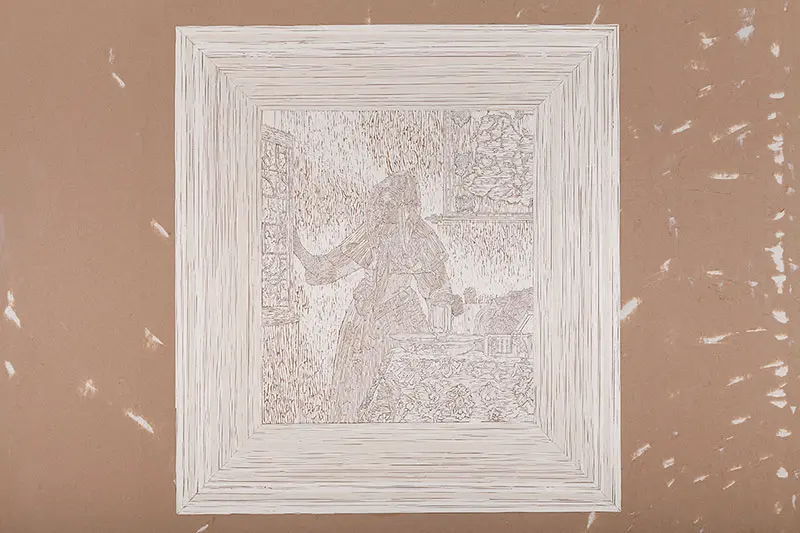
Technically speaking, Acosta continues to follow a process that is similar to the one used in the previous series, with the only difference being that the recycled paint comes from another place. The process of creating each work includes painting on wood, scraping the paint, and re-adhering it to the surface. There is something deeply visceral about the act of creating and destroying to create again. These are intentionally monochrome works because they use precisely the same kind of white paint utilized on museum walls.
This series is to a certain extent also closely related to the Wallscapes that began with a work exhibited at El Museo del Barrio, created specifically for the Biennial. In that piece, Acosta used the original wall of the museum as support and stripped it from its paint. The fragments collected were then returned to the wall in the form of a work of art, specifically as a reproduction of work from the Museum’s permanent collection that was placed in front of it. That is what originated the use of paint on the walls of museums to reproduce works from the collection.
Stolen from the Met is Acosta’s eclectic “ideal room” in which he brought together six pieces by the following artists under the same space: Diego Velázquez, Johannes Vermeer, Jean-Baptiste Greuze, El Greco, Pablo Picasso and Vincent Van Gogh. The Infanta Maria Theresa of Spain by Velazquez shares space with The Milkmaid by Vermeer and a portrait of Dora Maar immortalized by Picasso.
Despite being based on works by dissimilar artists, Acosta nonetheless achieves a formal and visual uniformity in his versions. To begin with, all are monochrome, white on carmelite backgrounds. Conceived on sheetrock support (plywood), all the pieces are of the same dimension and were installed hanging almost freely from the ceiling, suspended by two steel cables. A peculiar detail is that Acosta included the frames of the original works as a means to demarcate the background images.
Citations are an integral part of the work, so each piece is accompanied by a suitable code for smartphones that takes the viewer directly to the work that originally inspired it. Here we see a different dynamic of appropriation and recycling from the one that we are accustomed to: the artist appropriates an image and the viewer has to find the original in his/her memory. Although the original work is almost faithfully reproduced the effect is not consistent. Acosta is not interested in identical reproductions; his versions are based on the linearity of the figures constructed from fragments of paint. They are like puzzles that only he can put together through an intensive manufacturing process.
Thus, a dialogue is established between the work that originally inspired Acosta with the version that he created, in an intellectual game based on the images. Such interaction raises many questions that go beyond the purely visual. It touches neuralgic points of contemporary art such as the exhibition and collecting processes in Museums, intellectual property, the concept of originality, and the fetishism surrounding the works and their creators.
IRINA LEYVA PEREZ