
The
exhibition Realidades en Conflicto,
curated by Francine Birbragher and Oscar Roldán-Álzate with works selected from
private collections, revolves around three points: violence, politics, and
society. The show emphasizes the importance of collecting in a context where
the nature of art is not conventional due
to the fact that the very context is a problematic and disproportionate space.
The group exhibit hanging at Las Nieves Studios in Bogotá is comprised of
transcendental works in the history of Latin American art, the majority of them
known only indirectly thanks to references and books, put together for the
first time on the basis of a curatorial question. Reality and conflict are closely
connected, since any narrative formalized as real wears out and withers, giving
rise to conflicts where other tales struggle for veracity in order to attain
the category of reality. In Latin America, this struggle has been ceaseless.
For Latin Americans, Latin America presents itself as territory and utopia in the sense of being the stage for the most paradoxical events, while each country idealizes its situation in statistics and policies that do not accord to reality. This mismatch characterizes the region since its origins as a New World, with its tangle of forests and its race of “equivocal” peoples who, until the era of Pope Paul III were not considered “true” human beings and generated in Europeans the feeling that it all needed to be ordered. Man is an animal of realities, writes Zubiri, and in particular, Latin Man hangs between different realities in contradiction: at times inherited history does not coincide with truth or is simply a refinement of discourse, and as such a lie told a thousand times.
Realidades en Conflicto underscores the disconnect between narratives, which produces undefined zones where conflicts incubate and produce, after the struggle, new realities. Beatriz González said that Colombia is a disproportionate society in relation to its painting, which, according to Marta Traba, "destroys the hierarchical formal world so firmly sustained in Colombia since colonial times, acquiring a devastating critical power" (Traba, 1974). For Eugenio Valdés, "reality leaves behind pathways that the work of art can traverse, be juxtaposed, and even camouflage itself, adopting the appearance of a rumor; we live in a world in constant construction" (Valdés Figueroa, 2000).

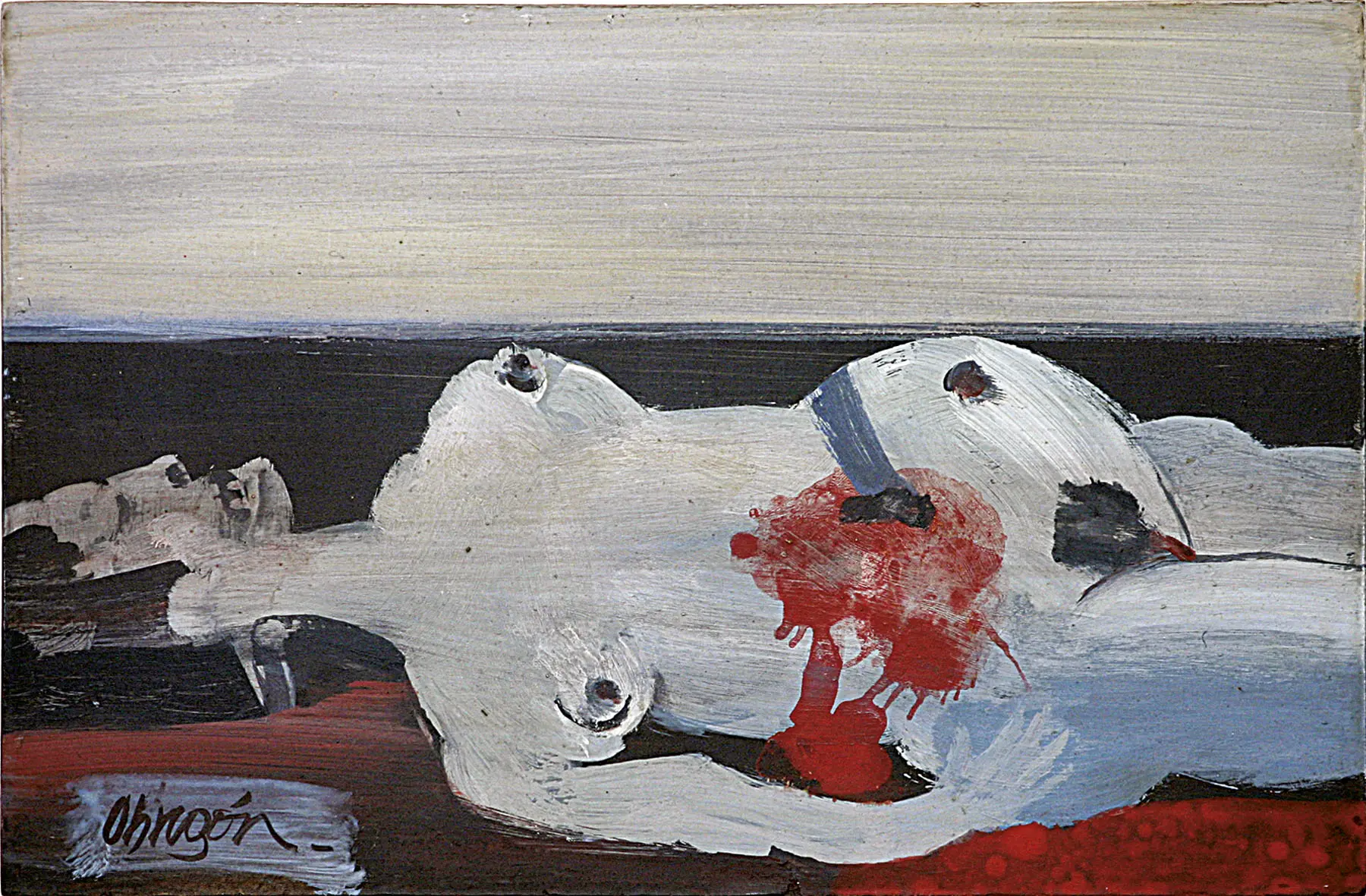
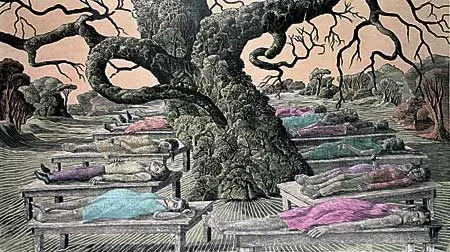
Perhaps the most accurate achievement of the arts in Latin American history is the unquestionable status of its words and objects, which are not merely aesthetic concepts or idealizations but penetrating, forceful artifacts and demonstrations. Weapon, word, and symbol are perhaps the embodiments of the axis chosen by the curators. Violence is manifest in the weapon (tool); politics, in the word (discourse); and society, in its symbols (ideology). The body as a thing is a byproduct touched upon in works like Alejandro Obregón’s Violencia, of which only an early sketch or study is exhibited, a jewel revealing the process of artistic internalization; in Alfonso Quijano’s Cosecha de los violentos and in Luis Ángel Rengifo’s Serie Violencia, a dead body is an inert object, ultimate and irrefutable proof of its destiny. Death produces the loss of all hope and a generalized malaise that can only be seen through metaphors since its nature is inexpressible.
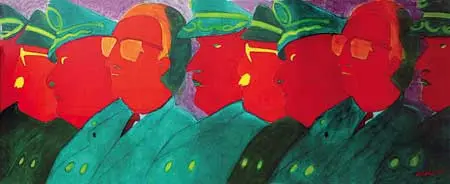
El arma más grande pone las reglas, the title of a work by Moris (Israel Meza), is at once a determining postulate, the atom bomb as final argument in any debate and with that impotence or the loss of reasonableness and autonomy in the use of power. Weapons are protagonists in the work of Carlos Castro (Codex Calixtinus), Edwin Sánchez (Clases de cuchillo), Regina Silveira (Serie Dilatáveis - Para Lizárraga), Fernando Arias (Humanos derechos), Carolina Caycedo (In Case Of Emergency), Oscar Muñoz (Horizonte), Liliana Porter (The New York Times, Sunday, September 13, 1970), Wilson Díaz (Baño en el Cañito), Zoraida Díaz (Flores para Diana), Jesús Abad Colorado (Medellín. Comuna trece), Luis Camnitzer (Execution - Ejecución), Moris (Israel Meza – El arma más grande pone las reglas), and Manuela Ribadeneria (Cortes y Recortes). In Codex Calixtinus and Clases de Cuchillo, Sánchez and Castro respectively, the struggle is hand to hand, the knife as micro social violence in urban wars in alleyways (Callejón, Juan Fernando Herrán) and monotonous cities (single-color cubes as in Metros cúbicos, by Jaime Ávila).
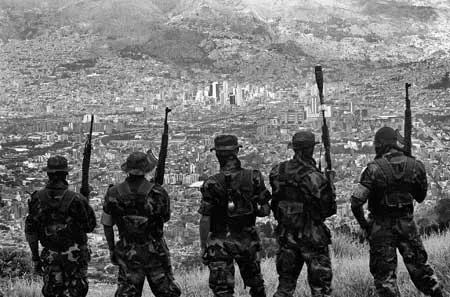
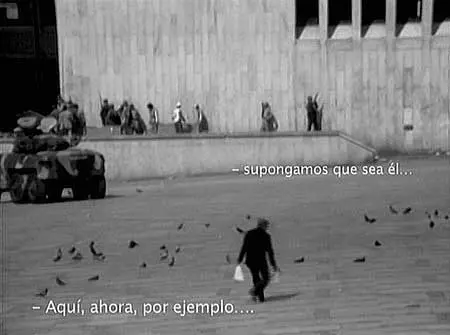
The photographs by Jesús Abad Colorado and Zoraida Díaz are inevitable connected to videos by Wilson Díaz and Fernando Arias at the level of a long-distance war “…where boundaries are systematically trimmed round, like an onion peeled by the methodical, insatiable scissoring of shrapnel” (One Hundred Years of Solitude, 1967). In Díaz’s and Arias’ videos, combatants are humanized as armorless knights, vulnerable but alert in their private individuality.
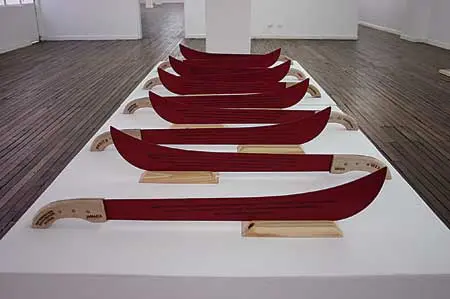
Latin American countries have been sites of a struggle for territory, an inner conflict like a snake devouring its own tail; guerilla wars have covered the entire map and history, as symptoms of contradictory politics. Oscar Muñoz and Carolina Caycedo, each on their own way, deal with this problem and generate new readings of armed conflict. In Horizonte, Muñoz tends to blur and fade the photographic record of guerillas in a work that embodies time and oblivion. The line of Liberal fighters marching into disarmament fades into the distance, and its blurriness is that of any event recorded in a manipulated historical narrative. Caycedo engraves on 10 red machetes the names of Latin America’s leftist armed groups; weapons and words fuse into a single object to emphasize their gray, conflicting nature.
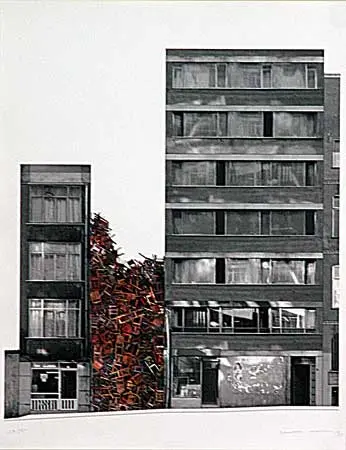
Discourse is another materiality engaged by the curators, under the axis of politics. In connection to reality, narratives become real by finding support in power, already a problem when we realize that “the biggest weapon sets the rules.” Works like those by Débora Arango (La justicia), Carlos Motta (Ideological Graffiti from the good life), Antonio Caro (Sal), Voluspa Jarpa (Minimal secret), Alfredo Jaar (Cien años de soledad. No realmente), Jonathan Hernández (Tirofijo), Alexander Apóstol (Yamaikaleter), Luis Hernández Mellizo (1000. Actuar sobre las masas como el cincel del artista), Beatriz González (Los papagayos), Kevin Mancera (A mal tiempo, mala cara), Adolfo Bernal (S.O.S), Pablo Helguera (Confesiones de otra máscara), Taller 4 Rojo (María Cano), and Helio Oiticica (Be an outlaw… Be a hero) turn words into art, objects that vibrate between the symbolic and the real as expressed in a sign like Alfredo Bernal’s S.O.S or a series of graffiti like those recorded by Carlos Motta in Ideological Graffiti From The Good Life, where a phrase like “I like it when you vote ‘cause you are so absent” brings forth a critical and mordant stele.

Voluspa Jarpa’s cardboard sheets (Minimal Secret) are tar-coated layout tables that demonstrate the way in which cover-ups are decisions someone makes; while information and words are veiled, the censorship revealed here reveals the ideological mechanisms that underlie the mass media. Helio Oiticica’s Be an Outlaw… Be a Hero situates itself in marginality as a space devoid of reference, a phantasmatic site like the alleyways of marginal neighborhoods, the outer edges of the city that expands like a dilapidated line. In that sense, Callejones, by Juan Fernando Herrán, represents the vacuity of uncontrolled space, the cracks that allow for decay, and the circulation of illegalities.
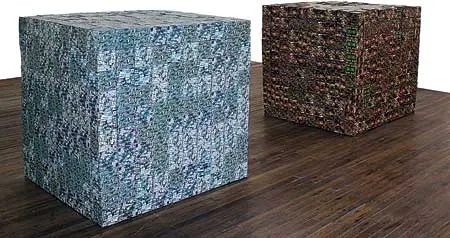
Finally, the symbol as artifact is the embodiment of ideology, the transformation of imagination into a sign that, beyond the metaphor, is determined by a fatally redundant social history. In this way, the curators engage works by Juan Manuel Echavarría (Réquiem NN. Bandeja de Bolívar), Jaime Ávila (Metros Cúbicos. Dios de la miseria), Johana Calle (Efluvios), Doris Salcedo (Istambul Project I y II), José Alejandro Restrepo (Verónica), Marcelo Cidade (Pequeños delitos), Juan Fernando Herrán (Callejón), and Regina Galindo (¿Quién puede borrar las huellas?) as carriers of a high symbolic load. Jaime Ávila’s Metros Cúbicos demonstrates that, in its poor neighborhoods and peripheral landscapes, every city has a characteristic color of monotonous overcrowding.
At this point, it is possible to conceive of a committed collecting, and interest in compiling works of art that transcend aesthetic Puritanism to present themselves as statements of reality, of crises, of politics, and of revolution. An art involved and immersed in a context that the artists themselves didn’t choose, but which, given their sensibility, they transform, internalize, and transfigure. Although the debate as to whether a committed art exists and what the role of the viewer confronted with such art may be has overtaken the Platonic value of the work of art as an instrument of redemption, we now understand that it is the processes through which these works are born, rather than their ends, that possess a value as reality, sentiment, and response. This is not art to save the world, but an in-situ, instantaneous act of salvation; a process involving many, as can be seen in the distribution list for Rengifo’s Sobre la Violencia, which, with its sincerity, remains as current today as ever.
BREYNER HUERTAS