
The
second level of the Museo de Arte Contemporáneo de Oaxaca’s remodeled
exhibition space is hosting Sonoplastia,
a group show featuring works by Mexican artists.
The exhibition showcases the explorations, investigations, and experiments of twenty-three artists and a collective, belonging to different generations, about the many approaches and possibilities of sound art for the materialization of contemporary art. It is presented as an alternative intended to eliminate borders and barriers, allowing for projects that use sound as their medium to flow in a free, unbounded way.
The origins of the idea for such a curatorship lie in interest to illuminate the process of sound art in Mexico today, as well as the evolution of a medium that, little by little, is gaining in understanding and appreciation.
Sonoplastia (from sono, sound, and plastós, formed or modeled) projects itself as the possibility of engaging sound in a new way, as yet another object. As though it were a tangible element susceptible of manipulation, creation, and representation as part of a variety of visual forms and proposals or, also, in isolation. In Sonoplastia, the sound is another tool that can be an end-point or an origin, and as such is malleable at one’s pleasure. This paradoxical approach transforms an intangible into a solid.
The exhibition presents sound in a different context, as the result of the search for a new medium within the creative processes of contemporary art and as its central concept. On the basis of a method for the understanding and analysis with a forty-year history, Sonoplastia presents the development, learning process, and honing of the use of this particular sensorial stimulus.
Sonoplastia is arranged around three thematic axes: La sinestesia, with the participation of Juan José Gurrola, Arnaldo Coen, Mario Lavista, Antonio Russek, Guillermo Santamarina, Iván Abreu, Arcángel Constantini, Juanjosé Rivas, Iván Puig, and Leslie García; Lo social, lo político y lo cotidiano, with Teresa Margolles, Gustavo Artigas, Luz María Sánchez, Tania Candiani, Roberto Arcaute, Marcela Armas, Arturo Hernández Alcázar, and Israel Martínez; finally, Lo conceptual, with Felipe Ehrenberg, Ulises Carrión, Atte. La dirección, Manuel Rocha Iturbide, Mario de Vega, and Rogelio Sosa. These three axes play a peculiar role: while they give a segment structure to the discourse, they also find points of contact that connect the proposals and generate a complementary dialog between them. The show was curated by artists Roberto Arcaute and Manuel Rocha Iturbide.
The reading one gleans from the three sections that structure the participation of the works in the exhibition as a function of their simple meaning. La sinestesia includes works that seek the sensorial stimulation of our hearing through colors, images, or specific objects. Lo social, lo político y lo cotidiano features proposals that for the most part are based on the documentation of a given action executed under one of these three topics. Finally, Lo conceptual shows more cryptic proposals that invite viewers to submerge themselves more deeply in the artist’s ideas in the elaboration of the work.
The exhibition is not organized temporally or thematically, and it doesn’t highlight or respond to hierarchies among the participants. The disposition of the artworks has been generated in an aleatory manner, with projects inscribed in any of the three axes presented in the same room. This fosters the development of relationships and an open dialog between generations and their proposals, as well as the show’s sections. Finally, the intention is to imbricate concepts and projects, offering the audience the possibility of encounter works created solely using sound as well as objects, fixed images, or images in motion.
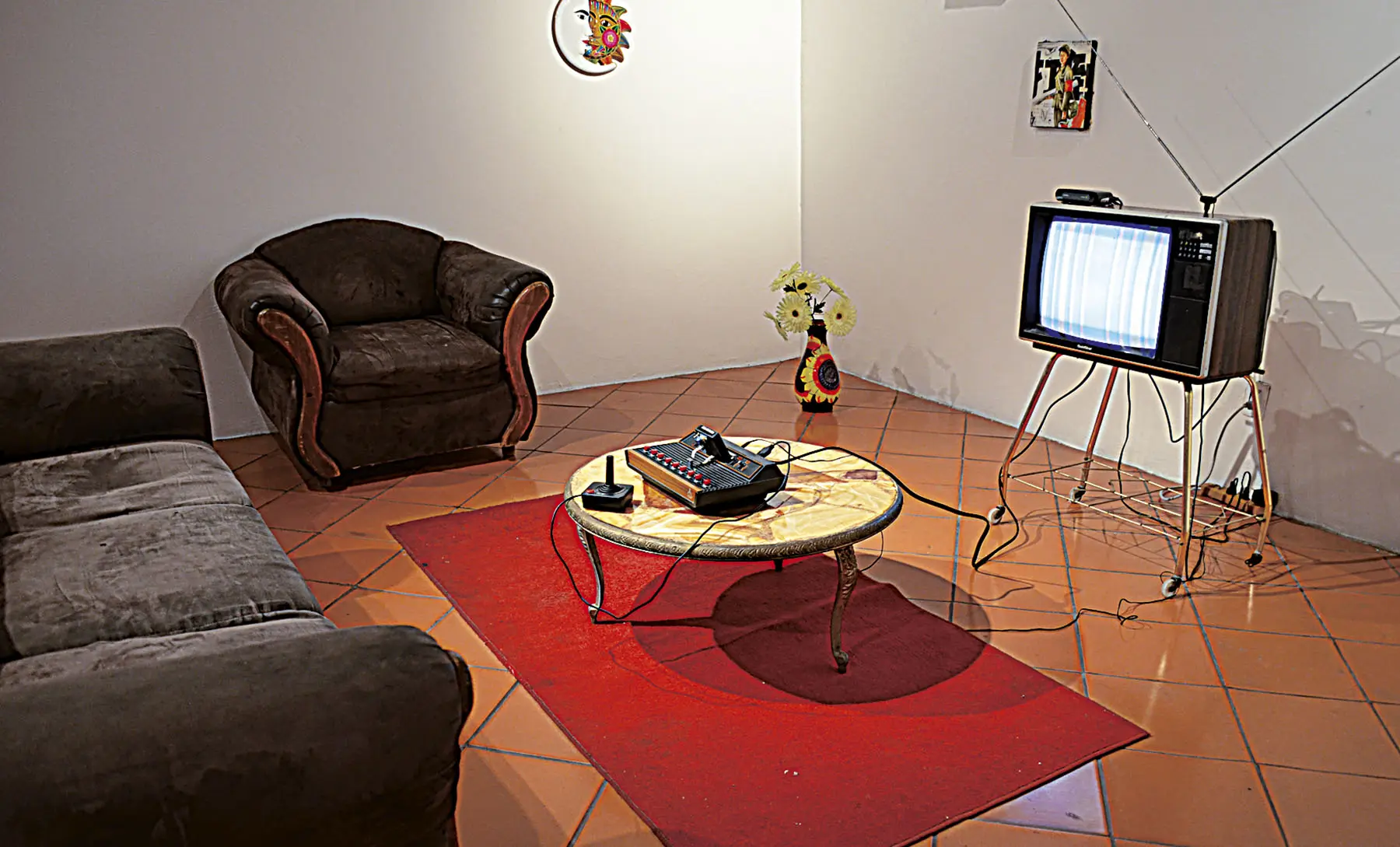
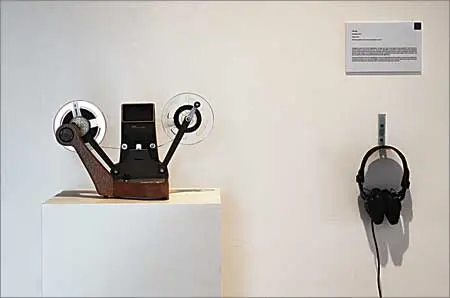
The proposals included in the exhibition include installations, sculptures, videos, and prints. Nails, records, cages, monitors, video games, and lecterns are some of the objects featured. Everything from a floor mat made with empty CD cases to complex invented sound devices with inorganic components and human traces. As part of this abundance of devices and objects, the omnipresent constant is speakers and headphones.
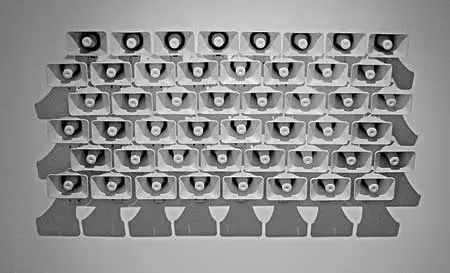
Frecuencias policiacas 2005-2014, an installation by Luz María Sánchez, is the first work that visitors encounter. It is comprised of a series of loudspeakers set into a false wall, broadcasting in a continuous and simultaneous loop the real sounds of communications captured during a confrontation between the Nuevo Laredo police and an unidentified organized crime group that at the time operated in that border region. The topic of Sánchez’s work involved the social a political character of one of the most intractable problems affecting today’s Mexico, so present in the country’s everyday life that it at times becomes common and imperceptible.
The common denominator of the art featured in Sonoplastia is their constant invitation to better understand the proposals through small texts that accompany each one of the works. This allows us to grasp the artist’s intention and the show’s museographic concept.
For a better reference on this point, Teresa Margolles presents an installation where sound is the sole stimulus. Confined to a single room in the museum, taking over an approximately 4x4-meter space—which is kept dark—in its entirety, a recording or people carrying out some kind of work is constantly reproduced. As the time of our stay in the room passes, the sound becomes clearer thanks to the lack of any other stimuli to our senses. The noise starts to establish connections in our brain and becomes associated with objects and actions we are familiar with, such as a saw cutting through an object. As we leave the room, the information about Margolles’ installation tells us that its title is Trepanaciones, and that the sound we perceived was indeed a saw, doing a trepanation during an autopsy procedure.
Alongside Frecuencias policíacas 2005-2014 and Trepanaciones, Sonoplastia also gives us some moments of playfulness and lessened social stress, presenting proposals that use sound as an evocative mechanism to transport us to the past and reveal sound’s importance in the evolution of technological processes of which, willingly or otherwise, we are now part.
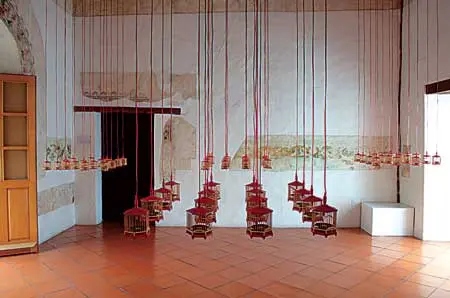
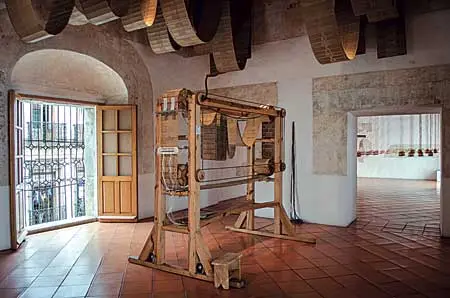
Telar is a complex installation by Tania Candiani, based on the old use of perforated data cards in Jaquard’s looms, which were the origin of the earliest computation systems. The process of the installation begins by introducing the data into the cards, which a read by a machine from Pasamanería de Tosi, a textile company located in Cuenca, Ecuador. The machine embroiders then 100 meters of labels with the legend “Hand-made”. The result is the translation into sound of a complex mechanical system for serial production, using an old machine that has survived the passage of time and is still performing its function. The installation seeks to provoke its audience and raise awareness of the importance of artisanal and mechanical processes involved in the production of textiles. At the same time, it plays with the visitor’s resolution of the premise of an object that carries the legend “Hand-Made” but has been created by a machine. It can be said that the programming was indeed hand-made, and only the process is mechanical. But in the end such a premise applies to anything that exists in today’s world.
Sonoplastia was conceived to evolve in an organic fashion during its travel. This evolution will take place depending on the place, the space, and the context in which the exhibition is presented. The mobility of its three directing axes can gradually complement the intent of the various proposals and provide future visitors the possibility of discovering new angles of approach and meanings that are still hidden from view.
HÉCTOR TAPIA