
Between April 26th and
November 30th, audiences in São Paulo have a chance to see Escenarios, an exhibition of works by
Vânia Mignone. With close to 58 artworks occupying the still-new space of MAC
Ibirapuera, the artist contributes to the museum’s proposal of intercalating
exhibition culled from its collection connected to the University of São Paulo
with shows featuring the recent work of artists with an established trajectory
in the Brazilian visual arts. The oldest work in this exhibition dates from
1993 and its title seems to announce a vantage for the viewer to appreciate the
artist’s universe: Palco (“balcony”).
It is not a painting, the support in which Mignone is best known, and, because
of that, it becomes part of an important series in the exhibit. It is
interesting to learn of Mignone’s proximity to the language of printmaking, not
contained only in her production from the 1990s but also in her more recent
images.
As we observe Palco in detail—the work does not exceed 30 centimeters in length—we encounter formal elements that have remained present in Mignone’s image production. The tension between ground and figure is noticeable here—one object, a staircase, suggests an enclosed space due to its scale. The lines engraved in wood reinforce and at the same time contest the black hues that dominate the work; the black suggests immensity with the oblique direction of the color, but also reminds us of its solitary character when we perceive space mathematically. Beyond these formal matters, it is interesting to pay attention to the staircase, the only element that can be ascertained thanks to its tone, closer to mimesis, and ask: to where are we ascending as we go in search of Vânia Mignone?
Other staircases, chairs, glasses, couches, plants, and a bed reappear in her images. The balcony of that initial engraving recurs in a 2013 painting, not through a title external to the image but with tracings that shape the letters inserted directly on the canvas’ surface, asking to be read by the observer. “Their theater” is what the ink tells us, and we are befuddled: whose? Mine, as an observer, or hers, is one of the several human figures that appear in the artist’s images. Without a cloth background, men and women have projectors on their faces and sweat through the brushstrokes that give them shape. At times, the objects comprising these airy scenes are what makes it possible for the bodies to present themselves erect to the viewer, using clutches to approach the oppressive color spaces that surround them. In other situations, the same objects become important in the apprehension of the tiny space of the human in a stage on which matter imposes itself.
These bodies are as inert as the industrialized objects of domestic décor. In a certain sense, we can connect Mignone’s images to Edward Hopper’s paintings, in terms of the apparent void of active life in their narratives. Hopper preferred to recode a perspective on “modern life” in the industrial US, filled with novel offerings but also with melancholy. On her part, Mignone takes away any element that could tie her canvases to classic narrative cinema and invites us to an appreciation, through the slant of the fragment, of the galleries, the balconies, of our experience of the real and, of course, time.
This is why it is essential to shedding light on one of the most powerful elements in Mignone’s images: text. A word can be the most important thing in her canvas, as in a comic strip. The repetition of shapes in a series makes this clear: a mate-drinking bowl and a couch are independently surrounded by different graphisms: “Saturday,” “Wednesday,” and “In the dark.” The drawing, derived from xylography, is repeated, and the importance of the entrance of acrylic and color is reinforced. Routine definitely can always appear different to our eyes.
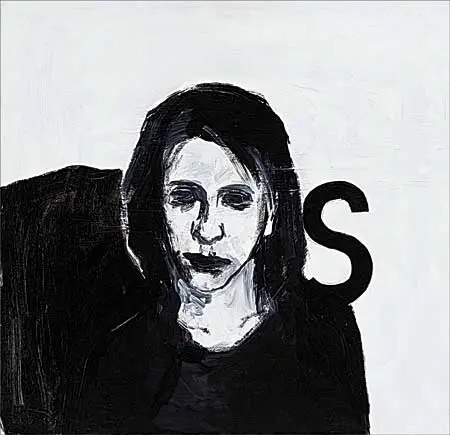
More precise are the insertions of letters and numbers made by Mignone. A woman with her face slightly erased, centered on the canvas, looks intently at the viewer. Next to her, a large letter. Young Woman with White Background and S is the title chosen by the artist, who reiterates for us the uncertain place we occupy regarding her universe.
In Vânia Mignone’s production, the are no ordering principles from an artistic point of view to prompt secure interpretations that merely illustrate specific concepts or issues in the history of art. After a panoramic review of her work, we descend the staircase of the balcony where we began this note and sit down again in the theater. It is best to continue with the never easy task of observation and the expectation of the next act in her journey.
RAPHAEL FONSECA