
Establishing
the continuity of a national space around a geographical principle—the
rainforest, the high plateau, the desert—is a deeply rooted practice in Latin
America, where almost every single nation-building project anchored the
singularity of a historical community on the temperamental disposition that
emanates from a natural context. But to organize a Latin American country’s art
production around a praxis such as landscape—which by definition remains beyond
the boundaries of the nation-state’s temporality and the various modernization
projects that characterize the region—is a greatly consequential gesture. Both
gestures lie behind the title metaphor in Waterweavers:
The River in Contemporary Colombian Visual and Material Culture, an
exhibition at the Bard Graduate Center Gallery in New York, with which this
academic institution, devoted to the study of decorative arts from a historical
perspective, consolidates a new vocation for the contemporary arts and design.
Waterweavers, curated by José Roca (the “Estrellita B. Brodsky” adjunct curator for Latin American Art at Tate Modern, London) with the assistance of Alejandro Martín, brings together sixteen visual artists active in Colombia, around two large thematic axes: the presence of rivers and of textile arts in the country’s arts and visual culture. According to Roca, the show’s “metaphoric, tangential” focus is inspired by the realization that starting in the 1990s, a sizable group of Colombian artists moved the thematic profile of their work from a frontal engagement with the issue of violence to an interest in the various ways in which violence is encountered in the natural world: “to talk about politics, artists began to talk about botany”.1 Yet, Waterweavers shows how for the current generation the turn to nature is projected onto a landscape that no longer is exclusively that of colonialism of the period known as “La Violencia,” but also the substratum that feeds into the country’s everyday life and vibrant material culture. The allusion to weaving—a practice whose cosmogony import for many of the region’s peoples must not be ignored—thus summarizes the organic connection between landscape and culture, modernity and tradition, where Waterweavers locates Colombia’s art production. In this way, the exhibition emphasizes the many interactions between the country’s contemporary art and the traditional art of the original populations—metalworking and textiles—and their rich visual traditions.
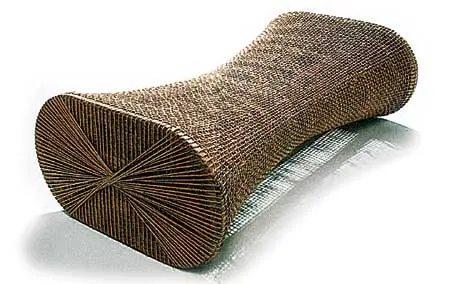
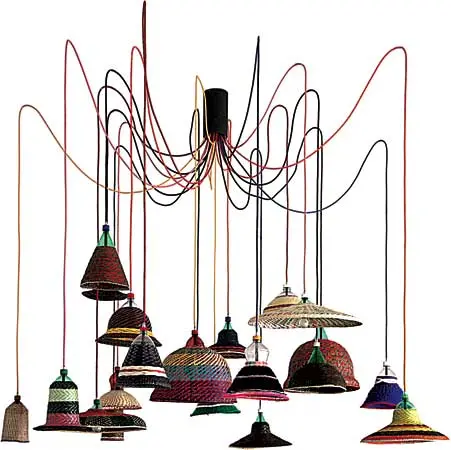
It is worth noting that this explicit desire to anchor the arts on traditional practices and figurative languages situates the works on exhibit beyond the usual coordinates set for contemporary art, within a space where graphic and industrial design, decorative arts, or ethnographic/documentary drawing all participate on equal footing. In this way, alongside the video installations presented by Nicolás Consuegra (Bogotá, 1976), Clemencia Echeverri (Medellin, 1950), and Alberto Baraya (Bogotá, 1968), which, deploying an aesthetics, not unlike that proposed by Harvard’s Sensory Ethnography Lab, evoke every day or symbolic experience of Colombia’s rivers, we find lamps woven from plastic bottles that Álvaro Catalán (Madrid, 1975) designed with Guambiano artisans, sisal furniture designed by Luci Salamanca (Bogotá, 1975) and manufactured by artisans from Curití, or paintings about the forest’s yearly cycle that Nonuya artist Abel Rodríguez (La Chorrera, 1941) created for an environmental organization. Such works bring forth an exemplary confluence of contemporary aesthetics, formal study and renewal in traditional arts, and collaborations between different creative agents who imprint the work with their own values and sensibilities.
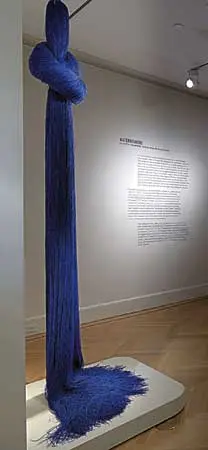
The exhibition, occupying three floors of the elegant Upper West Side mansion where the gallery is located, begins in the lobby with two works by Olga de Amaral (Bogotá, 1932), the dean of Colombian textile arts whose work is included in collections such as MoMA’s and the Metropolitan Museum. These works, presented to visitors as true tutelary figures, summarize the exhibition’s theme: Luz Blanca (1969), an early work that explores, via the evocation of a waterfall, the possibilities of a then-new material (polyethylene); and Nudo azul XIII (2012), a handful of fibers seemingly flowing from a single knot. It is an unexpected start, since in these works—both among Amaral’s most abstract productions—textile arts are at the degree zero: a single knot, its shape, and volume dictated exclusively by gravity and the material’s plasticity. Yet, reduced to its minimal expression, textile art finds its sculptural form: a form that in turn refers us to the plasticity of water bodies as they precipitate downwards. This is emphasized by the way in which Amaral’s works are placed at such height as to allow for contact with the floor.
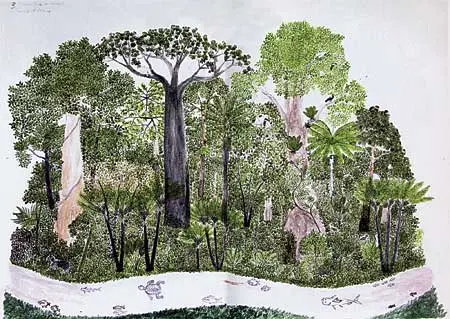
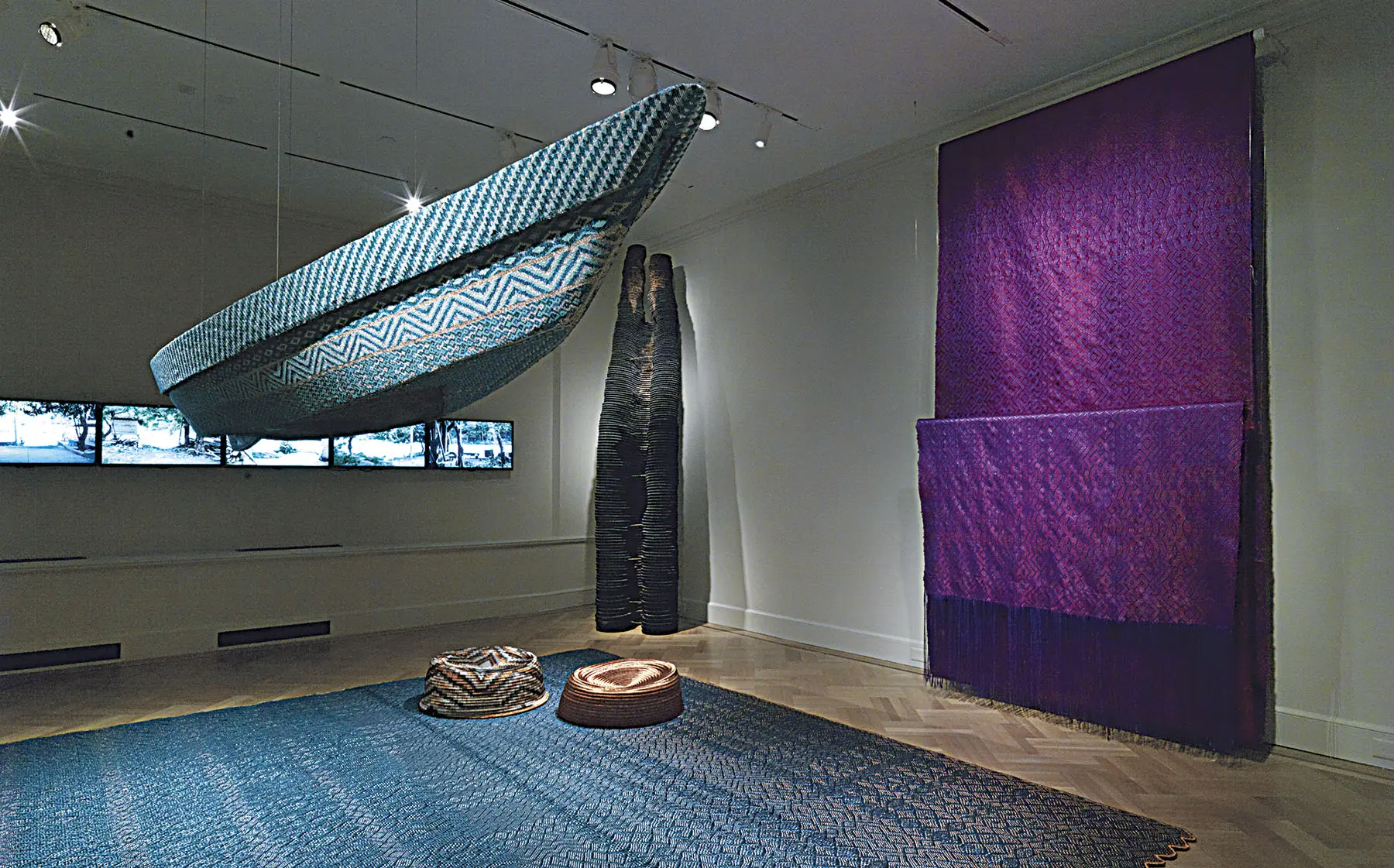
Crossing the bareness of this first threshold, which tests at the level of formal abstraction the possibilities of a thematic metaphor, viewers enter a radically different space, one that will set the pace for the exhibition as a whole from that point on: an exuberant space, where each available surface is covered by art (and furniture). The saturation of the exhibition space leaves no room even for the customary informational cards, which viewers will find instead gathered in a guide leaflet. The first section of Waterweavers is entirely devoted to Color Amazonia (2006-2013), directed by Susana Mejía (Medellin, 1978) and made in collaboration with a multidisciplinary team. Color Amazonia is the result of a long ethnobotanical investigation about colorants that can be extracted from the flora of the Amazon river basin, in particular areas populated by the Huitoto and Tikuna ethnic groups. The material on exhibit in the gallery comprises a series of thirty paper sheets dyed with more than one colorant—occasionally derived from several exemplars of a single plant—a wall covered with dyed skeins of rope (a textile installation in its own right), and a series of ten botanical monotypes made by means of contact with plants. Also on exhibit is a book documenting the investigation process in detail (Bogotá, Mesa Editores, 2013).
While this variety of media and applications responds in part to the imperative of documenting a dominantly process-based work, it is important to note that they also follow from a different set of objectives and that the tone is common to all the galleries Waterweavers comprises. As the absence of informational or technical cards already reveals, the exhibition aspires to create a kind of total sensorial immersion. The first thing we must say in that regard is that the strategy is vastly effective and that in the experience of the exhibition—at least for this reviewer— the effect of the whole as such does stand out. The sensorial coherence of each space is perhaps more long-lasting than the individual works or the details of the critical discourse around them. In one of the essays included in the catalog, curator José Roca explains his motivation to skirt two museographic styles that might have seemed unavoidable for an exhibition of this kind: on the one hand, the hyper-contextualization that characterizes ethnography or archaeology museums; on the other, the de-contextualization of design-centered exhibitions, which tend to isolate artifacts atop pedestals. Roca says he sought a third way, closer to the contemporary art museum.2 However, we must note that, regardless of what was projected, the show’s museographic solution is markedly not a recreation of the “flat space” so common in contemporary art, a space of forced neutrality from where any criteria external to the field’s own rules and any remnant of social production is expunged in favor of universal interchangeability. In Waterweavers, as we have said before, the firm intention of anchoring art on concrete cultural geography impacts the very space on which the exhibition is set and gives rise to museographic solutions of great originality. Instead of the neutral space of contemporary art, what we find is the construction of assemblages of languages, practices, and forms, where the sovereign agency of the artist tends to dissipate in favor of purely aesthetic and sensorial connections. As if mimicking a swelling river, the works in Waterweavers tend to overflow from their beds and flow into one another.
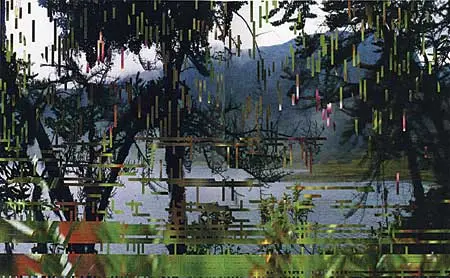
Two works—or series of works—display such a confluence principle in a particularly palpable way. The first is URUMU_WEAVING_TIME (2014), a video installation by designer Monika Bravo (Bogotá, 1964). Bravo’s work consists of animation, projected onto three walls, that recreates in digital format the process of creating a woven textile. At the beginning of each cycle, numerous color dots run from one side of the screen to the next. Through their intertwining, these digital threads build progressively clearer watermark patterns, giving shape to sequences of the landscape from Santa Marta’s Sierra Nevada. The patterns evoke motifs often found in Ika or Arhuaco textiles, produced by communities that populate those mountains. Bravo studied the motifs in great detail to create the algorithm that generates the image. Today, these motifs are widely used in Arhuaco backpacks, a local handcraft that has become very popular in Colombia and around which a modest export industry has risen. However, urumu (snail, in the Arhuaco language), the staggered motif most used in Bravo’s work, is also one of the most richly symbolic in the Ika belief system, as well as an important structural element in the Ika people’s weaving method. Transferred to digital media, this art’s symbolic connotations and figurative language acquire new proportions, which results in a powerful aesthetic experience.
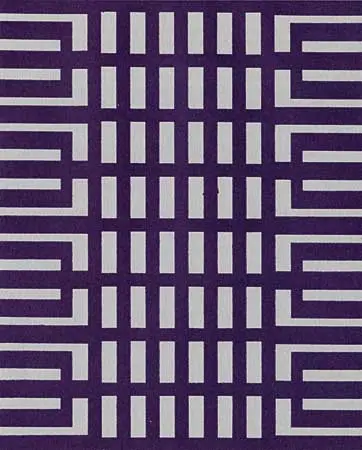
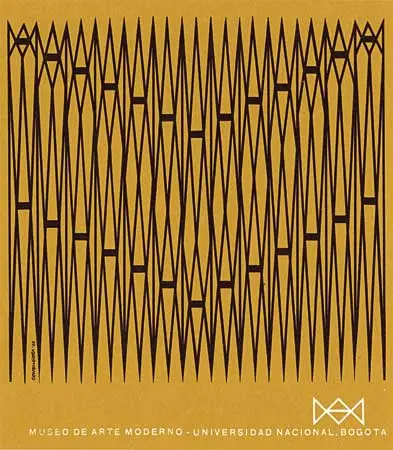
The second work—this one, a group creation—is built around designer David Consuegra (1939-2004), one of the fathers of Colombian graphic design and the founder of the country’s earliest academic programs in the field. In the late 1960s, Consuegra—educated in Paul Rand’s modernist school after his passage through Boston University and Yale—devoted a series of works to the study of geometric motifs in Colombia’s indigenous metal handcrafts, which resulted in the publication of his Ornamentación calada en la orfebrería indígena precolombina (Muisca y Tolima) (Bogotá, Ediciones Testimonio, 1968). As well as the book, Waterweavers features a variety of drawings, illustrations, posters, and covers designed by Consuegra between 1960 and 1983, materials that demonstrate how greatly this Colombian designer benefited from the study of such radically other languages. Occupying a central space in the corresponding exhibition room, Consuegra’s exemplary oeuvre was accompanied by related materials. The paths blazed by Consuegra continue in the work of other contemporary designers. Such is the case of two works from Bogotá’s Tangrama Studio, established by artists Mónica Páez, Margarita García, and Nicolás Consuegra, David’s son. The first is a geometric tapestry covering every surface in the room; the second is an interactive program that makes it possible to recreate the geometric patterns in indigenous metal handcrafts and to create optical animations based on their superposition.
Rather than the complete narrative of such a large exhibition, this note aspires to simply reflect some of the interesting ideas proposed both by Waterweavers specific works and the intelligent museographic discourse. A final note: with this exhibition, the Bard Graduate Center Gallery enters the field of contemporary Latin American art with high standards and a seal of quality that, it is to be hoped, should continue to produce great results in the future.
DAVID HORACIO COLMENARES