
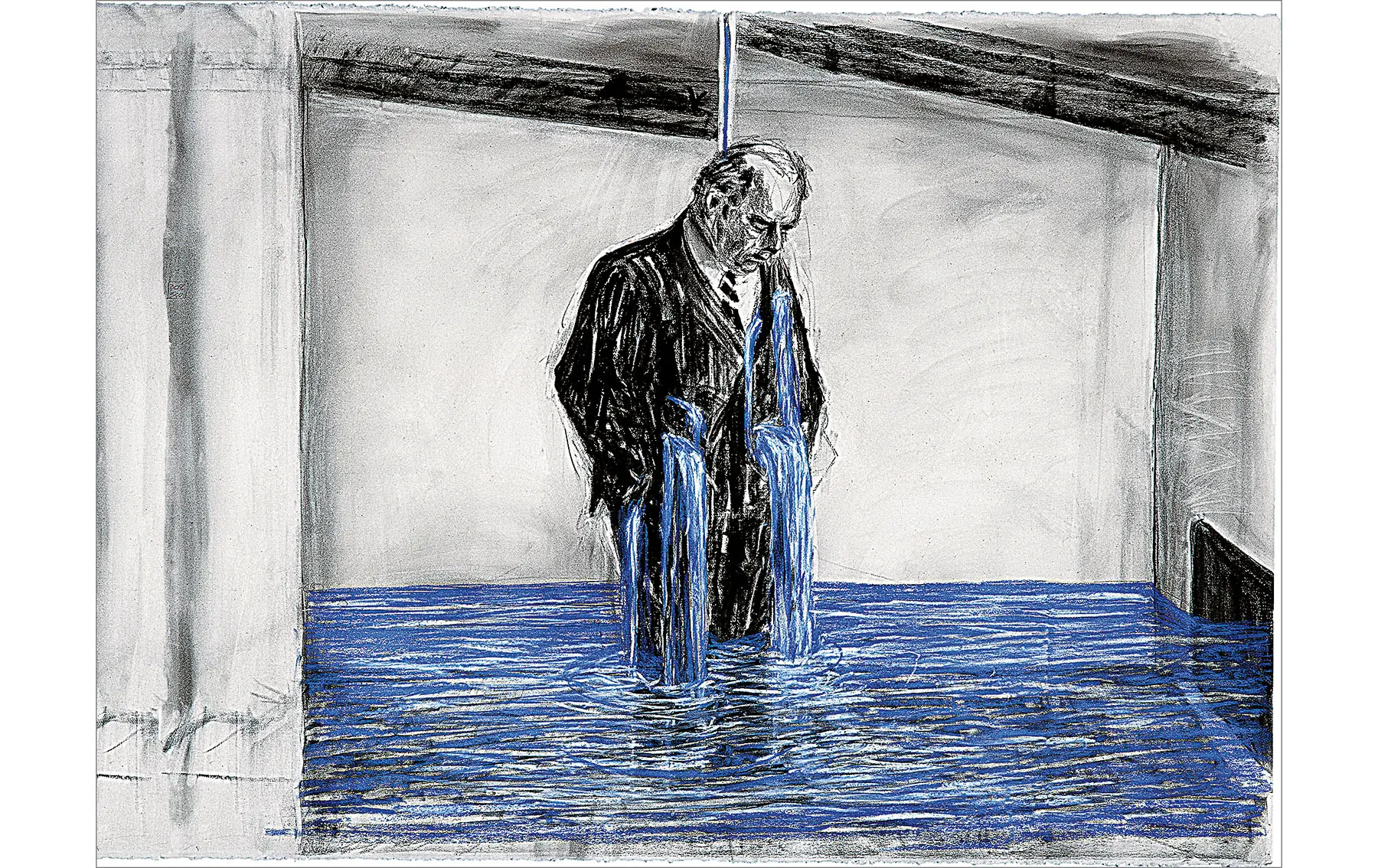
The exhibition Fortuna was presented during the
second quarter of the year at the Museo de Arte Moderno of Banco de la
República in Bogotá, and during the third quarter at the Museo de Arte Moderno
in Medellin. The show brings together nearly 100 works created during the last
three decades. The title of the exhibition alludes to the way in which Kentridge
conceives the creative process, which for him has to do with being disposed to
the fortuitous encounter of possibilities resulting from the process-centered,
intuitive nature of the creative exercise. The exhibition was curated by Lilian
Tone, with whom Kentridge collaborated closely, and comprises four sections
titled: The Room of Excess, A Look Back, Vertical
Time, and The
Shadow of a Shadow.
For the curator, the title of the show is directly connected to the
articulation of notions of chance and predetermination, to the point that she
notes that the artist works on the basis of directed chance or through the
manipulation of luck. Some artists who have paid attention to the importance of
the process as the ultimate sense of the value of the works speak of the
importance of working with an informed intuition, which takes its own path but
is not directed to any place; this is why one needs to seek intuition through a
variety of methods. Some artists use the extension of the working period as a
way of finding that informed intuition, and others do it by inventing ancillary
chores that require specific modes of concentration. It seems that Kentridge
partakes of both principles because in his work the dimension of time and the
presence of the gesture are both essential.
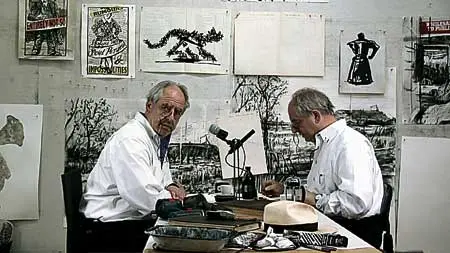
Kentridge’s methods are related to drawing and collage, magisterially combined in his animated films—perhaps his best-remembered works—which also contain the greatest evidence of the way in which thought is generated in his art through the accumulation of steps and the continuous adjustment of his path. Such is the lesson of the process as the foundation of a body of work which, had it not followed the specific path it did, would not exist. In fact, the idea of making films emerged from his interest in recording the road taken by a single drawing as the result of being shaped step by step, on the basis of gestures such as tracing or erasing. It is precisely the act of erasing, correcting, or adjusting a given line, which became a form of history and a mark of memory that could be equivalent to his interest in revising the traces or vestiges of life in his country as a consequence of Apartheid policies. In this regard, Kentridge points out that since childhood he found himself studying photographs he was incapable of fully understanding until decades later, showing people massacred by the police as they protested injustice and segregation in South Africa. Kentridge was to note, already as an adult, that those images of people on the ground appeared unconsciously in his work as a way of remembering the shock that had taken root inside him.
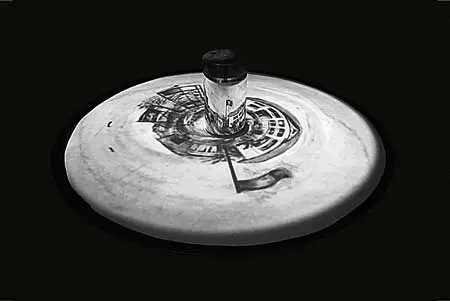
This idea of connecting a collective experience is not alien to his interest in documenting gestures, which sustains the tracing of lines in draftsmanship and could also generate connections with other realms of cultural experience that may have driven Kentridge to engage the field of stage arts, where human gestures acquire other dimensions and where collective human experiences are articulated in a different way. The gestural action present in his films, for example, has the potential to become the external memory of a given human event because, according to the artist, they can again evoke in a potent manner a shared past, a traumatic past, or a remembrance.
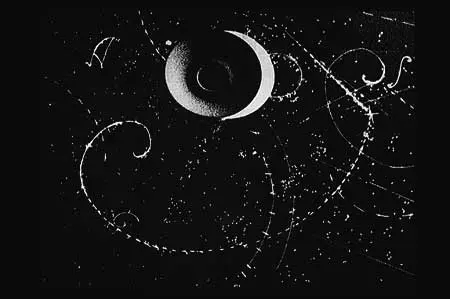
As Kentridge became more and more deeply engaged with the logic of film creation, recurring characters appeared with whom he defined a particular narrative. Such is the case of Soho and Felix, who, as they made appearances in various stories, began to outline their own narratives, their own features, and their own characters. Nevertheless, while making his third film with these characters, Kentridge discovered how they related to his own subjectivity, and for this reason, their distinctive characteristics began to mix; from there, he started to see them as self-portraits by proxy, since he has come to identify with them after seeing them in the films and has even said that he has been able to understand who he is through such an identification.
One particularity of the Fortuna exhibition is that the different sections proposed by the curators are preserved as chapters of its very museographic design, and as such posit specific relationships between the works and the exhibition space. This relationship between the sets of works appropriates space with the intention of emulating creative activity in an artist’s studio, but not in order to bring to mind its spatiality but to make reference to the encounter of a multiplicity of images and ideas that converge in the configuration of a body of work that desperately needs the work of trial and error in order to conjure memory.
JAIME CERÓN
Curator at Fundación MISOL.