
Already as school children, we’re asked to read inspirational biographies of “great people,” partly with
the intention of slipping history lessons into our curriculum, but also to
inspire us, to make us better people. It’s less than clear if any of this
works. The history is so manicured as to be syrup, and in any case, few of us
will ever be Napoleons or Mother Theresas, or Madam Curies. But the underlying
theme of simplified biography is repeated in biographies for grown-ups the idea
that a collection of anecdotes about the life of a public person explains their
actions, affects the quality of what they do. Were Napoleon’s accomplishments
really due to his being short and having to overcome an inferiority complex?
Did Hitler’s being rejected by art school make him a sociopath? If so we
wouldn’t be able to trust anyone below average height, and art schools would have
to think twice before turning down applicants. And what of President Lyndon
Johnson’s habit of expecting his advisors and cabinet members to be present
while he was on the toilet, to continue business discussions? Does this help us
understand his decisions about Vietnam or civil rights? Does Emil Nolde’s early
membership of the Nazi Party help to explain his breakthrough artwork? Can the
work of Aristide Maillol, André Derain, Maurice Vlaminck and Jean Cocteau be
seen as connected to their collaboration with the Vichy Nazi puppet regime?
Since biographies are essentially a collection of anecdotes, they have a blurry similarity to the gossip about celebrities in dedicated magazines. What was the real consequence for the world of Napoleon’s love life with Josephine? Does the fact that Ernest Hemingway wore girls’ dresses during infancy help us to understand his novels? And what is the difference between “authorized” and “unauthorized” biographies? Are we supposed to trust the anecdotes more when found in one and not the other? And then there are the memoirs of people already famous or in the process of becoming famous, serving large helpings of anecdote to justify their actions and promote their reputations. It is questionable how much of this “history” serves the common good. Instead, it would seem more likely that the industry of anecdotes is dedicated chiefly to creating ego-footprints. We are left with the problem of unraveling the important from the trivial, the serious from the ephemeral. Yes, Hitler was a vegetarian, but it didn’t help much.
What happens with all this in artwork? Don’t we believe that art is what it is, and don’t care about the author’s life? But this doesn’t hold true. What is stupid work by an unknown becomes interesting when the author is known and respected. Biographical information in this case redirects our way of looking. The ego-footprint becomes relevant, becomes in itself a source of power. In the art world, the administration of this power informs many strategies. The CAYC (Centro de Arte y Comunicación) in Argentina operated with the theory that mixing unknown Argentinean artists with internationally famous ones would make them known. Some people believe that being in proximity to important people makes them important. There is a gallerist who whenever he sees that a known person of the art world is being photographed tries to get into the picture. Other people talk about the presidents they know or put pictures of themselves with celebrities on their walls. Fame and importance are thus believed to be contagious, not simply earned. Maybe it is, and it should be treated as a disease.
These thoughts about biography and ego-footprints came about thanks to two recent exhibitions: the portraits by George W. Bush and the watercolors of Antonio Guerrero.
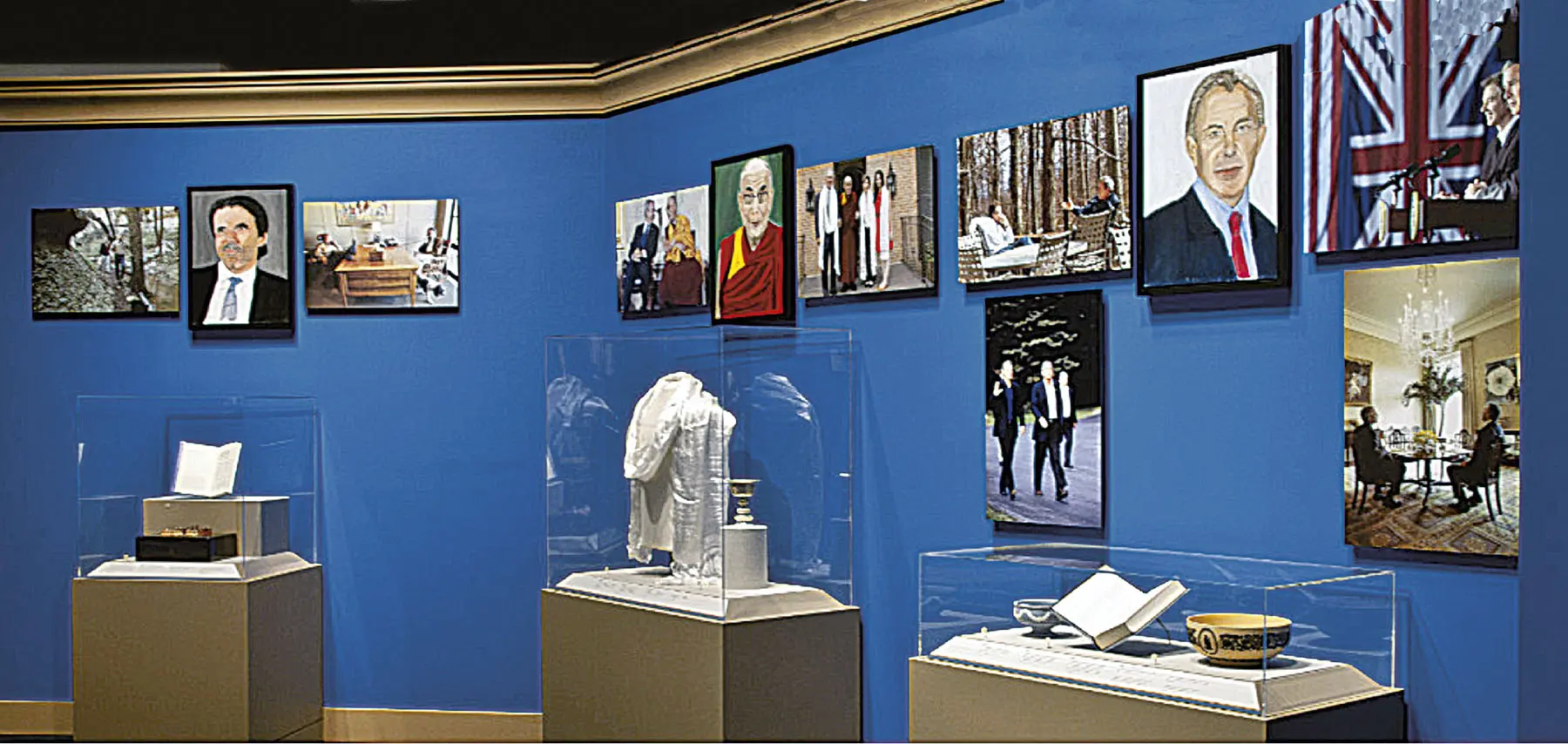
Not long ago, Romanian hacker Marcel Lazar Lehel (Guccifer) leaked George W. Bush’s “naked” paintings, raising a mini tsunami in the art world. Lehel was recently sentenced to four years in jail. It was not as punishment for his judgment with respect to art, but because over the years, he had hacked several accounts and invaded privacy illegally. To Bush’s credit, it’s not clear if he himself would have ever publicly exhibited his paintings without Lehel’s prompting. However, now he has. A show of his portraits of political world leaders is on view in the George W. Bush Presidential Center, a building erected in Dallas in his honor. The fellow world leaders were copied from images picked up from Google and they are displayed together with photographs (sometimes including Bush) and ephemera.
I haven’t seen the actual exhibition, but pictures of it seem to indicate that a new standard for kitsch-museography has been set. Connecting Bush’s art with his biography, The Guardian starts a review with: “Many good artists do bad things. Cellini and Caravaggio were both murderers; Schiele and Balthus had a thing for young girls. So just because a painter has – for example – the blood of up to 136,012 dead Iraqis on his hands does not, in itself, prove that he lacks talent.” The article then continues to comment on the paintings: “They are not bad so much as cautious, vacant, even servile paintings by an artist anxious, or perhaps incapable, of doing anything that might leave a mark.”1 In an article in The New York Times, much more succinctly, artist Paul Chan is quoted saying: “The paintings are kind of primitive and amateurish, which is kind of how I remember him as a president.”2 The institution showing the work presumably with the approval of Bush has a more didactic take and announces the exhibition with a paragraph certainly more puzzling than the paintings: The Art of Leadership: A President’s Personal Diplomacy will educate and inform visitors about the important role leadership plays in global diplomacy, and will provide an insider’s view into President Bush’s unique relationships with other world leaders.”3 Nobody, however, raises the issue that this record of “personal diplomacy” and the “insider’s view” may be a way of Bush attempting to validate his leadership more than his artistry.
Bush did not enter the art world unprepared. He studied painting for a whole month with Bonnie Flood, an artist from Georgia. Flood’s webpage shows her to be a versatile painter whose work covers all the rich range from competent still-lifes to sentimental abstractions. Referring to Bush, Flood believes that “He’s going to go down in the history books as a great artist.” But then, she also declares him to be a great ex-president. By all accounts Bush paints many hours a day, spending as much effort on painting his dogs as he does doing portraits of heads of state.
Antonio Guerrero’s exhibition shares with Bush the features of a polemical biography with art as a byproduct. With far lesser crimes than The Guardian holds against Bush, his biography culminates in jail (first in Florence, Colorado, and then in Marianna, Florida). Guerrero is one of the alleged spies known as the Cuban Five, tried and convicted of the crimes of general conspiracy, conspiracy to commit espionage, and conspiracy to act as a non-registered foreign agent. Guerrero was sentenced in 1998 to life in prison, plus an extra 10 years, just in case. (His sentence has since been reduced to 21 years.) The case against Guerrero and the other four in the group is not totally clear and might have had a different outcome in a more rational state than Florida.4 The acts of espionage attributed to the five were on behalf of the Cuban government, but not committed against the U.S. Their spying targeted groups of Cuban exiles who today, as residues of the sixties, are still trying to overthrow the Cuban government. By their own account, they were not trying to destabilize the U.S., but to protect Cuba from private acts that are considered illegal in the U.S. Amnesty International and eight Nobel Prize winners have denounced rigged trials and inhuman treatment, and mounted a campaign for their release. The whole issue about what the five actually did and their sentencing is surrounded by so much debate that the page of Wikipedia warns, “The neutrality of this article is disputed.” However, after reading the article it’s impossible to guess which side is challenging the information and why it is doing it.
Guerrero, a published poet before being jailed, learned how to paint during his imprisonment. Presently his work is on view in the Museo Nacional de Bellas Artes in Havana, Cuba. Some of the watercolors have been exhibited in the U.S. in cultural centers supportive of the group’s plight.
Even if the focal point of Guerrero’s work is his experience as a prisoner, and the exhibition of his art is linked to his biography, the work has sufficient independent merit to be discussed. But what is interesting in the Havana presentation is that it presents the intersection of two biographies where the one deemed important is not his.
Guerrero’s story and work prompted Cuban artist Kcho to create an installation to exhibit Guerrero’s art. Kcho is the Cuban flagship artist of the moment. He is internationally prominent and frequently participates in the more important biennials and blue-chip galleries. Sympathetic to Guerrero, he took it upon himself to promote Guerrero’s cause. In fact, Kcho provided some of the material used for this article. In the installation, the public is allowed to enter a jail cell to be handled roughly, cuffed, and for a brief moment, locked in by a guard. On the way out and still in the cell one sees Guerrero’s watercolors on the walls. The experience supposedly is a reenactment of Guerrero’s imprisonment, though his seventeen months of solitary confinement was less fleeting.
The installation prominently displays the biographies of both Kcho and Guerrero, something that in itself raises many questions. Kcho certainly doesn’t need to pad his curriculum vitae. Moreover, though more visible than Guerrero’s work, does not have the level of his usual work. The hybrid seems to want to promote Guerrero’s work by using Kcho’s prestige as a launching pad. Or is it the other way around and Kcho is using Guerrero’s work to cement his political standing within Cuba?
There’s also an ambiguity regarding intent in the case of Bush’s exhibition. The venue is the Bush Library, memorializing his presidency. Is Bush thinking that by exhibiting his portraits of his world-famous colleagues he validates his own career, suggestively airbrushing gaps in his own stature? Could it possibly be the reverse? That he sees his choice of characters as somehow validating them, his attention adding a dimension to their biography? It is at this point that the power reservoir created by biography becomes tricky. Bush’s subjects might do better without his help. And Bush’s art might do a little better in a different context.
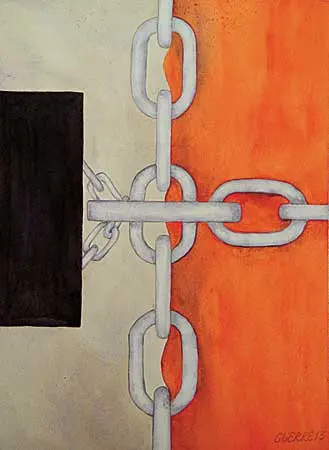
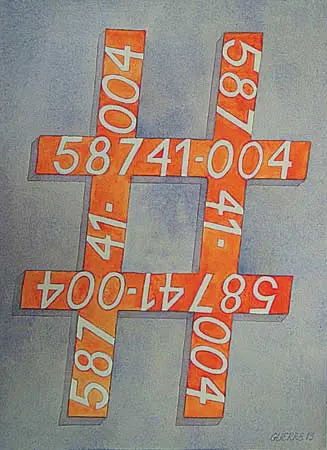
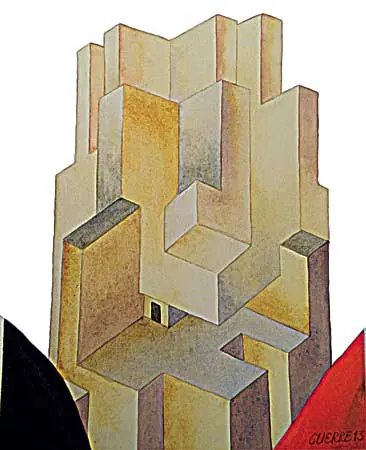
Guerrero’s watercolors could easily fend for themselves. They are surprisingly accomplished, both technically and in terms of imagery. Drawn from everyday prison events they are neither simplistic illustrations nor self-serving denunciations. La bolita (The little ball) refers to his loss of weight, his stomach disturbance, and tooth pain during solitary confinement (the nickname for his ills came from his prison mates, to help him relax). When Guerrero asked to see a dentist a medical assistant told him that all his health problems were the result of bad mouth hygiene. He advised him to tear threads from his towel and use them to floss. Número (number) refers to the loss of identity once he was assigned a number to take the place of his name. El segundo hueco (The second hole) is the room where his defense lawyer would meet him. Each of the works refers to some jail experience that in most cases only is used as a stimulus without becoming the subject for an illustration.
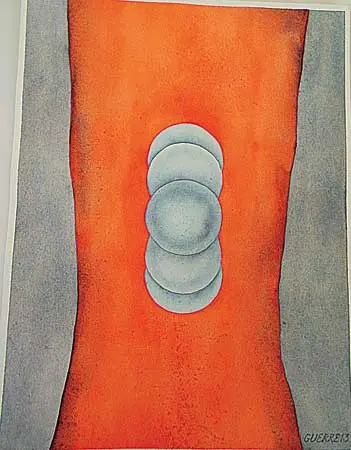
Most of Guerrero’s pieces, therefore, are like memory flashcards that don’t describe events but synthesize his experiences in a highly symbolized language. Visually the work seems filled with modernist references to the 1920s and 1930s. However, in their assuredness, they stand on their own. The connection with the art historical past (it is unclear how aware he might be of this) provides a nostalgic aura. Remarkable is that although the work is a product of these personal feelings and attempts to cope with imprisonment, there is no trace of self-pity or pamphlet art. Guerrero’s ego footprint seems to be totally absent.
I encountered Kcho’s metal cage walking around the hall of the Museo Nacional. I knew about the Cuban Five, but not their names, and a sign informed me about Kcho’s homage to Guerrero. I was peeking in from the wrong side of the cage and discovered the watercolors. I know Kcho and his work since he graduated from ISA (the High Institute of Art) and the beginning of his meteoric career. Known for big, roughly hewn, and strong installations, the possibility that he might have the subtle and light touch shown in the watercolors was unexpected. That made me ask questions and that is how I found out about Guerrero. The discovery was double-edged. It was refreshing to discover a self-taught person who didn’t do outsider-art and produced well-crafted work, with carefully administered symbolism and clearly knowing what he was doing. It was work that didn’t ask for tolerance and stood up to serious scrutiny. The series of works deserved to be shown without the help of biography. Here the watercolors seemed to be giving meaning to the installation rather than the other way around.
In truth, the situation is ambiguous. It would seem that the setup gives both artists equal billing (the bios of both are displayed without rank). However, what comes through primarily is Kcho trying to call attention to Guerrero’s case in a very well-intentioned act of propaganda. Kcho provides the pamphlet quality that Guerrero so carefully avoids. Given the imbalance in the amounts of artistic biographies, it could be said that Kcho’s installation is expected to act as a resonance box for an unknown suffering artist. Instead of achieving its purpose, Guerrero’s works appear as props.
Neither the Bush exhibition nor the Guerrero show would exist without biography. In both cases, the work is anecdotal in the subject matter. In both cases, it arrives at the exhibition for reasons having nothing to do with art. And in both cases, the presentation is located in a venue/context explicitly highlighting biographical rather than aesthetic issues. In Bush’s case, his artwork could not stand on its own without the biographical context. We know the work is there because George W. Bush was president of the U.S. and only for that reason. In Guerrero’s case, one discovers the work is fine without the biography. Humbly and uninfected it allowed itself to be found.
NOTES
1. Jason Farago, http://www.theguardian.com/artanddesign/2014/apr/04/george-bush-portraits-world-leaders
2. Peter Baker, “An Ex-President, Brush in Hand, Captures His Fellow Leaders,” The New York Times, 04/04/2014
3. http://www.georgewbushlibrary.smu.edu/News-and-Events/News/Bush%20Center%20Announces%202014%20Special%20Exhibitions.aspx
4. Two prisoners, Fernando González and René González have been released after finishing their sentence.
(Edited by Selby Hickey)
LUIS CAMNITZER
Uruguayan artist. Professor Emeritus at SUNY College, Old Westbury.