
Ary Brizzi is considered one of the great protagonists of the
second wave of geometric-constructive artists in Argentina who turned away from
the initial orthodoxy of the movement to resort to serial principles based on a
theme and its modification according to the musicality of color.
The color in his work determines the balance between expansion and concentration, between stability and movement. The manner in which Brizzi uses color is outstanding because of the sensitivity it reveals and for the admirable level of quality achieved. The impact attained by contrasting colors in serialized bands generates a power that illuminates the sensitive spaces with flash-like bursts of light. It is a reflecting attribute of light that likens his paintings to the pursuit of the absolute.
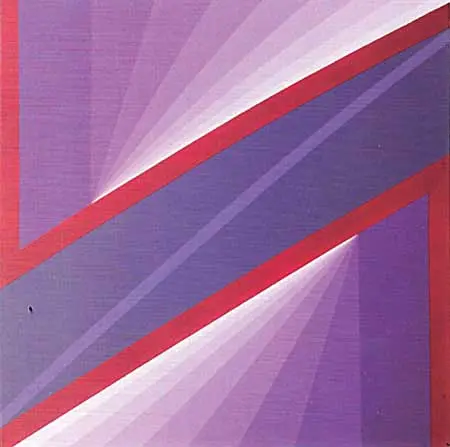
He also produced highly interesting three-dimensional works in acrylic, a material that lent itself to his pursuit of a multiplied vision. His outstanding contribution as a teacher has guided many young artists. Four of his students—Carolina Cerverizzo, Clarisa Cassiau, Eduardo Ruiz and Cristina Sicardi—organized a tribute to their teacher at the Galería Hoy en el Arte.
The show was called Ary Brizzi / Constructive Permanence. Great works by this master have established in this manner a dialogue with the works of those whom he introduced to the pictorial discipline.
Carolina Cerverizzo initially borrowed the selective and rigorous approach from contemporary constructivism and the sensitivity to record all the conceptual and formal avatars that geometric abstraction embraced throughout its evolution. The result has been the great freedom with which Cerverizzo handles the creation of a language that does not stop at absolute clarity but charges the image with metaphors and allusions.
Cerverizzo’s proposals are always dynamic and rely on enticing asymmetries that were initially characterized by the use of a specific base color on which the action of elusive strips or ribbons occurred. Today, she articulates planes of different colors covered with serial elements that establish a counterpoint of diagonals, active forms and subtle oppositions that demonstrate the central role of her explorations of the plane in her work.
As Elba Perez said: there is no pathos that can disturb the serenity of her images. In this manner, she has developed her work through the years and enriched the coherence that supports it with numerous openings, researches and travels.
Clarisa Cassiau surprises with her works from the series Turning I Go, in which curves of several pulsating colors, thicknesses and axes on circular supports channel the perception of viewers.
It is a moment in the operational approach that Cassiau has been gradually selecting and that has always been characterized by an explosive dynamic. One could affirm that geometrization in this artist’s work has always been turbulent. A drive to explore beyond any boundaries encourages all of her work. Even when she created the altar of the Lord of Miracles of Meilin, in Santiago del Estero, her constructive axes expand—either to symbolize the presence of God or the contact with the believer, or both—and are always on.
Along with Bielinski, Arteta, Dubos and Ara Monti, Cristina Sicardi for a long time was part of the group Tiempo Espacio Siglo XX that always stood out for the success of their explorations and completed projects. Sicardi has exhibited her work in several countries in Europe and America and, since 1988, has been working to expand her pictorial production by exploring the use of neon.
As Albino Dieguez-Videla said “from being used for awnings and street advertisements, neon has entered the world of galleries and museums.” For Cristina Sicardi the use of neon has become a new way of continuing her explorations with light, an element that no doubt has always been the central element in her paintings.
Eduardo Ruiz takes on constructive abstraction with the vitality of a young man wanting to revisit every proposal. In any case, he approaches his work with remarkable aplomb, as his acrylics on paper or canvas reveal a remarkable sensitivity for color, translucencies and rhythms. He knows how to put these elements at the service of the enigmatic and poetic nature of his work.
A loving and compelling tribute to the contributions of Ary Brizzi as a teacher, the exhibition is accompanied by a catalog with texts by María José Herrera, who recently was appointed Director of the Musei del Tigre in Buenos Aires.
NELLY PERAZZO