
Daniel Lezama told Sonia
Sierra—in an interview published in the El Universal periodical—that he created
an image titled Árbol Nodriza (Mother Tree) that he
described as “The Chichihualcuauhco or tree that feeds the
children before birth.” He later found out about another mythological
tree named Tamoanchan: “Tlalocan, or paradise, is a place where
there is a tree in the center that holds the sky. That tree is responsible for
the birth of mankind. It contains and combines the energies of heaven and earth
from which the story of humanity arises as those two forces merge.” This
explanation largely defines the theme in the oils that Daniel Lezama created
and presented in his new solo exhibition Mythical Trees at the
Galería Hilario Galguera.
In the visual imagery of Lezama there have always been plenty of motifs and treatments that violently and categorically assert an ideal of national 19th Century beauty with naturalistic tendencies. There is a profound narrative vocation in Lezama’s painting that is evident in the composition. Rather than being the last son of Mexican mural painting—and even if he does not create paintings on walls—he could instead pass for the reluctant great-grandson of Delacroix.
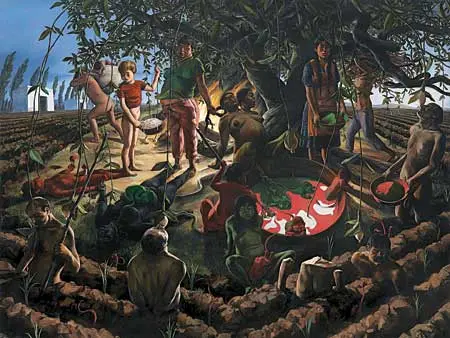
The name of his new series, Germinal, is a statement of principle that is consequent with the manner in which the artist has always paid tribute to Emile Zola, more because of his book of the same name than in honor of the film version directed by Claude Berri, starring Gerard Depardieu and Miu Miu. I feel compelled to make this clarification because Lezama’s paintings are actually very cinematic. Nonetheless his work has more to do with the digitally developed visual imagery of escapist cinema of the last twenty years than with the slogan of melodrama of the masses.
There is, of course, a political commitment by the artist that is full of excitement and doom. His characters embody the apotheosis of a losing struggle that we already know by heart; a tradition that to some extent Mexico shares with other Latin American countries, in which history, literature and art repeat like a litany the vindication of the abuse suffered by workers and peasants. This does not mean that I would label Lezama a man committed to social struggles. I do not think that the glorification of his subjects reaches out at the silent majority he appears to portray in his monumental oil paintings—his “models” here should be understood as examples of average Mexicans; given that Lezama does not use models, as he told Mónica Mateos-Vega of La Jornada in June 2012. He admits in the same interview that perhaps the only mystery of his work is “to imagine fiction.”
The bombastic and provocative verismo or realism that characterizes the treatment of the figures—which has become emblematic—is no more than the appearance, the stroke that rescues and recreates—like an allusion or reference—the mental catalog that he uses to build the allegorical content of his paintings—which are equally or more fascinating than the brutal beauty of his compositions and his dexterity as a painter). Lezama has managed to transcribe the figures of a medieval print into a medium that emulates the stridency found in billboards.
In the evolution of Lezama’s work, his allegories—the fictions that he represents on the canvas—have been reinvented again and again, and have at the end devoured themselves—like the Ouroboros of the Alchemists—in order to stop being a reflection of pictorial themes and instead become an eschatology. Lezama revisits some pre-Hispanic myths in his paintings and updates them to translate them as the symbols that define contemporary reality. It would be unfair to say that Lezama portrays the allegory of a social reality, halfway between the Zocalo dancer and the construction worker, between the healer and the maid. Somewhere between allegory and eschatology there is a leap into the void that can only be averted by turning to myth. The canvas that gives title to the exhibition depicts two figures interconnected by arms that expand like a column of snakes. The heads of the snakes—like high-voltage cables—illuminate the sky and suggest treetops. The primordial energies that unite heaven and earth are an allegory of electricity (or of the electric power company); the mythical tree has replaced electricians in a painting where magic has replaced progress as the transformative force. Or maybe not. Germinal is literal in its contents: they are figures that also plant. It Is the Garden of Delights, but also the Swamp Creature.
Lezama has managed to reinvent himself in the eschatology that he has created from the exhaustion of his allegories. The first impact can still make one fall into the obvious (the sleep of reason produces monsters) but Lezama’s importance as part of the political imaginary that emerged from neoliberalism is still pending review—or an answer, depending on how it wants to be perceived.
RICARDO POHLENZ