
The Sala de Arte Público Siqueiros commemorates the 40th anniversary of the death of its founder with an exhibition curated by Daniel Garza-Usabiaga. Focusing on a figure that the history of art has already approached from so many perspectives can be an overwhelming and compelling proposition. The title of the show refers to one of Siqueiros’s creative variables that most compellingly characterizes his legacy: the appropriation of industrial processes and products. According to Garza-Usabiaga, the title also comes from the book Mechanization Takes Command by Siegfried Giedion (1948). The curator declared that even before being invited to participate in the project, he had already been interested in Siqueiros, particularly in his postwar works; in the manner in which he used industrial materials not solely to discover innovative formats in his formal configurations and creative conditions, but also for revolutionizing—through display strategies and the potential of the industrial inner workings—the visual and ideological effects on the perception of a work of art.
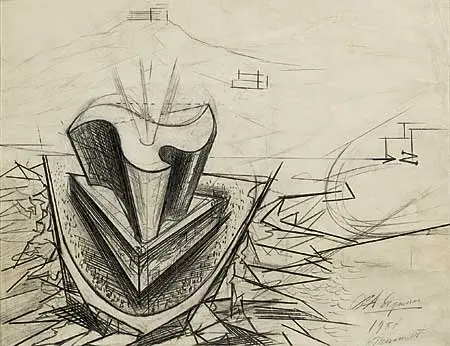
These interests are explained in the exhibition through a dialectical relationship nourished from two fronts: the use of new materials and the multiple consequences that such use entails, and the—clear or encrypted—representation of industrial images as symbols and ways of questioning social growth and progress. The art works selected by Garza-Usabiaga do not solely showcase the aesthetic and “corporeal” experimentation with materials, they also—by inserting sketches, photos and other elements—establish a series of interdisciplinary procedural relations, within a multi-purpose group, which informs on the intimate relationship between different states and conditions of “the mechanical” (the rational) and the emotional and material explosiveness that fertilizes Siqueiros’s artistic process.
A case in point clearly drawn from the exhibition is that Siqueiros—a master of foreshortening—nourished his gaze, his understanding of the immediate space and his creation of vanishing tensions by relying on photographic studies on the visual forms of the human figure, as he renders those images as unfoldable brushstrokes capable of multiplying spatially. Thus, strengthening these studies of vanishing figures by turning them into volumes in the space, Siqueiros gains the use of multiple perspectives to attract the mobile viewer. Siqueiros “activates” viewers to experience the multi-angularity configured by his spatial awareness displayed on walls, ceilings and facades. There is no longer a place for passive spectators like those still working/admiring works on easels. But not content only with a mobile gaze, Siqueiros expected the whole body to move through the spaced used by the work—front, back and around it—if viewers intended to have a complete experience. Only then, it was possible to activate the many angles that the artist had visualized to co-create—with the help of the viewer’s mobile interaction—the totality and purpose of public art.
The exhibition rightly includes some small size physical and visual “exercises” that appear to narrate material spaces as it heads toward that crowning achievement of his career that is the Polyforum and its 4,355 square meters of sculpture-painting—which not only the exhibition appears to gravitate to but also Siqueiros’s life and work. Some of the pieces that pull the gaze are early works in which the artist experimented with the use of pyroxylin: Nacimiento del Facismo (Birth of Fascism, 1934) and Ejercicio Óptico (Optical Exercise, 1934); as well as Correlaciones Armónicas (Harmonious Correlations, 1973) and Floresta Tropical (Tropical Forest, 1973), which were innovative in the application of acrylic on Novopan. These and other clues, exposed in their materiality, allow viewers to understand the manner in which Siqueiros’s aesthetic exploration and spatial understanding gradually developed through the constant practice of that which the artist called “controlled accidents:” formal-physical experiments that led to the some extent unpredictably reaction between materials and surfaces.
And a sort of controlled accident occurs between the paintings, sketches, videos, mockups, photographs and annotations that are displayed along with a sales receipt for material purchased in 1966. Is it a strange curatorial inclusion? On the contrary, I find that the receipt synthesizes in a very particular manner the core objectives of the exhibition. So it happens that this trivial sales receipt—now in a display window transformed into a meaningful and valuable sign—conveys the mundane familiarity found in everyday acts. This is when we know that—even if only for that moment—we share a common space with the legendary artist’s feverish gaze; having both been exposed to solving an ordinary problem that could easily be transferable to any other activity that involves some form of human creation. It is possible to think that by carrying out the seemingly innocuous process of selection and purchase of “something” that is necessary for the formation of our particular activities, we define to a greater or lesser degree, the possibility of finding, developing, and/or recognizing something true; the possibility of condensation (even if temporary) of a genuine existence that manages to be condensed externally, while devoted to the requirements of other bodies and from multiple viewing angles.
MARCELA QUIROZ