
Diana Dowek (Buenos Aires, 1942) wants his contemporaries to find in her work “a moment in their collective lives.” In her ideological and conceptual inquiries, she works in a series that address the events of her and our time. Her artistic trajectory confirms that she directs her gaze and endeavor to the fractured society, as she renders silences and marginalization, fences and crowds.
Dowek’s early works were framed by the turbulent 1970s in an Argentina in abysmal turmoil by the resurgence of the leftist urban guerrilla Movimiento Peronista Montonero-MPM and the death squads of the Argentine Anticommunist Alliance—also known as Triple AAA; the return and death of Perón, and the establishment of the military dictatorship that began in 1976. Her polyptych titled Lo Que Vendrá (What Will Come, 1972) anticipated the dozens of one-sided clashes that would occur in the streets of Argentina for decades; in fact, a painting from this series appears to reproduce the moment in which the Buenos Aires police, already under a democratic government, murdered Dario Santillan and Maximiliano Kosteki in a train station in 2002.
The work by Dowek, who participated in her first exhibition in 1967, is not only not oblivious to the significance of what is perceived, but actually expands on it. Her paintings and drawings, works created with mixed media, installations and videos reveal things that are public and generate a private shock. Her 2013 exhibition titled Urban Memories, curated by Kekena Corvalán, also co-author of the book Diana Dowek. La Pintura es un Campo de Batalla (Diana Dowek. Painting is a Battlefield), Buenos Aires, 2013, once again focused on imprisonment and things that rip people apart, as well as on the vulnerabilities of those out in the streets.
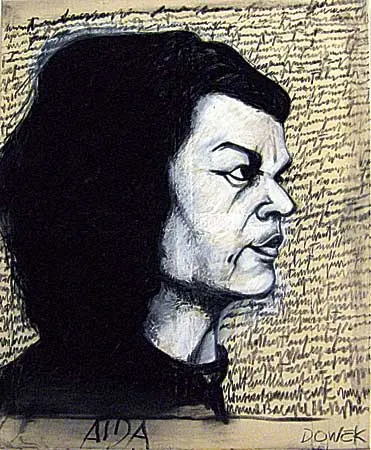
In the middle of these issues, Dowek—did she take a break?—decided to paint women that she admires. In Mujeres Queridas (Dear Women), an exhibition of portraits presented at Galería Jacques Martinez, she abandoned the images of anonymous subjects and the photographic transferences that she has been often including in her work since 2002.
There are 14 works with 15 women represented in them—rendered with charcoal, pastel and oil on canvas—that form a heterogeneous list of characters from yesterday and always. All have first and last names but one: the anonymous woman with glasses screaming desperately, a photogram taken from a silent movie frame from the film The Battleship Potemkin (1925) by Sergei M. Eisenstein.
In this collection the gaze of the characters are either fixed on the viewer or completely avoiding him/her. In these images the face of Virginia Wolf— remembering that A Room of One’s Own, personal and economic independence is often all that it takes for one’s own development—is right next to the one of social activist Clara Zetkin—founder of the International Women’s Day.
Many of these women have already entered the pantheon of Western tradition, like philosopher and politician Rosa Luxemburg, a revolutionary and Marxist theoretician who was tortured and murdered by a paramilitary group in Berlin; Chemist and physicist Marie Curie, the first person to win two Nobel Prizes; Jewish teenager Anne Frank, who died in the Bergen-Belsen concentration camp; writer, teacher and philosopher Simone de Beauvoir; anarchist Emma Goldman; Dolores Ibárrurithe Passion, also known as La Pasionaria (The Passionflower), a political leader during the Second Spanish Republic and the Spanish Civil War); along with Tina Modotti, whose life was as extraordinary as her photographs; and painter, sculptor, writer and pacifist Käthe Kollwitz complete the landscape of universally recognized “dear women,” by Dowek.
In a double portrait, closer to a local theme, Dowek painted Micaela Bastidas—the murdered wife and counselor of the Inca Túpac Amaru II—and María Guadalupe Cuenca, whose love letters to Argentine hero Mariano Moreno—unread by him because he died at sea—are an invaluable romantic and historic testimony. Also, in the figure of Olga Márquez-Arédez, wife of a missing mayor from Jujuy and one of the founders of the Mothers of Plaza de Mayo in that province, Dowek pays tribute to women who knew how to fight for the safe return of their love ones without allowing themselves to be used, also not allowed to use (voluntarily) by any government like the one currently holding office.
Finally, the drawer, writer, painter, and ceramist Aida Carballo is the only “dear woman” who Dowek knew personally. She was her teacher and then became her friend, and even her companion during political rallies. Dowek fondly remembers Carballo repeating: “the line has to turn around.” Likewise, Dowek also notes that this series is based on A Day in the Life of María Rosario, a Working Woman (2006), several pieces that narrate the endeavors and days in the life of a real person.
In the novel titled La Historia del Buen Viejo y la Bella Muchacha (The Story of the Nice Old Man and the Beautiful Girl, 1928), Italo Svevo makes his sixty-year-old character say that he is an old man. Dowek, who is over 70, approaches her work with more enthusiasm than ever and continues to use her artistic tools to be involved in public affairs like, for example, demonstrating against strip mining and excessive soybean planting or, as part of a group denouncing the “announced and preventable tragedy” of the Sarmiento railroad in 2012, which claimed the lives of 51 people and leftover 700 persons injured; and more.
VICTORIA VERLICHAK