
Although there is an ever-growing number
of video artists working in Central America, exhibitions focused on video art
in Panama are still rare. The presentation of the video Domino Effect by
Donna Conlon and Jonathan Harker at the DiabloRosso Gallery constituted a
significant exception. The video, which lasts 5:13 minutes, stands on its own
as an independent work through its audiovisual power, poetic quality, and the
implications of its content. Nevertheless, the show included peripheral
elements such as stills exhibited as artworks or reproduced on postcards, which
unfortunately diminished the element of surprise upon viewing the video for the
first time.
The collaborative works that Conlon and Harker have created in Panama since 2006 have recently garnered considerable international attention, both through exhibitions abroad and the fact that some of their videos have been acquired by the Tate Modern in London and the Guggenheim Museum in New York. Although Conlon was born in the United States and Harker in Ecuador, they both live in Panama City, which is the setting for most of their endeavors. While each of them works individually, they have formed an artistic duo (although they are not a couple) with a personality of its own. Their videos generally relate to everyday life, showing found objects that they combine with a consistent sense of humor and sharp ironic edge to make statements about serious issues. They often reference the sociopolitical context and urban problems of Panama City, which in recent years has undergone a real estate boom that they have described as a “frenzied metamorphosis ... that is obliterating the city’s architectural history and eating away at the collective memory of its inhabitants.”
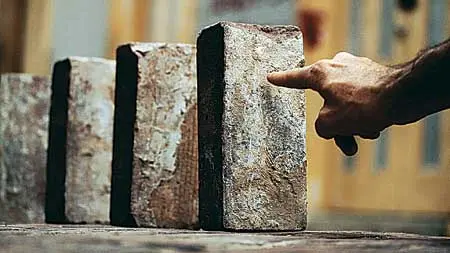
Domino Effect was filmed in Panama’s Old Quarter, a colonial enclave that was declared a World Heritage Site by UNESCO in 1997. The video shows the progressive fall of a chain of bricks placed in a long line that snakes through the streets, sidewalks and plazas of the historic district. The fall of the first brick (triggered by the artist’s hand) causes the movement of all the rest of them in a linear sequence, creating a domino effect. Along the way, the bricks pass in front of, through and behind a series of construction sites, symbolic spaces and emblematic structures of the old town center.
The video’s protagonists are over one thousand clay bricks that were removed as part of conservation project to repair the streets and place electric cables underground. This “modernization” scheme triggered numerous popular reactions and newspaper articles due to several apparent irregularities. The main issue was the laying of new bricks (made in Panama) that proved to be inadequate for paving, making it necessary to remove and discard those too, in order to rebuild the streets with other imported bricks (from the United States). The delayed process and the urban chaos it prompted had a negative impact on the lives of the people who live and work in the old quarter, as well as on the tourism it usually generates. In addition, while Conlon and Harker were working there, the government was building a controversial super highway on the sea surrounding the colonial center, the “Cinta Costera 3”, which threatened the historic district’s status as a World Heritage site.
In the midst of these troubled waters, Conlon and Harker perceived the opportunity and material for an artistic statement. Over many months, they gathered bricks (at a rate of twenty per hand cart) in clandestine collaboration with the Panamanian workers dismantling the original streets under the supervision of Brazilian foremen. The five-minute video is the result of about a year of preparation: from polishing the bricks, to planning their itinerary, placing and filming them, balancing the lighting, and removing all extemporaneous sounds.
The outcome is a visually seductive video that operates on multiple semantic levels. The viewer is initially impressed by the neat and playful way the bricks fall and the synchronized rhythm of the sound they make, as they guide us on a journey through the old urban center. The falling chain of bricks goes past torn-up streets, piles of garbage and dilapidated buildings as well as imposing neoclassic facades, promotional billboards and newly restored colonial houses. The video functions both as a portrait of the city and an allegory for the destruction of its history, which prompted deep emotional reactions in some Panamanian viewers. The clay blocks falling one after the other remind us of people who follow trends without much forethought, in this piece that Conlon and Harker describe as “a metaphor for development as a chain reaction.” The bricks in “Domino Effect” move along in a crescendo, just as the uncontrolled urban development has, finally leading up to the Old Quarter’s fortified walls, with a view of the new highway on the water in the background. One wonders where all this will end, as the video concludes in an apparent suicidal act with the last brick falling into the sea.
MÓNICA KUPFER