
Eight years after his last exhibition in
Chile, Francisco Valdés (1968) demonstrated in Témpera how experimentation in painting remains possible at this
point in history, building a body of work of great conceptual density that will
always surprise us with the possibility of new interpretations. This, provided
we are attentive to the correct details and questions, as it is highly probable
that unadvised observers will only scratch the surface. The artist works by
making things more complex and convoluted, adding signs and references, in order
to resituate himself as a practitioner of neo-conceptual painting. A resident
in London for the past ten years, his production encompasses different
techniques—drawing, photography, video, installation, performance—but painting
always provides the appropriate register for talking about art and also other
contexts and appropriations, for instance, the possible crossings between Europe
and Latin America.
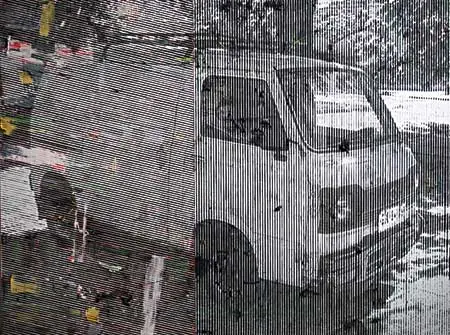
The first thing we note in the exhibition is a new way of painting. In the entire series of paintings, Valdés superimposes on the realistic blotch a kind of linear grid that is pure painting, textures, pastes, and lumps, where the model appears rather at a distance, our eyes half-closed, put together by means of a kind of veiling or white noise, finally encountering the representation of a mage interfered by deficiencies of printing or transmission. This work is not, then, directly based on the model, but perhaps on a photograph or video capture. It is a work of transfers where the original is not an original, but the copy of an image or the copy of a copy. In that game of transfers, what reaches us is the image and its noise, the product of the flaws in a low-tech mechanism. In truth, models seem like everyday private photographs, the careless framing of a wagon, a garden fence, a 1980s toy highway, of a landscape painting with the flash reflecting on the protective glass.
So, what matters here is not painting as much as a way of painting, where what we see is the copy of an interfered image of the everyday; the gaze of the machine on that everyday life captured through a controlled manual impulse.
The connecting point for hand-making and low-tech, image and noise is also implied as a “trap” in three other works. One is small, a frame or board held in place on the floor by a stake. The linear trap remains present here, but not the image, which is white in its entirety, nor painting, since it is a plaster object. The second work, also on the floor, objectual: a platform with notebooks with sketches and crumpled sheets, printed images, the painting of a photocopy machine made using the same textures, plus cables and electrical plugs. Meanwhile, in front of the large window onto the street, there is the image of a toy highway painted on a large piece of transparent PVC.
The object is present but above all painting as a system halfway between figuration and abstraction, between informalism and minimalism. The representations appeal to a mediated reality of the instant of transfer. They also point towards a moment in the history of art, the moment of modernity; an instant in the history of painting, its conceptualization; and an instant of the image: when it comes about through a play of effects both light-based and optical and technological, bringing into question the totalizing status of the photographic image.
Other interpretations of this proposal become clear in the texts that accompany the exhibition. There we learn that the points of reference have been three artists’ key in a definition of local art against the Eurocentric drive: Venezuelan painter Armando Reverón (1887-1954) and his use of tropical light; Brazilian artist Helio Oiticica (1937) and his work with color and space; and Chilean-Spaniard artist José Balmes (1927), with his use of earth and matter. We are back, in other words, to a moment of transfer: that of Modernity in Latin America. Because Valdés arrives at the production of these works “after a subjective re-reading of the Twentieth Century avant garde.”
Other links in the chain of meaning are the show’s title and site, which connect under the same concept: Témpera is a material used in pre-modern and pre-Renaissance painting before oil became common, and it is also the most widely used kind of paint used in the country’s schools. In a space affiliated with the National Culture and Arts Council, located next to the Education Ministry, Valdés is referring to the teaching of art in Chile: a process that depends, precisely, on mediated images, where the originals are kilometers away, and their appropriation is not exempt from errors and noise.
CAROLINA LARA