
Galería GBG Arts
inaugurated March a major exhibition by Master Harry Abend. The small
show—given the size of the gallery—was a successful demonstration of how to
organize an exhibition that condenses fifty years of artistic trajectory. This
was possible because of the correct choice of works that covered very specific
times in Abend’s artistic production, and also because of the projection of
photographs of his artworks integrated into the architecture of the space,
works placed in public areas, and the inclusion of his creative processes. The
group of works definitely presented an integral vision of the artist.
Given the layout of the gallery—which consists of a lobby and two exhibition rooms—the show was divided into three parts: the lobby was occupied by a documentary area with a selection of Abend’s publications, drawings, and a display window that contained a series of small carvings of the “organic” period. Exhibition room one focused on the abstract-geometric work that the artist created from the mid-1960s until well into the 1980s. It contained two decades of constructive art during which he made reliefs based on the systematization of basic geometric shapes—squares, triangles, rectangles—and cylinders whose variations depended on the compositional organization of the materials used—wood, concrete—as well as on painting, where employed. The realization of these reliefs can be interpreted as the result of his training as an architect. Abend himself has acknowledged that he designed these pieces by relying on an absolutely rational process. This dual vocation—as architect and sculptor—has been fundamental in the successful execution of important works integrated into architecture as a result of his familiarity with architectural spaces. They are based on a similar approach to the one used in his reliefs, with the scale being the notable difference between the two. In this sense, the following murals and sculptural works are notable: in the Synagogue of the Unión Israelita in Caracas (1969), in which he intervened the ceiling, the dome, the altar, and the lighting; the Hall of the Exhibition Center in the CANTV building (1973); the Sala Plenaria in Parque Central (1973), the Synagogue of the Bet-El Association (1974-1975 and 1989); the facade of the Complejo Cultural Teresa Carreño (1980-1982); and PDVSA in Puerto La Cruz (1998), among many others. This part of the exhibition was completed with the projection of photographs taken by Barbara Brändli between 1982 and 1983, which visualized the process of developing the facade of the Complejo Cultural Teresa Carreño and showed the details of those murals. Also projected—and integrated into the architecture as public workpieces—were photographs by Paolo Gasparini of Abend’s work from different periods and locations.
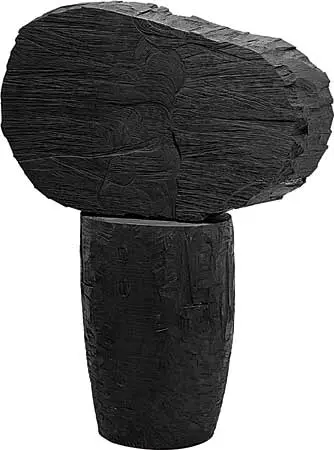
Room two displayed a collection of wood carvings made ¿¿in recent years that were used as part of an installation. These carvings belong to Abend’s organic period, which actually begins in the mid-1980s and continues to be developed to this day. A change in his approach occurred when he decided to create works that were much more spontaneous. However, the essential minimal form that characterizes his previous work continues to be employed. This intention is ultimately not new. His first bronze sculptures from the late 1950s and early 1960s denote a willingness to create simple, volumetric, and clearly organic forms. This return to organic forms in later decades indicates an interest that remains relevant and that marks the beginning of Abend’s freer approach in the execution of his work. The factor that is arguably different is the value that Abend bestows upon wood this second time around. The carving of the wood is in most cases very precise and discrete, in an effort to allow the material to express its intrinsic expressive values.
To let the material “be” it is also necessary to know how to control the hazardous and unpredictable elements. This certainly involves a major change of attitude and maturity over his earlier constructivist period; a change that is also evident in the resulting works. No doubt that transitioning from relief to carving and to the entire package implied a great change of approach. And even a greater step was to go from the precise, constructed, form to the natural, organic, quality of wood. There is in this, one might say, a desire to rediscover the archaic, elemental, form. But even in this intuitive approach to creating the architect’s vision persists. Federica Palomero points to it in her introduction: “A certain underlying architectural order is still present: columns, capitals, gates, doorways, through which the artist organizes an adequate space for his woods, as he turns them into columns capitals ... which in turn generate his space.” Although space is certainly important in any sculptural space, in this case, it is treated differently: while during his constructive period Abend’s works were constricted to the given architectural space, during his organic phase the artist has the privilege of creating his own space. Both modalities are equally important.
SUSANA BENKO