
José Bedia’s most recent solo
show, Solitary Sailor, is a thematic exhibition. The
arrangement of the works corresponds to an order determined by the artist and
intended to propitiate an interpretation that is, to a degree, linear. This is,
no doubt, an autobiographical exhibit. The works on display become individual
pages of a kind of personal journal, in which the artist “narrates” his
experiences.
The main room is occupied by a selection of large-format works, placed sequentially, as if wallpapering the gallery, in fours groups, three with six elements and one with four. The first group, located to the left of the entrance, emphasizes individuality above the collective. One work in this thematic set, Como llegar a casa en medio del maratón de la noble causa, presents us with the individual as an animal-headed man walking to the right, in contrast with the group and the collective, represented here by identical black outlines of many men and women moving in the opposite direction.
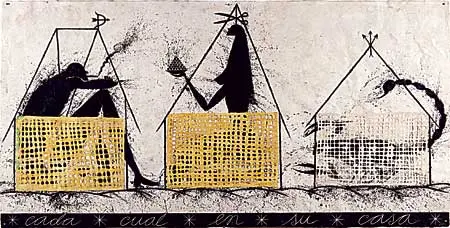
On the center wall-hung works illustrating situations with which the artist disagrees. His commentary contains a dose of humor, and we see the typical characters of Bedia’s iconography alongside other elements of contemporary society. Bedia comments on the dominant position occupied by technology as it invades everyday life, represented by the selfie phenomenon and Instagram. He is talking about a hedonism channeled through social networks, which can result in great vulgarity. Perhaps the work that best represents this intention is Guaricandilla taking selfies for Friends in Facebook. Here Bedia includes elements from Cuba’s popular culture, such as the term guaricandilla, meaning a vulgar and sexually promiscuous woman. Formally, the work differs from anything Bedia has done in the past in terms of its composition. At its center is a she-devil, a horned woman, here outlined in green. This character already played a protagonic role in a previous solo exhibition, Une Saison en Enfer. The rest of the composition is structured on the basis of small icons outlined in black against yellow ground. Each icon is surrounded by texts written in popular jargon, many with explicit sexual content, as a critique of vulgarity. Two more works, also harking back to elements of the previous show, also focus on the same topic: Having Sex on Instagram!!! and Algunos bichos de la fauna local. Here, the she-devil appears again as a central element, and Bedia refers to the role of sex n interpersonal relations and how it often becomes a means of manipulation.
The third set of works represents the force of nature, illustrated by the presence of totemic animals. One of the works dealing with this theme, A mis enemigos veo venir, located to the far right as if closing the selection, summarizes the idea behind the entire exhibition. In it we once again encounter the solitary lion that becomes Bedia’s alter ego. Bedia includes in this work prayer for protection. Here the artist clearly illustrates his feelings of being, as the show’s title warns, isolated like a solitary sailor.
The exhibition includes two more triptychs, one made on parchment and illustrating animalist-type rituals, and a second triptych dedicated to Babalú Ayé. Bedia’s works on parchment stand out for the delicateness of his lines, as well as the figures and colors he uses, all in correspondence with the chosen support. In contrast, their themes have a rather violent character, once we notice them. The largest parchment is Lilith, the apocalyptic renegade, represented here as a woman with the head of a lion. It refers to the first woman created by God, who later became a diabolical being after equality with men is denied her. The second triptych, Babalú Ayé, Piango pata Piango llaga, y Coballende, are made on jute, perhaps the material most associated with this deity, and includes recognizable elements, such as clutches and dogs.
Solitary Sailor becomes a compendium of emotions and disappointments referred to the artist’s life experiences. Some of the images are reflective, others are visceral; some illustrate personal scenes, others comment on social uses. These works are the mechanism Bedia has chosen to “unload” feelings and frustration accumulated in recent times. It is his way of being at peace with himself through his art, which is how he communicates with the world.
IRINA LEYVA PEREZ