
Thanks to the initiative of Miguel Miguel, curator of Espacio Monitor, we were able to observe the work of talented Mexican artist Jose Dávila (Guadalajara, 1974), who presented specially conceived pieces for that exhibition hall and others that are part of recent series that have been enthusiastically received by international critics.
Formally trained as a sculptor and architect, Dávila’s interest focuses on the three-dimensional shape and spatial dynamics it generates. In this sense, the artist enters the perceptual frame of the form, as he resorts to a grammar made by basic and frank elements that in their simplicity help to reveal the play of interactions and appearances, thus—as Venezuelan art critic, Costanza De Rogatis correctly points out in the text of the exhibition—Dávila “exposes the most basic characteristics of the relationship established between objects and their environment, and the participation that as viewers we have in such interaction.”
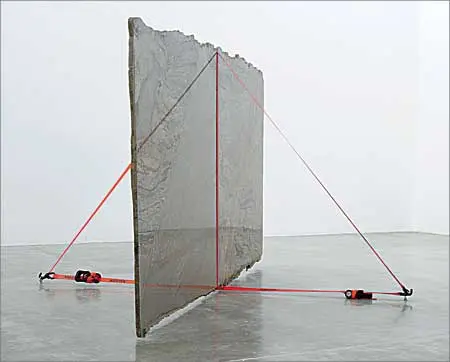
The configuration of the pieces in the exhibition and the materials they are made from the call for simplicity: the repeated use of construction materials, iron, cables, cement, and the enunciation of simple shapes that emphasize the relationship between mass and the negative space of a body that surrounds and penetrates the space. However, the unfriendly bareness of his pieces subvert the formality, and leads us to discussing perception and its illusory nature and, thus, to comment on art and architecture and the ways in which all this already historic “formality” affects our perception and the discourse about contemporary art.
To Dávila, the emphasis on the relationship between form and content, between space and emptiness, becomes a way of critically dealing with fundamental aspects of art history and the memory that it has inserted into Western culture. Dávila uses multiple means to confront viewers by relying on the specificity of each medium, so that what is perceived passes as appearance, convention or reality.
In the series Homage to the Square of Josef Albers, for instance, Dávila draws on the work of the famous modern artist and produces a series of mobiles that are reminiscent of the square series by Albers. With the mobiles by Dávila— human-scaled and created in metal—the space is no longer limited to the two-dimensionality of painting but it becomes a changing element. Here, color is a metal line that contains a transformable space similar to the emptiness left behind by a silhouette in motion. As result of the effects caused by movement and its progression, it is difficult to convey the unyielding stillness that characterizes Albers’s work. In this regard, in revisiting the modern masters Dávila opens the possibility of subverting and commenting on their geometric explorations as these pertain to our memory, as spectators immersed in a world in which forms and historical references create an indivisible framework.
De Rogatis has rightly drawn attention to Dávila’s reiteration of perceptual tricks as a way to impede the viewer’s “educated” perception. “This idea of deceiving perception to dismantle ideas that we accept a priori is a constant concern that runs through Dávila’s work. And one specific aspect of this approach—the silhouettes of the vacuums, a duality presence-absence, which is established, both as referent from one image to another and as a vestige of that which even if is not there, it is.”
A number of the works shown are presented as concrete blocks in which neon tubes outline their sides as a perimeter line. In Promise of a Better World, for example, the tubes appear to emphasize the distancing of the form—a block—-from its original purpose of serving to support a volume and contain a space.
Notably, Jose Dávila’s artistic trajectory has recently permitted him to be nominated for the Acquisition Award that is granted yearly by EFG Bank and ArtNexus, to be announced in Art Basel Miami Beach in December of this year. Also recently, the Museum of Modern Art (MoMA) in New York approved the purchase of an important monumental work of his for its permanent collection. Likewise, the Getty Foundation has awarded Dávila a grant to carry out a large-scale installation at its headquarters in Los Angeles.
KATHERINE CHACÓN