
What seduces us so strongly in the work
of Lucio Fontana—and the retrospective exhibition at the Musée d’Art Moderne de
la Ville de Paris shows it brilliantly—is the freedom that characterizes it and
the relentless experimentation it expresses. Above all, freedom of the gesture,
on the selection of materials, stylistic and technical freedom, swaying between
abstraction and figuration. Although it is disconcerting at times, and loses us
on occasion with its singularity, it is one of the 20th Century’s more important
bodies of artistic work because of its abundance, its openness towards world
art, its renewal of the relationship between painting and space, and its
theoretical contributions. This exhibition, organized with the collaboration of
the Milan-based Fondazione Lucio Fontana, is the first in France since 1987.
The museographic path proposed reveals the Argentine artist’s prolific
diversity through more than two hundred works, including paintings, sculptures
(ceramic, mosaics, terracotta, plaster, bronze), and environments that make
possible to offer a global view of a complex, atypical oeuvre that seems
difficult to attribute to a single artist for its style shifts.
After Jacques Lassaigne, an emblematic director who welcomed Latin American artists like no other museum head had done before, and in a short span of time (Guayasamín in 1974, Tamayo and Torres Garcia in 1975, José Luis Cuevas in 1976, and José Clemente Orozco in 1979); after the presentation of three large-scale group exhibitions—the first in 1965; the second, Da adversidade vivemos (Carta blanca a Carlos Basualdo, in 2001; Resisting the present (contemporary Mexican art) in 2012— the Musée d’Art Moderne de la Ville de Paris adopted the policy of periodically showing a foreign art scene, or artists whose work is not always as celebrated as it should be by public institutions. Thus, in the long history of this museum, this policy has made possible innumerable discoveries and rediscoveries.
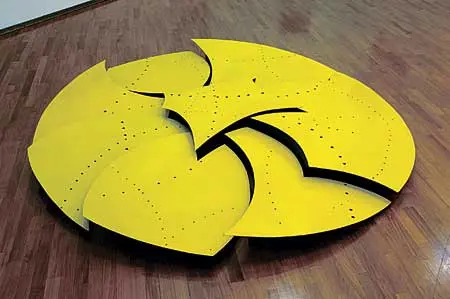
Born in 1899 in Rosario, Argentina, to an Italian father, and educated as a sculptor, Fontana traveled to Milan in 1927 and spent there the largest portion of his life. After one return to Argentina during WWII, he settled back in Milan in 1947 and came to dominate the post-war art scene in Italy. Today he is best known as a theorist of the Spatialist movement (16 – Fontana et ses lunettes spatiales (Fontana and His Spatial Eyeglasses) 1965, photograph by Lothar Wolleh) and for his lacerated canvases called Tagli (fissures), the radical gesture that characterizes him only came to the fore in 1949, when he created his first perforated canvases and titled them, as he would do later with all his works, Concetto spaziale (8 – Concetto spaziale, water painting on canvas, holes, 100 x 124cm, 1961).
The exhibition is chronological and thematic at the same time since it brings together the variety of techniques grouped according to the serial titles given by the artist—Tagli (fissures), Nature (natures), Olii (oils), Venezie (Venices), Fine di Dio (the end of God), and Trinità (trinity)—and the three long-span periods in his career: ceramic, ripped and perforated canvases, and Spatialism. Be it in his earliest human figures in plaster and terracotta, schematic and archaic (1930-1933); his matterist ceramics inspired in the seascapes of Albisola (1936-1940); or his “Spatialism” (1946-1952), a period when Fontana produced highly figurative ceramics influenced by Italian folklore (warriors, 4 - Il Guerriero, polychrome ceramics, 108 x 52 x 45cm, 1949, battles, crucifixes, harlequins, etc.), Fontana’s taste for figuration moves from a certain “primitivism” to the embodiment of an idea, at once futuristic and baroque, of continuity in space by means of motion.
In 1946 Fontana developed his spatialist theories and established their foundations in the White Manifesto. Upon his return to Milan, in 1947, the beginnings of the movement correspond to a group experience of debates, exhibitions, and publications that brought artists, writers, and philosophers into Fontana’s orbit. Spatial art is seen as something that goes beyond traditional genres and a synthesis between “color, sound, movement, and space.” The exhibition presents a convincing selection of spatialist works, most of which were made in canvas after 1945. We also encounter some examples of other materials that open up wildly varying aesthetic universes, always abstract, as in Concetto spaziale (virgin cloth paper, holes, 100 x 100 cm, 1949; Concetto Spaziale (oil, mixed technique, and glass fragments on canvas, holes, 144 x 100 cm, 1955); or 10 - Concetto spaziale, New York 10, three copper panels, fissures, scratches, 234 x 270cm, 1962.
Three sections of the exhibition are devoted to Fontana’s architectural collaborations (enhancement of monuments) and his environments such as the neon ceiling (reproduced in the show) for the Sources d’energie gallery of the Italia 61 exhibition, or the small labyrinth created in 1968 for Documenta in Kassel. The installation of his Nature, a group of markedly sexual sculptures in terracotta in the shape of hollowed or cleaved balls, is also an evocation of the universe that perhaps translates, before Fontana’s exploration of religiosity (Fine di Dio and Trinità), a quest for a new serenity.
CHRISTINE FRÈROT