
Returning to the vicinity of his history
in the East Village, Meyer Vaisman has marked his reentry with his own signature,
writ large, and stamped with the current year of the Jewish calendar, Ayin
Dalet, 5774. The return of Vaisman’s work to the Lower East Side of Manhattan
delimits a period of fourteen years, which the artist has spent in Barcelona,
bracketed in 2000 by his last show at Gavin Brown’s Enterprise. These years saw
a hiatus in his production of art, profound emotional struggles, conversion to
orthodoxy, and, ultimately, regained productivity.
Walking into either of the two spaces that comprise Eleven Rivington, anyone familiar with Vaisman’s work of the previous fourteen years would immediately recognize his hand. Or, perhaps more accurately, his mind is apparent, as he is generally not directly involved in the making of the objects on exhibition. The artist continues to effectively deconstruct the idea of a work of art and presents, instead, a product. Albeit one that formalizes the creator’s concept. Dan Cameron stated in 1987 that the works conceived by the artist “…emphasize a cancellation…of intimacy” and “…distance the viewer from the process of fabrication.” More succinctly, Irving Sandler in his ë Lescaze when he urges: “…it is important to know that my involvement in these works is minimal.”
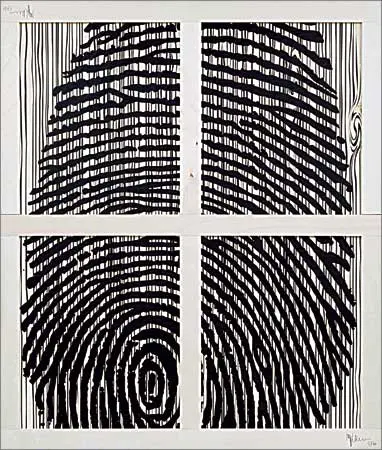
For the latter-day viewer these new works, all from 2014, are probably less confounding than they were in 1987 when a frustrated young man tore one of the four toilet seats from The Whole Public Thing and tossed it out of the window at the Sonnabend Gallery, but they do require careful consideration. To a great extent, the challenge is embodied in the extreme coolness of the objects. The techniques and technologies used to build the current pieces, primarily inkjet printing on plywood, are smooth and flat, the texture of the plywood being nearly implied in print, rather than heightened—not unlike his earlier enlarged canvas motifs. Further, the wall pieces are effectively shown in reverse, with the stretcher bars on the face of the board, placing another layer between the observer and the work and the artist. These devices do demand consideration to achieve an understanding of the work, but in some instances, the result is less satisfying than the process.
Mounted in both spaces of the gallery, the initial impression in each venue was very different. On Chrystie Street, the work suffered to some extent from over-crowding, although some of the stronger work was there, especially Under My Thumb A, the artist’s fingerprint. Printed in black and white, the thumbprint floating on the grain of the plywood, the large panel is divided into quadrants by the crossed stretched bars. This, in the end, is probably as close to the artist that one will reach, if not quite providing the window it simulates.
At the 11 Rivington space, the installation was sparer, which quite literally allowed the pieces more space, but also afforded the intellectual environment to more closely analyze the works. The exhibition was also decidedly enhanced here by the inclusion of Untitled Flower A, a sculptural work occupying the floor in the center of the gallery. The flower was typically well-conceived and beautifully fabricated (as were all of the works). Composed of six separate pieces resembling small, still, pools that took the form of a stylized flower, the urge to move and rearrange was almost irresistible. This desire surprisingly mitigated the imposed distance between the maker and observer. Coincidently, this mitigation flowed throughout the smaller space and generally enriched the experience of this show.
It is difficult to judge where Meyer Vaisman will be in the next segment of this cycle of fourteen-year episodes. It seems certain, however, that he will continue to conceive and design thoughtful works of art that initially push the viewer away, but provide enough tantalizing traces to draw one back. The greater question may be whether or not the artist will move beyond this most recent treatment of his own signature or imprint. If, as one piece proclaims, in the—slightly muddled—venerable adage Ars Brevis, Vita Longa, perhaps we will be ready for a bit more vita.
CLAYTON KIRKING