
Miguel Rio Branco has already been
described by critics as the “Caravaggio of photography.” And the comparison
still stands when observing his latest exhibition titled Color Theory at the Pinacoteca do Estado de São Paulo. The Spanish
artist—of Brazilian aristocratic descent—presented nearly forty works that span
the beginning of his artistic trajectory in 1960 to works created as recent as
2012.
The selection included photographs, installations, objects and paintings that showcase the variety of techniques and solutions used by Rio Branco in the construction of his works. In them the artist thoroughly explores the potential of the most diverse visual languages and even combines some of them. However, an equalizing factor is that all share the same essential driving force of pictorial nature, the exuberance of the artistic mediums, the drive of the chromatic material, the brightness of light and drama of the shadows.
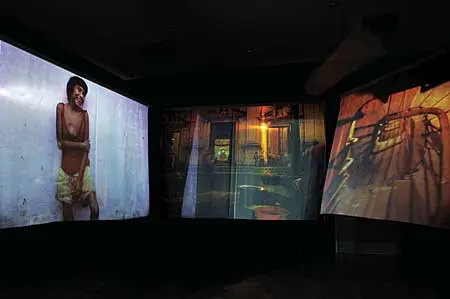
In his paintings Rio Branco incorporates collage, highlights volumetries and suggests narrative rhythms; in video he establishes combinatorial systems with the projection of still images obtained from editing and film editing. According to José Augusto Ribeiro, curator and researcher at the Art History Research and Critique Department of the Pinacoteca: “It is not by chance, then, that the environments and objects in these works by Rio Branco degrade, are precarious and accumulate signs of use. The bodies show scars while contrast, color saturation and light erase the boundaries between the elements in the images. In short, this artist creates an atmosphere of pleasure and pain, drama and lyricism, in compositions that are quite unique in the context of Brazilian contemporary art.”
Painter, photographer, filmmaker, creator of multimedia installations, Rio Branco studied in the 1960s at the New York Institute of Photography and, in 1968, at the Escola Superior de Desenho Industrial (ESDI) of the Universidade do Estado do Rio de Janeiro. In 1964 he began his artistic career exhibiting paintings and, by 1972, he was already showing photographs and films. He worked as a photographer and experimental filmmaker in New York from 1970 to 1972. Later he directed and photographed several shorts and feature films. His award-winning work has been exhibited several times in the past twenty years, in venues like: the São Paulo Biennial (1983), the Stedelijk Museum Amsterdam (1989), the Palazzo Fortuny in Venice (1986), Magnum Gallery in Paris (1985), Fotogaleria FUNARTE in Rio de Janeiro (1988), the Kunstverein in Frankfurt (1996), and the Museu de Arte Moderna in Rio (1996).
Since the 1980s, the artist has been seeking to develop in his photographs and videos a documentary work of expressive poetic charge, as evidenced in the installation from 1983 titled Diálogos con Amaú (Dialogues with Amaú) which marks the artistic transition from photography to the projection of images. In that work, the proposal to create an edited film based on still images is taken to the extreme: 80 photos are swiftly alternated and repeated on fabric backdrops, creating overlaps between them. The thread of the images is a series of portraits of a deaf-mute Kayapo named Amaú.
In the installation Entre los Ojos del Desierto (Between the Eyes of the Desert) that includes images produced on the border between the United States and Mexico in the 1990s, three projections show a succession of more than 400 images. The variety of times and the combination of images suggest a hypnotic, sensation accentuated by the confusing superimpositions. The work is an approximation of two classic genres of photography: portrait and landscape. On one side, there are the pictures of eyes, while the other shows records of the desert and the border, urban scenes and ruins—all places charged with nostalgia.
In his photographs, Miguel Rio Branco adopts the same symbolic and spectral charge he presented in the captured images of Maciel, a deteriorated neighborhood of the Pelourinho region in Salvador, with its semi-destroyed colonial facades, prostitutes and drug dealers. Rio Branco extracts from that landscape a documentary and sociological synthesis that coexists with a piercing aesthetic discourse. These emotionally charged images, achieved through powerful chromatic backgrounds and striking figurative forms—faces and bodies are shown in close-up along with situations of degradation and poverty—reveal the bitter beauty of his poetry.
Thus, visiting this exhibition becomes first and foremost a moving adventure. It means witnessing the regenerative nature of the memory accumulated in Miguel Rio Branco’s oeuvre, as he reinvents the past to compose the present in an entropic circular motion. The works arranged in a large retrospective attest to the complexity of the poetic structure of an artist whose vast aesthetic resources demonstrate a strong environmental commitment that broadens a mystical and ritualistic sense. The viewer walks into a world intertwined with overlapping fragments, translucencies, juxtapositions, cuts and collages. In situations of continuity and discontinuity, the whole is revealed united as a work in progress, an archive of itself, in which the artist is multiple while also being singular.
ALESSANDRA SIMÕES