
Between May 7th and June 14th,
Andrea Rosen Gallery presented recent works by Mika Rottenberg (Argentina,
1976). Titled Bowls Balls Souls Holes,
the show was an expansion of Rottenberg’s first institutional exhibition in the
United States, which, organized at the Rose Museum in Boston, was accompanied
by a monographic volume with essays by Christopher Bedford, Julia Bryan-Wilson,
Wayne Koestenbaum, and the artist.
At the crossroads where video installation and sculpture meet, the exhibition in Manhattan revisits themes that have been recursive in Rottenberg’s work, such as voluptuous women that allude to consumer society and the world of work, reflection on the logic of time from the standpoint of what the artist dubs “the production of luck.” This is to say, using carefully depicted images and objects that, with their kitsch aesthetics, refer to Capital, warning us about global warming and the production networks of an often incomprehensible multinational system.
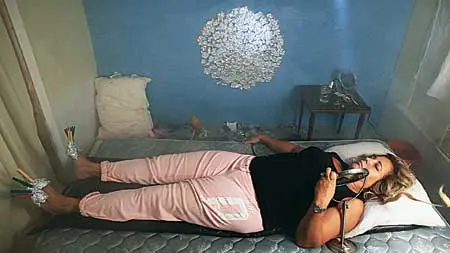
A 27-minute video loop (the show’s centerpiece) dialogs mysteriously with the sculptures installed at the front and the back of the gallery, prompting viewers to think about time not only in the video (a medium that alludes to this trope all by itself) but also according to its relationship with three-dimensional objects. Thus, a revolving wall at the gallery entrance—with a large aluminum-paper circle to one side and a bingo machine, a catalyst of luck, on the other—reappears in the video in different ways, so that mystery connects with fiction and reality. After crossing the wall and being guided by the sound of a recording, visitors walk around a large yellow structure to access the video projection through a purple passageway with small circular figures, also in aluminum.
The video, whose title the exhibition takes, begins on a full-moon night with a middle-aged woman preparing a kind of lunar energy. The woman is in a derelict motel, clad in pink trousers and a black top, reclining on a naked mattress. The wall facing the camera is the same that revolved outside with the aluminum circle, the same material the woman is arranging between her toes and around clothespins. Perhaps she took the aluminum from the wall or vice versa: nothing here allows us to secure a timeline, a recurring element in Rottenberg’s work. The artist, born in Buenos Aires, raised in Israel, and relocated to New York, generates detailed images where the absurd becomes believable and the magical mundane, looking at the canonical logic of time and space with particular irony. Still reclining, the woman in the video looks through a hole in the ceiling and waits for the moon to align with her. She falls asleep. The next day, she goes to bingo in Harlem, where she works as an announcer. The room is yellow, like the exterior of the structure containing the video, and we are left to consider, again and again, the video’s relationship with the architecture and the objects in the gallery. In close-up, the camera captures the woman as she extracts the balls from the machine. Her nails are long and have universes painted on them, and the game’s participants await, without great enthusiasm, the winning numbers. In a corner, a voluptuous woman with magical powers sleeps, and we wonder: is she asleep because she is not in the game? Every so often an AC unit drips on her shoulder. She is awoken. She is upset. Furious, she glances at the announcer, and then the action changes, and as this happens we remember Tsss Tsss Tsss, the work at the entrance of the gallery consisting of an AC unit that drips on a frying pan. And the video continues… the announcer drops colored clothespins through a hole. The clothespins descend through several obstacles until they reach a smaller room, where Mr. Stretch, a lean, bald man, attaches them to the outline of his face. Then the man turns and disappears, as the clothespins fall on the sky in some other part of the world. Since the bingo balls are what dictates the action, one of them takes us the image to the North Pole, which, melting, alludes to global warming. Then, the full moon and the motel reappear, and it all starts again.
On exhibit in the back of the gallery are small sculptures that, after seeing the video installation, no longer seem strange: in a corner, a small yellow vertical rectangle contains an aluminum figure and a vial that shines under a porcelain lamp (we remember, by the opposition in terms of scale, the large yellow structure in the previous room and the revolving aluminum wall); five glass jars contain boiling water (we remember Tsss Tsss Tsss and the image of the melting North Pole); a black circle on the floor simulates a hole inside the gallery (we thing of the hole where the announcer dropped the clothespins or the one through which she looked at the moon). It all seems mysteriously connected. With great cleverness and ingenuity, Rottenberg shifts the automatized logic of time in order to reflect on the production of hidden forces behind chance, delivering the viewer into an astounding, yet also alarming, present moment.
FLORENCIA SAN MARTÍN