
Entering a museum of contemporary art
and believing that one is inside the premises of a lumber company deserves
clarification. We are in the exhibition titled Use and abuse by Patrick Steeger (Santiago, 1970). Thanks to an
agreement reached with the forestry company Celulosa Arauco, Steeger was able
to work on and develop a small-scale experiment with a single material: wood.
He showcases his technical mastery of the medium with mixed results. Some works
require the interaction of viewers more than others, other pieces are exercises
in recontextualization, and others yet are prototypes and mockups. It is a
collection of works created by Steeger in recent years whose results—in terms
of the artistic experience by visitors—shed irregular sensations. The large
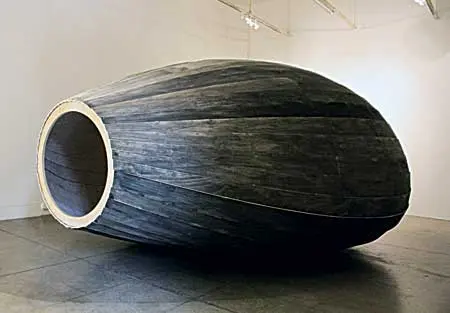
size works are displayed in the second level of the MAC. One of these is a
large oval that viewers can enter and take a few steps inside. It produces one
of those irregular sensations I was referring to earlier: an incomplete
experience, halfway between a public sculpture (inside the museum), an
interactive work (in which there is not much to do), or aesthetic stimulus. As
an urban art sculpture, it required to be approached differently, in a manner
similar to the other work (Oval) by the artist also exhibited at the museum.
Yes, the direct reference to Ciudad Abierta in Ritoque, by the Chilean coast,
does become relevant. Ciudad Abierta is a building complex built in the late
‘60s by students and faculty members of the School of Architecture of the
Universidad Católica in Valparaíso, one of the major projects of modernity in
Chilean architecture.
In the central hall, the artist has arranged tiny pieces of wood on the floor for visitors to play with, recreating a scaled version of a city, or as Steeger has called it: an “urban Google Earth.” Again, an attempt to activate the visitors’ participation is not completely successful because Steeger fails to define an objective that goes beyond playfulness. A burned watchtower, which establishes a vague connection with the rest of the pieces, serves as a witness of this miniature city. Other items displayed include revisions of earlier works such as the castings of classical columns in Más de lo Mismo (More of the Same) shown at the Galería Animal Gallery in 2008, in an exhibition in which Steeger also played with the idea of mini-cities projected from small pieces of wood—a reference to the decoration of Chilean palaces and churches that imitate noble materials with plaster or wood, showing the willingness of the local aristocracy to match European buildings. Equal in meaning is the decontextualization of a white subtly lighted frame that evokes decorative elements found in a house. In short, in Use and Abuse Steeger brings into the museum space a laboratory of his experiments with wood, a material he dominates masterfully but with results that could be improved in terms of the viewer’s experience. A work in progress that could become a compelling proposal if it could somehow manage to involve viewers more.
JUAN JOSÉ SANTOS