
A box by Ricardo Brey can be a
trigger for many things: from raising intellectual speculation before a
multiplicity of objects that he would reveal on the inaugural day, which would
almost lead to a detective-like investigation about a missing component—a book,
I think—that in the end was never lost. His daughter had taken it. In any
event, the research is a “letter” that has poetically marked the work by this
artist born in Havana (1955) who answers to the last name of Rodríguez and who
has been living in Belgium for several years already.
A member of Volume I, an exhibition regarded as a milestone in the artistic and aesthetic renewal of Cuban visual arts during the 1980s and, according to critics then, an exponent of anthropological research, the renamed Ricardo Brey was reunited with the primarily Cuban public through a colorful exhibition named after him. Eclectic not solely because of the variety of artistic disciplines included—drawings, photographs and sculptures, some displayed individually while others were part of installations—but also because it provided a selection of his corpus of recent works created between 2013 and 2014, but strung together with other precedents.
This was the case, for instance, of the mentioned boxes that belong to the saga Every Life is a Fire. Consisting of several layers, the boxes denoted a usufructuary conception of post-structuralism. There, Brey stratified from memorabilia to found objects, comprising signifiers created by him in an archeology of memory and knowledge that only a hybrid alchemist, maker and collector can compose; and one that only an initiated—even in esoteric rituals—can reveal. Symptomatically, he was the one who stripped the inside of the boxes. But in doing so he did not reveal the meaning of that which was shown. It was a liturgy in which he officiated as performer and demiurge. Such approach by Brey made one think that the best is not the one hidden from sight but one that eludes understanding; it is not one that remains under the cloak of invisibility but one that hides behind an encoding system. The title is just a hint. Not even the transparent glass of the display windows that are also part of the exhibition allowed delving deeply in the cloistered papers.
Did the charred tree stumps photographed by Brey pose an environmental complaint concerning the indiscriminate logging of the green lungs of the planet? Were they a record of the crime scene, with the material evidence that incriminated mankind? Were they a naturalistic-inclined approach to the inner essence of a vegetal organism that confesses with its number of biologic rings the accumulation of years lived? By threading those images with bright necklaces, was Brey comparing the devastation with the symbol of wealth, or was he inciting a showdown? The artist also showed the (un) balanced nature of the Universe, conditioned by random variable of the dice in relation to an equilibrium; and by the hands of man: which gloved or not, gradually leaves the imprint of his gesture—sometimes damaging—on Nature.
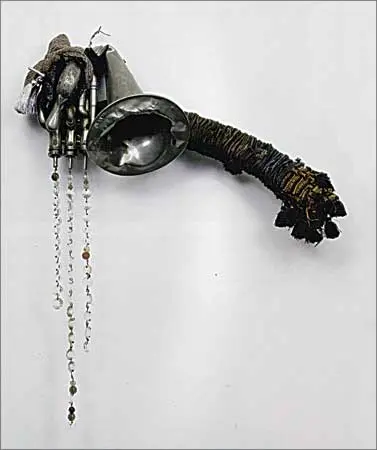
The abundance of inanimate or broken objects, the mise-en-scène with museum elements—perhaps to preserve old documents—and the collapsed planetary system in the center of the exhibition hall, conferred an apocalyptic tone to the exhibition. An angel blowing a wind instrument by the entrance appeared to be announcing the Last Judgment. But they were aberrant guesses about the proposal of someone who makes no distinctions between the noise a hammer makes when building or destroying. In addition, the archangel was not playing the proverbial but a saxophone—alluding to a musical composition by Coleman Hawkins.
By virtue of works like that one—it was not the only one in the exhibition that was associated with music—Brey found elements in common with other Cuban authors who have made of that artistic discipline a source of inspiration. Some have represented the performer and/or the instrument. Others have incorporated sound into their artistic projects. Some have sought to establish analogies between abstract painting and musical instruments. Brey—who studied piano as a child and used to draw on the pentagram—has intervened the perforated paper rolls used in recordings. He needs melodies as a source of inspiration and uses them to compose visual proposals. He favors wind and brass instruments, as they entail the pneuma or vital breath.
In this manner, Ricardo Brey inserts himself in a tradition that—from the perspective of the historic Cuban avant-garde—has had important exponents. There are the geometrized drums of Cundo Bermúdez, unavoidable for those who transit through the Edificio de Arte Cubano, where Brey exhibited his work between April and June of this year. Brey did not ignore them. A candle told me that the black prince and the red rose visible around those days in every permanent exhibition room were his ideas. He paid tribute to those teachers who preceded him—or not—in the path of art, en route to the space that he reserved for the reunion.
ISRAEL CASTELLANOS