
Two simultaneous exhibitions (May-June,
2014 confirm the singular and sustained presence of Saúl Kaminer (Mexico, 1952)
in the contemporary Mexican scene and reveal the conceptual and aesthetic
transformation of a body of work that has for many years engaged different
disciplines and created multiple universes. With painting, sculpture, and
drawing; with various materials such as terracotta, iron, bronze, or cardboard,
Kaminer’s work tends today to a greater purity, with a noticeable attenuation
of the properly figurative modes of expression that characterized it until a few
years ago.
These two complementary exhibitions highlighted several aspects of Kaminer’s recent evolution and brought forth the intellectual and sensorial reflections that lie at its base. Instituto de México, located near Galerie Thessa Herold, decided to present thirty-eight works, among them a site-specific installation with a rather spacious and convincing curatorship that traces the path towards what we can call a “sensible” abstraction. For several years now, Kaminer’s painting has undergone a formal and conceptual mutation within which nevertheless persists a basic constant: three-dimensionality. Indeed, as far as we may want to go in his cosmogonic, mythical narrative impregnated with a discreet passage of the real—especially in his figurative paintings of the 1980s and 1990s—Saúl Kaminer presented us with a wise constructive challenge consistently associated with his poetic imagination and an elaborate, refined practice of color.
From the richly celebrated wordiness of that period to the scant use of words intertwined today to his visual discourse, more abstract now but always brilliant, it is that paradox of a stale instability that brings the artist’s and the observer’s gaze into the transparent, virtual honeycomb work of a “double” reduced to the essence of its lines. The imagined and controlled decomposition, the progressive and ineluctable destruction of his figurative space as observed in the most recent works on exhibit here, reveal the role and the impact of light, the mystery of reflection, the virtual character of matter, the density or lightness of the gesture, and announce the non-permanence that characterizes the adventure of canvases like En el vientre de la ballena (oil on canvas, 130 x 97cm, 2011) or La casa del soplo (graphite and oil on canvas, 114 x 146cm, 2013), “trimmed” drawings and sculptures such as El pequeño Moisés, oil on trimmed Arche cardboard, 50 x 74 x 14cm, 2011) or Cuerpo espacial sensible (trimmed steel, 120 x 40cm, 2013). Although chance seems controlled in an attempt to contain it, motion nevertheless introduces the appearance and disappearance of form, the passage of light and shadows, the evanescence and the permanence of volumes, confirming in this way the ephemeral and ineffable nature of the instant.
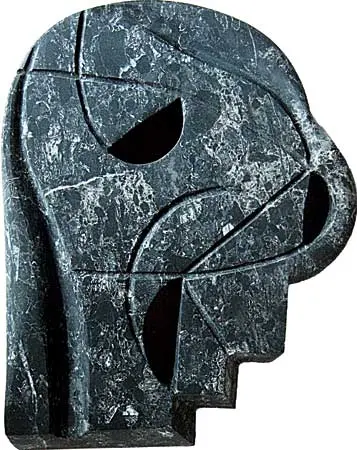
At Galerie Thessa Herold, the museographic proposal organized around sculptures in ceramic tile, granite, and onyx, along with some drawings, pastels, and oils (thirty-two works), introduces a relative figurativism evoked by some of the masks on display. The ritual and mythical elements that have for a long time populated Kaminer’s large narrative canvases subsists in a way in these stylized, “geometrized” figures that at times bring to mind Madi “objects” somehow lost in Mexico’s pre-Columbian world. A discreetly revealed interiority comes across in these sculptures, which are drawn as much as they are sculpted (features, volumes, perforations of the material, trims), like Máscara-Espíritu (ceramic tile, 26 x 18 x 12cm, 2013) or Máscara-Noche (granite, 28 x 22 x 5cm, 2014), where dimensions are controlled and the balance of shapes is subtle, as is the balance of color—grey veneers with the granite, golden veneers with the onyx, dark and matte hues with the tile.
Where does Kaminer’s interest in masks come from? In the catalog published for this exhibition, the artist notes that for him, “the mask that occupies the space in front of the face becomes a sound, a mythical narrative, an animal, the presence of nature, the divine, the grooves of history, the shadow of shadows, a petrified rictus, a talisman, ancestral memory,” adding that “masks are the voices of the earth, the light for the gaze, the site of all aliance, fire born of water.” Kaminer seems to possess something of the shaman and of the sorcerer, but he is above all a constant and deep thinker of the space in which he attempts, incessantly, to find meaning, each time renewing his private relationship with nature.
Perhaps save only his earliest sculptures, where Kaminer inflates and trims, unfolds, opens and closes the figure, but retains the palpable flesh of the real, what directs the choreography of his recent work is playfulness. A play of light and shadows, of masses and lines, of colors, or of materials. Eyes open or closed, magic acts. The mystery of contrasts posits infinite perceptions. The ondulations create a mineral universe traversed by water and air, in constant renewal. In this way, then, Saúl Kaminer takes us on an uncertain adventure that places our imagination in a state of permanent alert, so that doubts are dispelled and we are better inspired.
CHRISTINE FRÈROT