
“Meanwhile, we too admit that the
present is an important time; as all present time necessarily is. The poorest
Day that passes over us is the conflux of two Eternities; it is made up of
currents that issue from the remotest Past, and flow onwards into the remotest
Future. We were wise indeed, could we discern truly the signs of our own time;
and by knowledge of its wants and advantages, wisely adjust our own position in
it. Let us, instead of gazing idly into the obscure distance, look calmly
around us, for a little, on the perplexed scene where we stand. Perhaps, on a
more serious inspection, something of its perplexity will disappear, some of
its distinctive characters and deeper tendencies more clearly reveal
themselves; whereby our own relations to it, our own true aims and endeavors
in it, may also become clearer”.1
Much of Kadir López’s work is inspired by a meditation on time. By blurring the lines between the past, present, and future, he critiques the effects of progress, or lack thereof, and its spiritual, economic, and political consequences on society. In mining Cuba’s rich and complicated history as well as personal events, he creates a multilayered reality that combines space and time into a unified visual universe. His exploration on the theme of continuity has led him to traverse the finite limitations of both his own geographical surroundings and the pictorial plane. While it is possible to try to reconcile and assimilate contradictory information, Kadir embraces the idea of a present whereby differing histories coexist and inform each other. The amalgamation of ready-made materials and intervention allows him to be an observer and participant, author and audience. As a result, the world he creates is at once complex and beautiful, ambiguous and revealing, critical and hopeful.
Just as time plays a crucial role in his work, Kadir’s own personal history coincides with the birth and growing pains of a new nation. Born in 1972, as the Revolution entered its second decade, the cultural milieu oscillated from one extreme to the other. The 1970s in Cuba saw the both the condemnation and affirmation of artists, culminating in the jailing of Heberto Padilla in 1971 and the formation of a national art school, the Institute of Superior Arts (known by its acronym ISA), in 1976. The cultural policy set forth at the start of the Revolution is generally thought to have its genesis in a speech by Fidel Castro called “Words to the Intellectuals” in 1961. The now-famous quote, “Within the Revolution, everything, against the Revolution, nothing” begs the question if a line was to be drawn between within and against, who determines the perimeters? Struggle between the State and the artist has been an ongoing, fluid, and somewhat tenuous conversation. As an artist and academic Luis Camnitzer noted, “by allowing art to evolve at its own pace within the new society, Cuban leadership hoped to have the contradictions slowly go away on their own.” Camnitzer acknowledges that the contradictions did not go away, and in fact laid the foundations for an environment that was in constant flux—with each side subjected to losses and victories. The landmark exhibition Volumen Uno at the Centro de Arte Internacional in 1981 is one of those victories and is considered to be the origin of the “New Art of Cuba.”3
Whereas artists of the 1980s pushed the limits of what “within” and “against” meant in the name of autonomy, they did so with the realization of their right to openly critique issues ranging from the personal to the political and everything in between. As the first generation born and bred of the Revolution, they did not view their actions as contradictory to the State4. In defense of their independence, artist Arturo Cuenca maintained, “We don’t ask ourselves anymore if this is or is not revolutionary. We are revolutionaries and that is internalized.”5 Taking as their subject the quotidian activities of life on the island, their work explored varied issues such as memory, loss, nostalgia, identity, isolation, and exile—with just as diverse approaches to the style. These artists were remarkable for their ability to work within the system and be critical of it at the same time. The decade thus unfolded with an incredible force. In the absence of a forum for open debate, artists were the self-appointed mouthpiece of the public. Able to give form to the concerns on everyone’s mind6, Cuban art garnered attention in the local sphere and at the international level alike.
When Kadir arrived at ISA two decades later in 1990, he entered an artistic environment well-worn from the struggle between the triumphs and ravages of perpetual conflict. Experimental policies had taken their toll and would again with the island on the precipice of what became known as the Special Period and another mass exodus7. Many important artists working at this time left. While tensions had devastating effects on the spiritual and social life of the people, the artists who remained continued to be a voice of criticism and reform. Devoted to freedom of expression, they ensured their legacy by training a new generation of artists as professors at ISA.
Benefiting from Cuba’s adoption of the Soviet model of pedagogies, Kadir’s artistic education began at the age of twelve. Even though he entered ISA with seven years of academic training and a well-developed facility for painting, Kadir recognized a disconnect between the skills mastered in his hands and the thoughts in his head. That was soon to change. Artists turned professors, such as José Bedia, Flavio Garciandía, and Eduardo Ponjuan, offered revelatory instruction on aesthetic principles and the power of artistic expression that otherwise would not have been possible without the vibrant art scene being cultivated in Havana. Kadir’s training included critiques and uninhibited discussions on his work with such luminaries as Gerardo Mosquera and Llilian Llanes. Owing to the struggles of these predecessors, Kadir and his contemporaries inherited the autonomy to freely consider the purpose of art and its effects upon the individual and society. Kadir cites Plato’s Allegory of the Cave, Umberto Eco’s The Limits of Interpretation and Semiotics and the Philosophy of Language, and Thomas McEvilley’s The Shape of Ancient Thought and On The Manner of Addressing Clouds as having a profound influence on him. The awareness that his training was at once a consequence of the island’s history, the present movement, and future potential led to his fixation on simultaneous realities and connectivity. These concerns would consume his practice for the next decade.
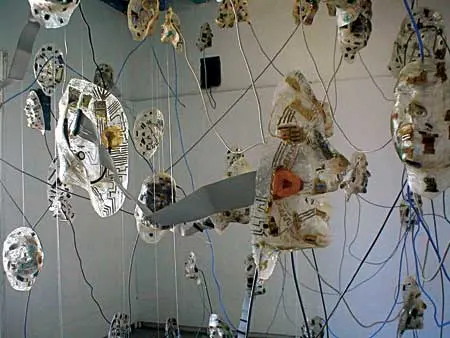
In an early installation titled Clone-Art/Clonart (2003), Kadir suspended masks of his own face—executed in resin and embedded with computer chips and discarded pieces of hard drives—at various heights linked in an entanglement of cables. The three-dimensionality of the piece makes physical the concept that objects in space can overlap, coincide, and exist on multiple planes at once8. Functioning as containers of collective memory, the masks, and their umbilical cords create a web of lines that act as a conduit linking people and events, as well as the past, present, and future. Thus the work can be read as a search for identity within a haphazard environment but also functions on a redemptive level revealing the connectivity of all things. Kadir further developed these concepts in the Signs (2008-2012) and Palimpsests (2009-2013) series.
The tradition of absorption and incorporation has long been discussed as a characteristic essential to Cuba’s development as a people and a nation. Fernando Ortiz (Cuban essayist, anthropologist, ethnomusicologist, and scholar of Afro-Cuban culture, 1881-1969) likened the makeup of Cuban culture to a popular stew called ajiaco. Stemming from a mixture of American, African, and European influences, ajiaco derives its unique flavor from a variety of ingredients. For Ortiz, the stew provided the perfect metaphor for a culture whose history has been an ongoing process of colonization, immigration, post-colonization, and independence. Kadir’s work shares this integration—incorporating lessons passed down from previous generations of artists, while constantly searching for authentic expressions of his individual perspective.9
For Kadir, the question of “how” to make art preoccupies his practice as much as the “why” to make art. His interest in exploring the possibilities beyond the traditional properties of a medium is fueled in part by the desire to work outside of his comfort zone. Additionally, this exploration allows him to experiment with the formal elements of a composition and to reflect on the philosophical intent of his work. A shortage of artistic materials readily available in Cuba limited his production to the use of paint and led him to spend a decade investigating the physical aspects of paint on canvas. Using acrylic, oil, and watercolor, he searched for ways to bridge a simplistic visual palette with the complex subject matter.
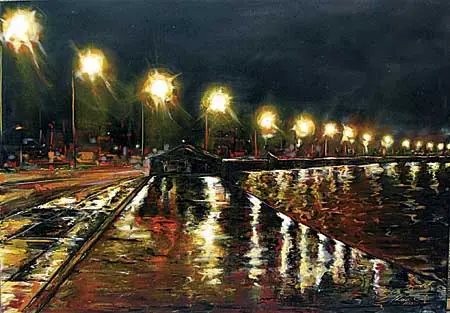
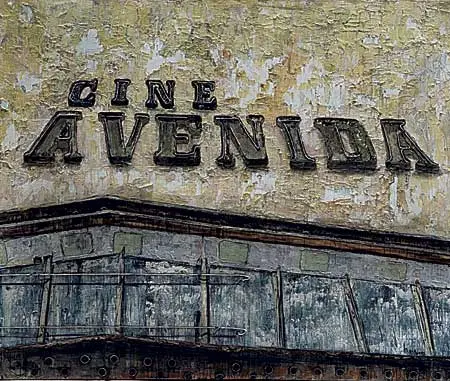
In The Infinite Line/La línea infinita (2006) from the series Leijas (2004-2008), a limited range of colors—black, white, yellow, and shades of red and orange—illuminate the surface and create a sense of depth, while simultaneously de-materializing both physical objects and perceived reality. It is through Leijas that Kadir first delves beneath the surface of appearances for deeper meaning. In his next series Kasting (2007), Kadir focuses on re-creating images of the faded facades of Havana’s abandoned movie houses.10 This series further exploits the relationship between subject and execution. With great fluency, a reduced scale of yellow and blue hues creates a tension between the sense of stillness and loss in the painting. The wear and tear upon the collective soul of society are evident. We are Well/Vamos Bien11, a popular slogan of the Revolution at this time highlights the apparent disconnect between the official and the actual version of reality. With so many stimuli, Kadir stripped his compositions down to their essential elements—resulting in the photographic quality of this series. In the process, Kadir found that he exhausted the limits of paint on canvas.
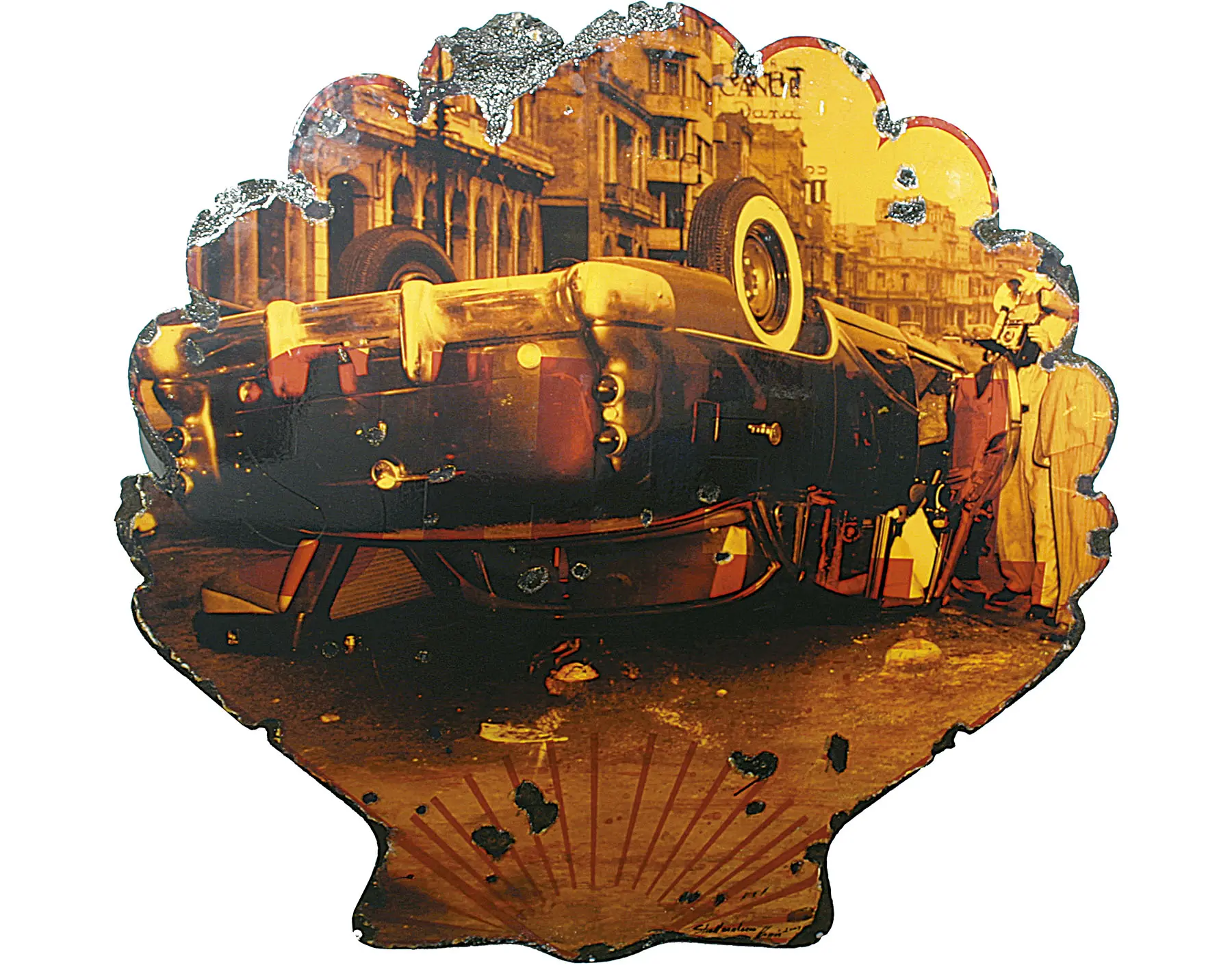
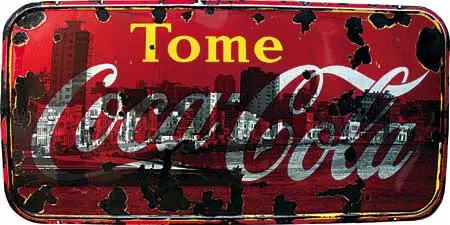
In search of a new medium, Kadir turned to ready-made objects. His interest in the economic, social, and political triumvirate led him to examine the plethora of images used for propaganda and publicity purposes. In his series Signs (2008-2012), he repurposed porcelain-lacquered steel advertising signs from pre-Revolutionary Cuba that celebrate the island as the economic and cultural capital of the Americas by fusing them with black-and-white photographs that chronicled events of a bygone era. The irony achieved by juxtaposing text and image reveals a deeper, more complex reading of the island’s history. Discarded and neglected for nearly 50 years, Kadir halts the degradation of the signs with a chemical application. He then unites the image with the sign by layering transparent glass pigment paints and low-temperature ceramic lacquers. This process is an act of reparation altering the meaning of the historical object and giving these artifacts a new presence. This assemblage of surface textures—the deteriorating sign, the highly polished photograph, glass paint, and ceramic lacquers—joins discordant perspectives into a new visuality.
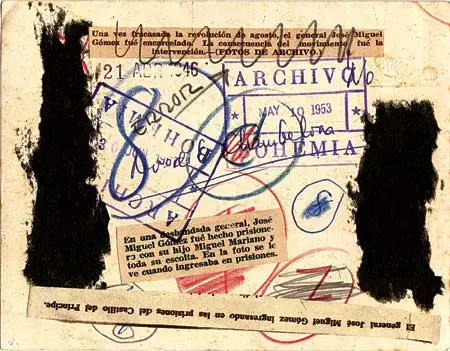
While exploring the rich visual history of the island, it became evident that a mingling of realities had an enduring legacy in a nation that has struggled with issues of independence and identity for most of the 20th century. In his Palimpsests/Palimpsestos series (2009-2013), Kadir revealed intricacies of his country’s past by exposing the back of photographs once used by the Cuban government in print media from both national and world history. The backsides were inscribed with various captions—at times hand-written, typed, taped-over, even blacked-out—producing a recondite narrative of past events. Palimpsests, literally meaning “scraped clean and used again,”12 were originally manuscripts on parchment in which text was erased and written over. The process, however, did not entirely obscure or destroy what was underneath. In the case of the particular photographs Kadir used, a myriad of information speaks to the shifting realities experienced by a country in revolution. Born from the layering of all previous experiences, the palimpsests provide us with a link to our understanding of the present.
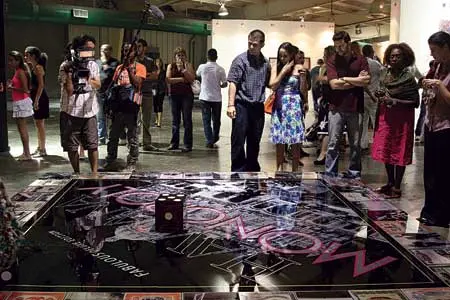
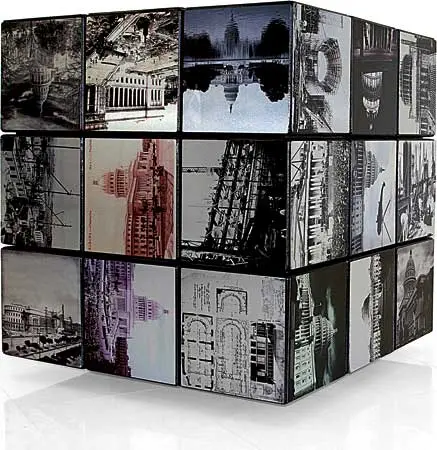
Kadir’s realization that photographic images have the power to influence and shift the perception of reality leads him to continually exploit this tension in his work. For him, creating in a serial fashion provides a way to both penetrate deeper into an idea and present him with a technical challenge. Able to develop a proliferation of images based on a single matrix, we see the persistence of this theme in his next two series, Havana Monopoly/Habana Monopolio (2012-2014) and Rubix (2012). Working in a large-scale format, Kadir continues to use the photograph to create a dialogue between the past, present, and future using the visual referent of the game. Revisiting the idea of the choteo from his artistic past, as well as recalling Cuba’s former position as a dominant player in the international market, the series considers the precarious nature of power in economic and political realms.
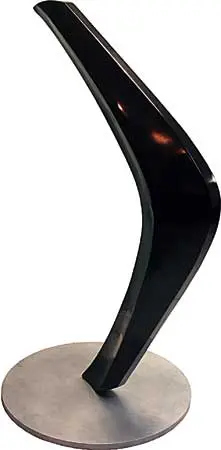
Ever restless and introspective, Kadir has mastered the ability to translate his vision into reality and searches for new materials for this expression. Having reached the apex of his work with photographs (for the moment at least), he returns to sculpture with Opposed and Boomerang. Working in bronze, a substance unfamiliar to him due to its scarcity on the island takes him back to his days as a student.15 Discovering the language and codes of unknown material is a great challenge and one that Kadir is thrilled to undertake. He resists translating his pictorial work into this new medium, trying instead to find all the possibilities inherent in the material. Creating a continuum with his existing body of work, his preoccupation with discovering beauty in contradiction allows him to create art from disparity. As his country also forges ahead in its struggle for reconciliation, recognition of the present as a bridge between the past and future proves to be the way forward.
NOTES
3. Ibid: 100.
5. Camnitzer: 135.
6. Weiss: 106.
7. After the initial migration in the early years of the Revolution, Cuba experienced two more major waves of people leaving the island: the Mariel Boatlift in 1980 and the Balsero crisis in 1994.
8. The inspiration for this idea is based on the concept of the space-time continuum. For further reading see Gravity Probe B: Testing Einstein’s Universe. Stanford University, Stanford, CA. http://einstein.stanford.edu/content/relativity/q411.html (accessed: June 30, 2014).
9. Catoira , Patricia. A Recipe for Modernity in Cuban Counterpoints: The Legacy of Fernando Ortiz. eds. Mauricio Augusto Font and Alfonso V. Quiroz. Lanham, Md.: Lexington Books, 2005: 181.
10. It is estimated that Havana had over 300 movie theaters at the time of the Revolution in 1959.
11. The text, along with the sole figure of Fidel Castro, was seen on billboards all over Havana. While the imagery used was stark and to the point, the ambiguity of the text could be construed as both a denial and an attempt to assuage the problems.
12. Definition from Dictionary.com. Collins English Dictionary - Complete & Unabridged 10th Edition. HarperCollins Publishers. http://dictionary.reference.com/browse/palimpsest (accessed: June 30, 2014).
13. Clavijo, Raisa. ”An Interview with Kadir López.” Art District Magazine. http://artdistricts.com/an-interview-with-kadir-lopez/ (accessed June 30, 2014).
MICHELLE NAIMO BIRD
Art historian.