
While Tomás Espina’s work is recognized for its strong symbolic charge and unfolds in a variety of media such as drawings, paintings, post-photographs, installations, photo performances, and video performances, it is most closely identified with one material: gunpowder. Not many have, like he did, followed Duchamp’s suggestion of experimenting with non-traditional materials, including coffee, tea, chocolate, cigarette smoke, or shaving foam.
A Plural Proposal
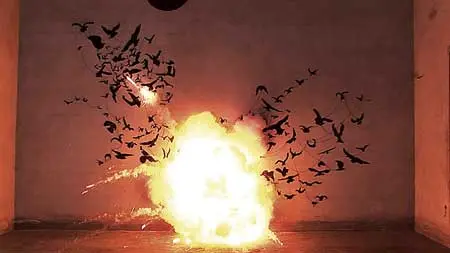
With its capacity for random expansion, gunpowder served to represent everything from scenes of street repression to flocks of pigeons launching into flight, contributing its value as a symbol to the intensity of the proposal. Some works using gunpowder would have an abstract appearance; such is the case of Mancha (2003), a small 35 x 45 cm work that brings to mind Alberto Greco’s informalism, which turns matter into the main event in a painting. Beyond the virtual nature of all representation, they both bring reality into their work. This is the foundation for Greco’s Vivo Dito and other works in a neo-Dada key, where he had a dog walk on the canvas or himself urinated on it in an extreme attempt to de-sacralize academic practices.
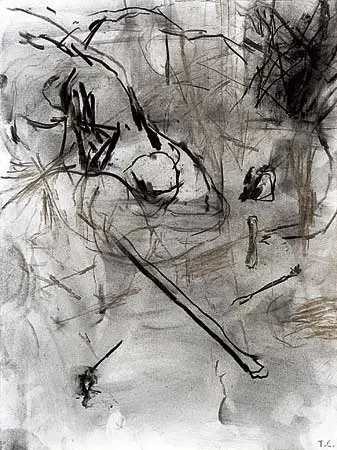
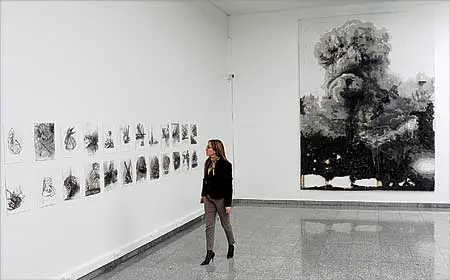
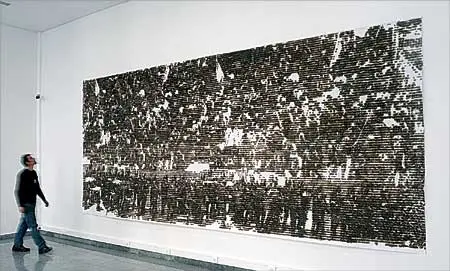
It is not by chance, given this interest in the matter and its metamorphoses, that some of Espina’s projects find their motivation in alchemy. Nigredo (2008), the title for a set of 32 small charcoal on paper drawings (40 x 30 cm.), harks back to one of the alchemical stages of the transmutation of matter. The series was exhibited at Sala Gasco Arte Contemporáneo in Santiago de Chile in 2009, in a show that reflected the diversity of formats, themes, and materials in the artist’s production. Alongside the series of small works were two large works made with gunpowder: La gran nube (400 x 300 cm.) and Caterva (273 x 640 cm.). While the small drawings sketched fragmentation, the irrepressible cry of the dismembered body, the explosion of the cloud appeared as an implacable unit inundating space.
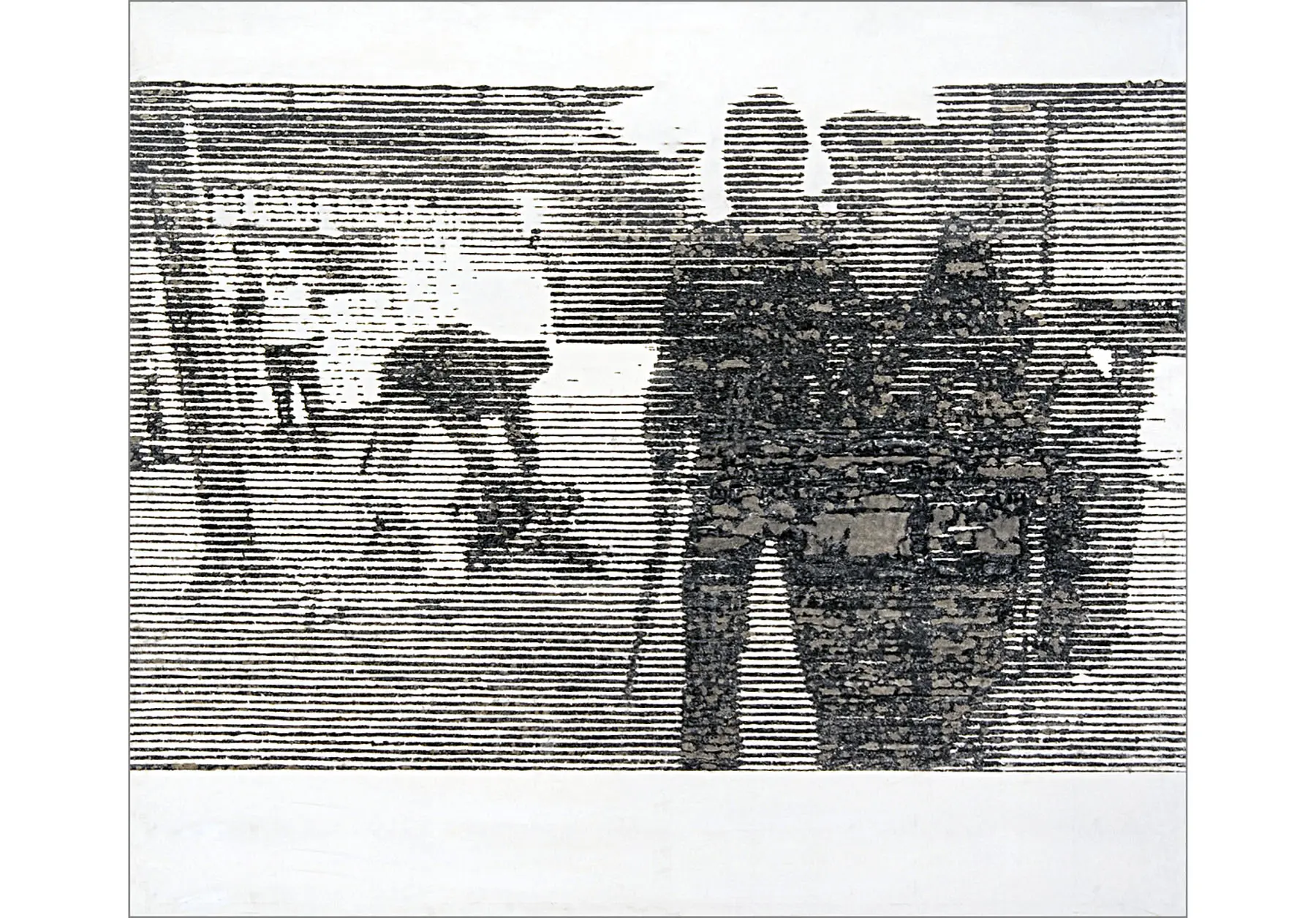
In the case of Caterva, the fragmentary vision came from lines that broke the continuity of a documentary photograph recording a street rally. At a distance, and with a certain difficulty, it was possible to visualize a flag-weaving multitude confronting a line of police; close up, the narrative is vague. It is as if the fate of all images were, in the end, none other than their disappearance.
A Critical Look at the Present Time
What is the place of Tomás Espina in contemporary Argentinean and Latin American art? It is clear that in the 2000s his name left a mark with a body of work that sustained one quality of the region’s production, what was known as a “strong image of Latin American art.”
Born in Buenos Aires in 1975, he has a Chilean background on his mother’s side. Between the ages of 7 to 16, he lived in Chile; before, due to exile, he lived in Mexico and Mozambique. It was only at 16, two years after his mother’s death, that he returned to Argentina.
Dating from 2001, S/P & S/T is a photograph where Espina intervenes a well-known photograph by Ernesto de la Cárcova, Sin pan y sin trabajo. The first step was to draw it in charcoal on his studio’s wall, leaving the space occupied by the female figure blank; then, Espina who with this work won the second edition of the Banco Ciudad Prize placed himself in that spot, naked. His intention was to hang this photograph as a poster in the city, and on occasion, standing next to it, to “autographically” support protest actions such as those by workers fighting against the closure of the Brukman textile plant in 2003. Espina questions the use of stereotypes in de la Cárcova’s painting, among them the woman’s attitude of passive resignation. In the original painting, we see the tense expression of the worker seated at a table on which manual labor tools lie, as he contemplates through the window an industrial landscape. At the other end of the table, a woman holds a child in her arms, her gaze lost in the distance.
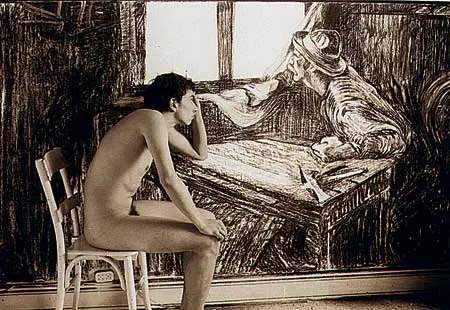
This photo performance with Espina as its protagonist turned into a video performance where the passivity of the woman becomes restless activity. I WASH, I COOK, I SEW, STRIPPER, ACROBAT are some of the signs used by the artist to advertise his services. His posture is uncomfortable. Actively naked, he holds not a child but a loaf of bread, which he obstinately tried to hide for fear that it be stolen. In this way, Espina actualizes the content of de la Cárcova’s painting in the context of the Argentinean economic crisis of 2001.
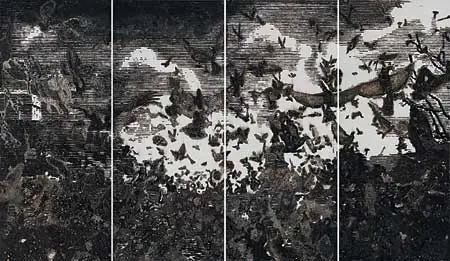
It was precisely in the context of that crisis that the execution by firing squad registered by Espina in 26 de junio de 2002 (Los Fusilamientos) took place. This work inaugurates a cycle where gunpowder serves to indicate a colossal violence, as evidenced for instance in a photographic report that spread through the mass media. It presented the moment in which a policeman shot Darío Santillán, militant of the MTD (Jobless Workers Movement, in its Spanish initials), in the former Avellaneda station, close to the Puyrredón bridge that connects the city of Buenos Aires with its suburbs.
By introducing gunpowder, Espina adds to the virtual character of photography the materiality of the real. Our reading of this coupling becomes difficult as the image is interrupted by lines, excavated in the material, that repeat horizontally. The incorporation of the engraver’s technique characterizes a large portion of these works in which Espina uses gunpowder to intervene photographs.
We could see in them a critique of the technical reproducibility that, as it documents, pushes us away from the event. The camera in this way becomes a sublimation of the weapon or, to put it in Susan Sontag’s words, a “soft killing” explained by its essence as a “double,” this is to say, as appearance.
The specific event to which Espina is referring in 26 de junio de 2002 (Los Fusilamientos) adopts the more general shape of a symbol in Pájaros (2006), where a flock of black pigeons takes untidy flight in a space blighted by burning. In the same symbolic perspective, and close to Goya’s aesthetic, is Van a volar (2007), an intervention in the Ferrocarril Oeste storehouses. On the wall, Espina represented a flock of birds; he added gunpowder and entwined the images with explosive fuses, recording in a video—now in the MALBA collection—the spark’s advance. It is a multisensorial proposal that joins vision and hearing (with the sound of fire as it expands).
The Triumph of Death
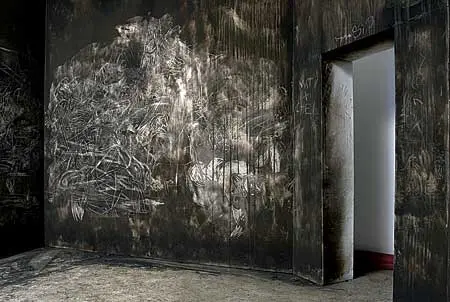
In 2007, Espina created a series of drawings inspired by Brueghel’s The Triumph of Death, a painting to which he returns to time and again. This is what happens in Habitación Quemada (La furia de Léucade), with which he won the Petrobrás Prize (2009) at the ArteBA fair. This was not the first time the artist used the burning of a room in his work. In 2005, for the BUM show at Centro Cultural de España in Cordoba, he deployed a similar strategy.
For the Petrobrás Prize, he used a square room, 400 cm on each side and 360 cm in height, lit solely by a 25-watt lamp. The execution of the work begins with the ritual of moving around with lit tar in order to stain the white walls. Then, Espina draws on them by extraction, using his fingers, elbows, and a wine-bottle cork, among other instruments, to take away matter.
Viewers entering the dimly lit space were able, after a few minutes (as pupils dilated), to distinguish drawings alongside pieces of tar strewn on the floor. If armed with the necessary information and skill, viewers would have recognized fragments of Brueghel’s The Triumph of Death.
The nocturnal aesthetics of this “burnt room” gave way to an experience of disquiet, oppression, and anxiety that not all visitors to ArteBA were ready to accept. This is because the dissolution of the images of extermination continued on the viewer’s own body, which could barely be seen. Perhaps to reassert their presence, some instinctively fell back on the gesture of drawing a sign on the wall, using their fingers. Thus the “fury of Léucade” was to be imaginarily canceled. We need to remember here that the rock of Léucade was the place where unrequited lovers, devoid of hope, threw themselves to the sea. I chose that subtitle,” Espina explains, because that burnt room can be read as the instant, the very second prior to death, as the last breath of despair. I could have chosen "The despair of Léucade,’ but I thought that ‘fury’ works better with fire, no?” Like the rock of Léucade, Espina’s installation was a place of passage and he, like Hermes, operated like the messenger and guide on our way to Hades.
Small Stories of Major Violence
Espina’s draftsman vocation was manifest in the Nigredo series, mentioned above, and in Alcaebza ed Surgenda, a kind of anagram of “La cabeza de Rugendas” (Rugendas’ head). This installation, presented at the Mercosur Biennial in 2009, salvages a moment in the life of Mauricio Rugendas (1802-1858), a German explorer and painter who represented with great fidelity landscapes and customs of different regions, South America among them. As his companion Robert Krause tells us, Rugendas suffered a grave accident when he fell from his horse, an event César Aira animates with images from his own fantasy in Un episodio en la vida de un pintor viajero. Aira’s text had an impact on Espina, who felt a fatal identification with the traveling painter’s state of mind. Alcaebza ed Surgenda resulted precisely from that identification. It is a series of 127 charcoal drawings, 48 x 36 cm, suggesting the intense pain that Rugendas had to ameliorate using morphine, despite its hallucinatory effects and the mental confusion it caused.
Espina uses abstract shapes of great dynamism, assuming the difficulty—and even the impossibility—of representation. What is the shape of a cry or a howl? In this way, he retains Rugendas’ concern with capturing “from inside” (from a visceral space), with quick drawings and sketches, the speed of the malón, the name given to surprise Indian raids in Argentina.
The 46 drawings from the Alcaebza ed Surgenda series on exhibit at the Mercosur Biennial were a “visual explosion,” like a projectile directed towards the eye of the viewer. The fragmentation, the foreshortening, the multiplication, and the vertiginous acceleration brought to mind the way in which Rugendas represented the malón.
The portraits that Espina made in Unquillo can be considered a “pause” in the middle of a poetics of revealed catastrophes. By the end of 2009, he returned to the city of Cordoba, where he spent his adolescence before moving to Buenos Aires for his education as an artist.
The series Retratos sociales, projected with Syd Krochmanly, was exhibited at the Lino Enea Spilimbergo museum. It was the result of Espina’s weeklong exploration of Unquillo’s streets, bars, parks, and restaurants, armed with an A-4 notebook and charcoal pencils. A compulsive portrait maker, Espina captured the image of students, office workers, functionaries, painters, merchants, street peddlers, casual laborers, bank employees, etc. On opening day, 118 of his “models” were able to see their faces as works of art in a museum. But the project took the shape of a work in progress when one hundred new characters had their portraits made in the museum itself. Finally, the show, which combined a festive element with the cultural phenomenon of social networking, was completed with the projection of a video recording moments in the history of Unquillo and the process of the construction of the work, thus highlighting its socio-anthropological axis, which attended both to the portrait subject and the concepts of “place” and social fabric.
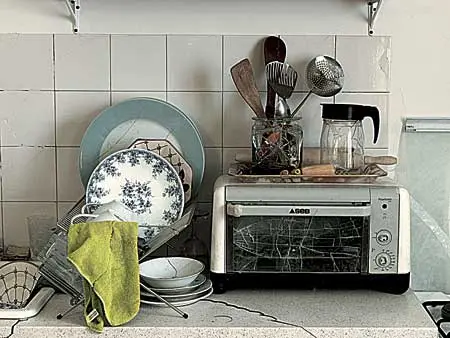
Another “small” story that referred to as the place of belonging is what we find in Dominio, one of Espina’s most significant works, made in collaboration with Martín Cordiano. Acquired by the Geneva Museum of Contemporary Art, it was exhibited there in 2012; a year later it participated in the Istanbul Biennial, which for that edition was provocatively titled Mom, am I a Barbarian?
Dominio spoke of home, of the domus, the domestic as the practice of place, of inhabiting. Houses are built; homes are inhabited. What makes us build is the ontological possibility of inhabiting, not the other way around. The domus is constituted as a relational space, a place of encounters and misencounters, of effects that sustain and fears that destabilize.
Espina’s and Cordiano’s installation was presented as a common environment with an integrated kitchen, two exterior windows, a couple of posters on the walls, books on painting, and literature dispersed on the furniture crammed with porcelain dinnerware. However, as viewers advanced and observed the installation more attentively, they would note in each element the traces of breakage. Unlike Liliana Porter’s installation El hombre con el hacha y otras situaciones breves (2013), presented at MALBA, in Dominio, broken things had been carefully repaired. Each fragment returned to its place as part of a “cured” object once again operating as useful even as destruction left the indelible mark of its vulnerability.
History as a narrative that does not close
Among Espina’s most recent works is Geometría sagrada. The project, presented in late 2013, suffered a series of problems that impeded its inauguration, although this undesired fact can be considered perhaps an involuntary part of the work.
Along with nine other artists, Espina was invited by Argentina’s Ministry of Culture to install works in the city of Bariloche. Working In situ (that was the title of the Ministry’s project), what most forcefully grabbed his attention was the monument to Julio A. Roca. A politician, soldier, and President of Argentina, Roca was the author of the Conquest of the Desert, in which a number of indigenous people were exterminated. It’s no surprise that the monument to this nefarious character has been the focus of vandalism. Espina’s inquisitive gaze, however, discovered the great unhappiness that lay behind the pathetic bronze figure. His proposal was to make it visible. To that end, he built a bridge over the monument in order to provide new viewing angles. The day after it was set up at the Civic Center, and when half a day of work was still needed to finish it, a wave of supermarket lootings exploded and the city was declared in a state of siege. The authorities ordered Espina’s work to be dismantled because of a supposed threat to burn it down, although in fact protesters had installed tents under it and filled the space with banners clamoring for legitimate work. In the event, the bridge was dismantled and never inaugurated. Nevertheless, Espina considers it an “important gauge” to measure the large social differences that exist. “These differences,” he says, “was what I was essentially proposing to overcome in my project. However, I realized that it is much more difficult than I imagined; it will take much more time, but I am certain it will happen.”
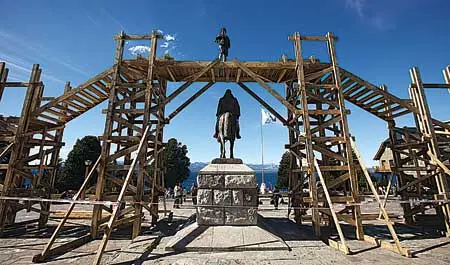
Espina explains that the title Geometría Sagrada “responds to the fact that the Mapuche had the four directions as the ritual axis for their ceremonies. Later, the conquistadors imposed a binary logic (characteristic of Western culture), with north and south as opposites, and this is why the Roca monument is situated facing north. For the Mapuche, north symbolized evil and south symbolized good, and the only way for those forces not to be in conflict, the only way for them to harmonize, is to incorporate east and west; this is to say, to make a cross.” In building a bridge that crossed the monument east to west, Espina reestablished the original cross. Thus the title, “Sacred Geometry.”
With the great diversity of techniques and materials, Espina reminds us that all authentic art is political in the sense, noted by Walter Benjamin, of “combing history against the grain,” of questioning the grand narratives of official history. To say it in the words of Theodor Adorno, authentic works of art bear the seal of “negativity,” take us out of what is habitual, and in that way propitiate transformations. But while, in general terms, all works of art are political, not all thematize the relationship or make it explicit. Espina does this by centralizing aspects that are inherent to the political: violence, power, manipulation, without this canceling other idea brought forth as counterpoints to the sacred, restitution, healing, and human resilience.
ELENA OLIVERAS
Elena Oliveras holds a Doctorate in Aesthetics from the University of Paris. She is a member of the Argentinean Association of Art Critics and the International Association of Art Critics. She is a member of the National Fine Arts Academy, Argentina.