
While many approaches can be used when
reviewing an exhibition, there are two lines of thought that a critic must not
ignore: one for those who have not seen the show and another for those who
have. Tunga is an artist who provokes strangeness in a poetic manner. By
analyzing his work system it is possible to observe that he integrates certain
elements in his pieces from different worlds—crystals, sponges, rubber, wood,
bronze, glass vessels, and ceramics—that he combines to create a new entity.
There is nothing free or contrived about his work; on the contrary, they are
austere and evocative in a minimalist sense. Tunga uses his gaze to exercise a
sensual simplification of the history of mankind, art history, and the history
of materials. Therefore, in this fifth solo exhibition at Luhring Augustine,
viewers find themselves overwhelmed by the materiality and dematerialization
that they are confronted with.
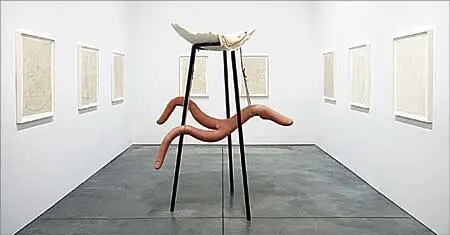
Strange characters inhabit the exhibition rooms. Each new look at them reveals something new—birth, death and amputations, damage, cuts and healing, connection, association and memory, groups, triads, fragments, fingers, faces, breasts, and phalluses. It is heterosexual conjunction in which each sculpture contains communicating vessels, gestations, and approaches. How could one best classify each of these new beings presented by Tunga? Are they entities, sculptures, installations, or “instauration,” as the Brazilian artist calls them? As “entities,” they represent work and creation. As works of art, they are sculptural forms because some parts are carved, modeled, or casted; characteristics that inform us of the use of sculptural processes and techniques applied in these works to create forms that are more arcane than modern. Each piece is also an installation because it interrupts the space. We cannot go through them as they create different islands or continents.
Lastly, and to use Tunga’s vocabulary, these three-dimensional works are “instaurations” in that they are established and revealed as a new entity. Here the word “love” is a connecting factor that generates a third being from the union of two others. It is undeniable that the trio, the tercet, is markedly present in the exhibition, either in the vertical elements of the tripods and their rings or in the horizontal elements. The tripods merge the ideas of supporting, displaying, collecting, interrelating, and articulating several elements and materials. Hence, in these anthropomorphic works by Tunga the tripods act as structures with a double value that generate a new relationship between human nature and vegetable, mineral, and sidereal nature.
The adjacent exhibition room contains eight ink drawings on Himalayan handmade paper that coexists with a three-dimensional work mounted on a vertical tripod with a single horizontal ring—unlike the others which have three. This sculpture-installation-instauration has few elements: a bowl, a folded cloth, tile, hooks and a trio of knots. The drawings are framed and placed on a wall in a traditional manner. They are outlined on the mirror and the author considers that the line is independent of the background. These are gestural drawings in that they are part of the same labyrinthine line in which the beginning and end are attached. Tunga made eight drawings before he created the “instaurations.” In The Humid Way the anthropomorphic predominate even in the title. The organically human does not appear in the form of realistic representations and the abstract derives from organic-symbolic forms—bowl-matrix and drawing-blanket—to receive the new being. There are fabrics—linen—in several instaurations, some of which are extended while others are folded. The opened ones hang from any of the additions, expanding the sculptures-installations and revealing that they are drawn in a different way.
The entire exhibition centers on an even tonal range that gravitates toward marine colors. White predominates and black inhabits the lines of the ink drawings, tripods, hooks, and metallic resources. The terracotta is used as a color and as material; it is earth and to some extent, it also alludes to the carnal: There are a few leather ropes that confirm the organic and the skin. There are translucencies of quartz and resins, as well as bronzes with greenish-blue-aqua patina. The artist makes us subscribe to, and find ourselves in, everything that we have been observing in the visual arts. While the primitive and the ritual are present in his work they escape usual presentation/representations. Tunga develops neo-conceptual surrealism outside traditional references. He includes counterposed meanings in his work and shows ephemeral materials in their raw state or, as he has been doing for many years, transformed into resistant elements covered with a more perishable material—cast bronze objects covered with terracotta, for instance. The ritual is present in all the works by Tunga. In them, the element of time becomes a poetic vector for preparation and execution that works with opposing materials to generate a new sunrise.
GRACIELA KARTOFEL