
Trans-visible (entre lo ya no y el aún no), the title
selected for the 19th Paiz Art Biennial in Guatemala, is a reference
to French poet Serge Venturini, who coined the word to name the threshold
between the visible and the invisible, the transition between dream and
wakefulness, and poetry of becoming and transhumance. The title also alludes
to transdisciplinary artistic practices and cultural processes related to
transgression and horizontality. Crucially, however, the curatorial team
invokes a poet and a collection of images inflow, unstable, in order to shape
the four categories that are to unfold across the various sites of the
biennial. This linguistic or literary drive goes beyond the title. For example,
the book/catalog for the biennial includes poems by artists Regina Garrido and
Jimmie Durham, and one of the exhibition’s most complex curatorial categories
is Specificities that name themselves,
defined precisely by their resistance to being named. The parenthesis in the title (entre lo ya no y el aún no, “between
the no longer and the not yet”) describes an interval between two instances
that have yet to reach their best definition. It is an attempt to speak of the
present in the present, without obscuring the tautology implied in this
exercise, its difficulties, or its potential for contradiction. This image of transit between bodies and contexts traverses the three remaining curatorial
categories (Healing and Self-Knowledge;
Masculinity and Violence; Body/Territory/Sexuality).
Most of the biennial’s almost fifty participants come from Guatemala and although the selection is dominated by artists born after the 1980s, this is a multi-generational exhibition that includes artists like Margarita Azurdia (1931-1996), a painter, sculptor, and pioneering performance-art practitioner, as well as artists with a recognized career like Moisés Barrios and Aníbal López, the latter recently deceased. With a decidedly local bent, the biennial doesn’t seek to capture a moment in contemporary art but to account for the complex social and cultural dynamics in which it itself is inscribed. Local, yes, and with a clear desire for openness, the show established dialogs both inside and outside, with such dissimilar artists as Jimmie Durham, Terike Haapoja, Leandro Katz, Nuno Ramos, Francesca Woodman or, closer to home, Adán Valecillos, Mariana Castillo Debald, and Chemi Rosado.
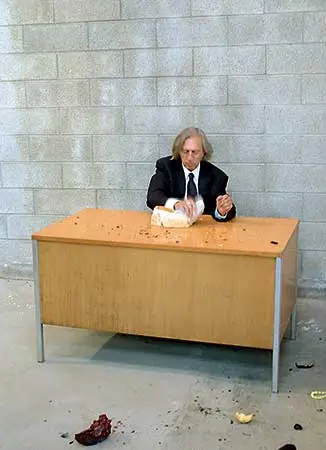
Exhibition strategies and the (vitiated) ways in which art circulates have a terrifying political potential that is even more exacerbated when what is on display are “cultural objects”. Many of the works included in the Specificities… section reflects upon, discuss, or parody the museum apparatus and the strategies deployed for the representation of indigenous cultures. Shooing away all localism, one of the first works encountered at Palacio de Correos is Smashing (2004), a video by Jimmie Durham, a Cherokee artist deeply involved with indigenous people’s struggles in the Americas. Smashing is the record of an action in which Durham, sitting behind a desk, smashed one after another a series of objects placed in front of him. The objects vary in relevance but the procedure is always the same: a person places something in front of the artist, who uses rock in his hand to crush it repeatedly, and then gives whoever brought him the object a signed and sealed document. The absurdity of this asymmetrical, savage, and the bureaucratic transaction is emphasized by the artist’s seriousness; the action shakes up notions such as rituality, technology, and authenticity. Prospero and Caliban (the civilizing subject and the savage) coincide in the gesture that stamps an official seal or crushes an object.
In the same gallery, Manuel Chavajay presents a series of ceramic objects on which he has drawn scenes of massacres suffered by indigenous communities in Guatemala. The objects hang from the ceiling by nylon threads, and a map drawn on the wall offers clues and explanations about the events. In a video, part of the same series, Chavajay shows the process of cooking clay in open-air burnings, and his title evokes, poetically, the moment when the clay makes contact with water and liberates its aroma. Chavajay’s insistence on matter, technique, and doing contrasts with Durham devastating video, and the biennial seems interested just in such dialogs and contradictions. From its prelude, the show takes into account confronted visions of the object (actualized or crushed), suggesting a wider understanding of materiality and its immediate relationship with the context. Or, to put it more clearly, how an object preserves or dilutes its communitarian and symbolic value when it is presented in an art biennial. This inescapable question is formulated also thanks to the work of Manuel Pichillá or the duo of Calel and Sotelo, later in the exhibition.
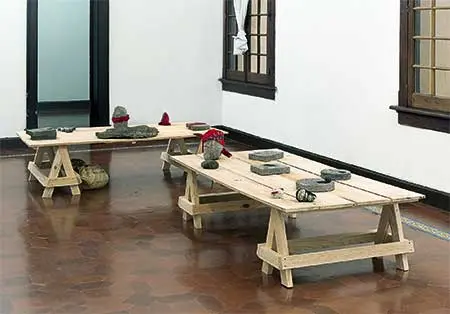
For his Glyphs (Contemporary Archaeology), 2014, Pichillá built two wooden tables as altars for the presentation of ceremonial stones he has transported from his community to the exhibition gallery. Some of these stones are carved, others are covered by thread or fabric and present traces of soot or candle wax. Pichillá intends to challenge the archaeological fetish in order to reveal “the authenticity of use,” and he does this without providing clues about the ceremonies or rituals in which the stones were used. The “contemporary archaeology” he suggests does not explain its objects, and it doesn’t feed any didactic fantasy of the exotic. But, how are the object, its value, and our reading of it transformed with the shift in context? To what degree is the transport of these stones, their move from a familiar to an institutional context, sufficient to preserve their ritual character, which is essential to the artist’s logic, as noted in the technical card? The operation ideated by Pichillá for Glifos is paradoxical in the end: it replaces the archeological fetish with its anthropological counterpart, replacing an authenticity for another without truly questioning the notion of the authentic, the exotic, and other univocal fancy terms. This transversal drive against unidimensionality is one of the biennial’s most forceful proposals, although it is not present in all the works with equal solvency or effectiveness.
The proposal developed by Juan and Ángel Poyón also speaks of authenticity and its fiction. The artists grouped objects of varied origins, scale, function, and complexity, all alluding to Maya culture, and presented them in a large installation, Colección Poyón. The voracious collection includes caricatures, books by Guatemalan Nobel Prize-winning writer Miguel Ángel Asturias, photographs by celebrated photographer Luis González-Palma, kitsch trinkets made for tourists, t-shirts, magazines, pictures of Maya-style architecture, videos ranging from documentaries to the popular Mexican TV Show El chavo del 8, and a large and multifarious etcetera. The provocation of this gesture—displaying a series of objects carrying different ideas and stereotypes about the Maya—is quickly exhausted by the lack of intentionality in their staging and the unbalanced selection, which offers very few contrasts and nuances. The banality—or rather, the repetition of the same kind of banality—in many of the objects doesn’t in the end build a constellation or outline an unexpected panorama. But the benign mockery of the museographic order of the Colección Poyón does set in black and white the question about the limitations of the object as representative of a culture, and the truncated methodologies at hand for the exhibition of a living culture.
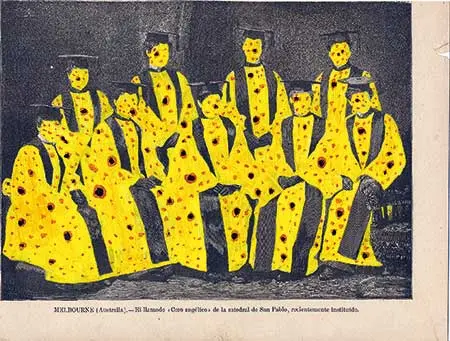
For decades, Moisés Barrios has investigated the fruit business in Central America, the political role of transnational firms in the region’s “Banana Republics,” and their iconographic games. In his Serie Europa, the artist starts with single pages from old books or magazines illustrating domestic situations, portraits, or local customs, which he partially intervenes with yellow acrylic. On the yellow, small black stains evoke both the maturing peel of a banana and a sickly, pustule-covered human skin. This bananization of the image proposed by Barrios makes explicit the corruption of the image and its putrefaction. It is a slippery reminder of the relationship between European life and that other skin of colonial history, and it is strategically installed in a small room every so often filled with the aroma of fresh or fermented fruit coming from Edgard Calel’s and Rosario Sotelo’s installation Abuelos.
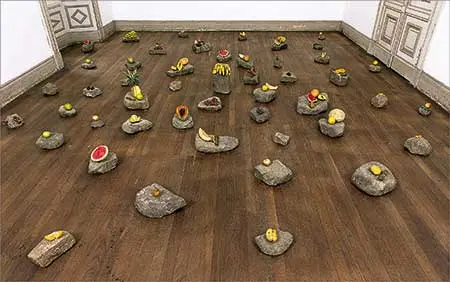
This work by Calel and Sotelo evokes fruit as part of a gratitude ritual, freeing it from narrow functional readings and embracing its symbolic potential. For its realization, the artists transported seventy rocks from Comalapa to Guatemala City, and placed on each a fruit to create a kind of miniature forest on the arid landscape the rocks created in the gallery. Abuelos responds to a ritual action described by the artists in the accompanying card: “It is our Toj or tribute for the weight of our bodies and what our thoughts generate.” The installation presents a combination of vegetal and mineral elements and impregnates the gallery with a fertile, at times decomposing aroma. Questions about the materiality and the specificity of the context seem more alive, more dynamic, and also more vulnerable since the fruit must be replaced each week.
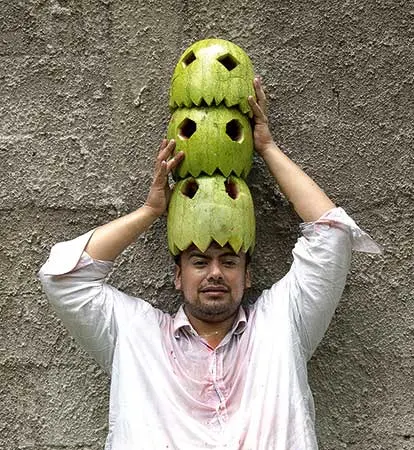
Tres fantasmas, the video performance presented by Naufus Ramírez, is projected on a monitor in an adjacent room. It shows the artist carving watermelons to create the figure of the ghost from the Pac-Man games so popular in the 1980s. María Lionza, El Negro Felipe, and El Indio Guaicaipuro are the three ghosts alluded to in the title (racial ghosts, let’s insist), invoked via the foreign, de-racialized, electronic image of a videogame that contributed greatly to visual culture in a large part of the world, including Guatemala. In the final minutes of his performance, the artist places three watermelons on his head, and these barely stay for a few moments before falling to the floor. Naufus shifts the context and the origin of the references associated with the autochthonous, the rural, and the supernatural, to create an unexpected genealogy that is impure both in racial and spiritual terms and converses (at least during the biennial) with the Maya Grandparents and the characters of the Europe Series.
Masculinity and Violence
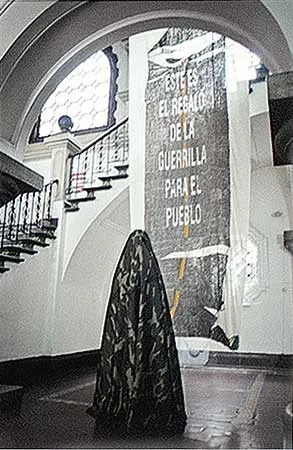
A certainly more literal ghost is the protagonist of the series of eight photographs presented by Mario Santizo, El fantasma de la posguerra visita…, where a body covered in camouflage fabric, presumably the artist’s, appears in various locations. The ghost is not discreet; he poses openly in these portraits, like a fly on the wall disdaining or presenting the scene. His presence is raw, at times comical or grotesque. Santizo’s ghost is even harder to see than a civilian ghost, clad as it is in an outfit designed to fuse with its environment. What terrifies is not only its ubiquity but its adaptability: we see him at the Museo de Historia, alongside national heroes, paintings, and mannequins; we see him also in different spaces in the Biennial, even inside the same room where the work is on exhibit. This extreme game of literalness (“hi, I am even here”) puts the biennial itself in perspective in connection to the construction of History (capital “H”) in the National Museum. Santizo wants to make the double fold visible, the camouflage imposed on the ghost, two different ways of negating the visibility of a body that render it evident.
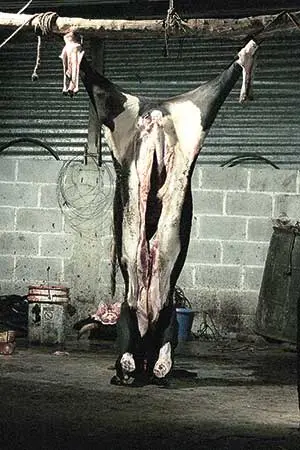
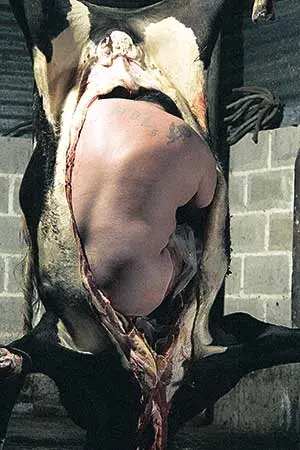
A brutal and metaphorical view of the body (and of painting) is powerfully articulated in the room that hosts the work of Jorge de León and Terike Haapoja. For his video Estudio de Luz y Sombra (2014), de León did a performance where a nude figure is introduced inside a flayed ox hanging from the ceiling, in a clear allusion to Rembrandt’s The Carcass of An Ox (1655). De León doesn’t enlarge or falsify the action. He enters the animal’s body with difficulty and without prettifying the scene and remains there for a few seconds before being expelled, birthed by the ox. It is not a choreography or a performance exploring the physical limitations of the body. Neither is it a mystical or ritualistic performance, or an appropriation of Rembrandt’s painting (the performance recreates the actions in the small oil study, which de León presents alongside the video, but its colors, tone, and composition structure are different: the body of the artist inside the animal is the central figure). The open body of the animal presents itself as an outsize vagina that de León is able to inhabit for a few seconds. The small, emotional, cold painting is illuminated only by the reflections from the video. Without any formal pretensions, this lighting of the painting by the video documenting a performance materializes the tension between disciplines and bodies suggested by the Biennial’s title and amplified in the work of Naufus, Marmolejo, Ramos, Santizo, and in Terike Haapoja’s Entropia video.
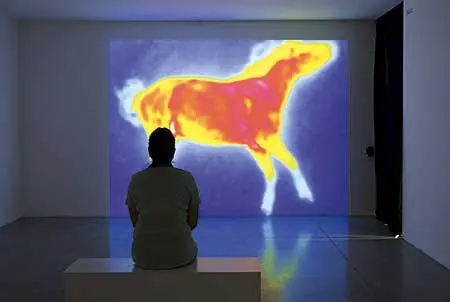
Entropía shows the process of a horse carcass cooling down, recorded in infrared light. The original recording, nine hours long, has been edited down to 25 minutes. Against a violet-colored ground, we see the outline of the horse in high contrast, visually clashing with the acid, technological hues of the infrared lighting, and the more visceral sepia and gray tones of de León’s video. This continuous loop, coming in and out of a body, constructs the image of the transvisible that informed the Biennial’s entire curatorial concept.
Healing and Self-Knowledge
According to the brief interview with Walter Mignolo included in the Biennial’s catalog, this is perhaps the curatorial category most connected to the local Guatemalan context. Mignolo, a key theoretician of decoloniality, rejects the European references that abound in the exhibition’s theoretical framework, considering them vague and foreign; rather, he celebrates the concept of “healing,” which he deems concrete and specific. He speaks not only of the colonial wound but of the war.
The Biennial understands healing in personal, social, and cultural terms, and it features works centered both in private and public stories, operating at the social level and on the psyche and the individual ego. A good portion of these works lean, perhaps with excessive faith, on the therapeutic possibilities of art, showing more or less deep wounds and more or less original resolutions. True, a view of healing implies walking a careful path through a minefield (a hackneyed one at that), filled with ostentatious mechanisms for the participation of the audience, which in exchange receives experiences that are rather simple, mundane, and easily accessible in other, non-artistic domains.
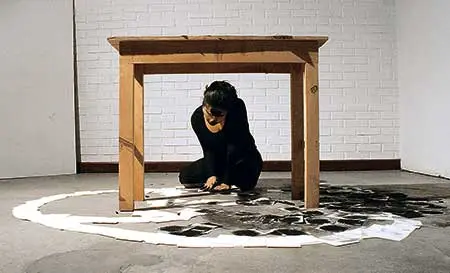
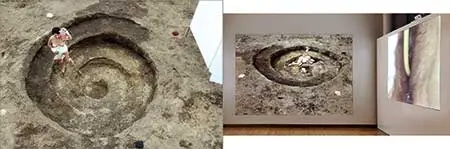
Celebrating two pioneering women, this section begins with Ana Mendieta (Corazón de Roca con Sangre, a 1975 film) and a series of rituals performed between 1985 and 1995 by Margarita Azurdia (1931-1998), a painter, sculptor, and precursor of group performance art in Guatemala. This lineage of women working on the basis of their own bodies is updated with a project by María Evelia Marmolejo (Cali, 1958), herself a pioneering performance artist in Colombia who is virtually unknown and matter-of-factly forgotten in the history of Latin American art, with an intermittent and barely visible oeuvre. In Anónimo 5, a project conceived in 1982 and only executed for the 2014 Biennial, Marmolejo uses her body as a healing tool in a private ritual here, after connecting catheters to her nose and urethra, the artist ambles through a spiral carved on the ground, then lies down and, in a kind of symbolic trans-fusion, donates her fluids to the land. The action is presented in three videos: the first one features a ritual where Marmolejo asks for the land’s permission; the second, the action proper in the carved spiral; the third, the insertion of the catheters into the artist’s body by a medical team. Frontally showing the medical paraphernalia precludes any idealized reading of the action. Similarly, the super close-ups in which the action is filmed leave no doubt about the physical pain involved, or about Marmolejo’s desire to show the female and feminist agency with which she invests it. The selection of Atitlan as the site for her performance emphasizes the social and political dimensions of Marmolejo’s project, distant from any personal or intimate pretension and open to a social, anonymous body.
Body, Sexuality, Territory
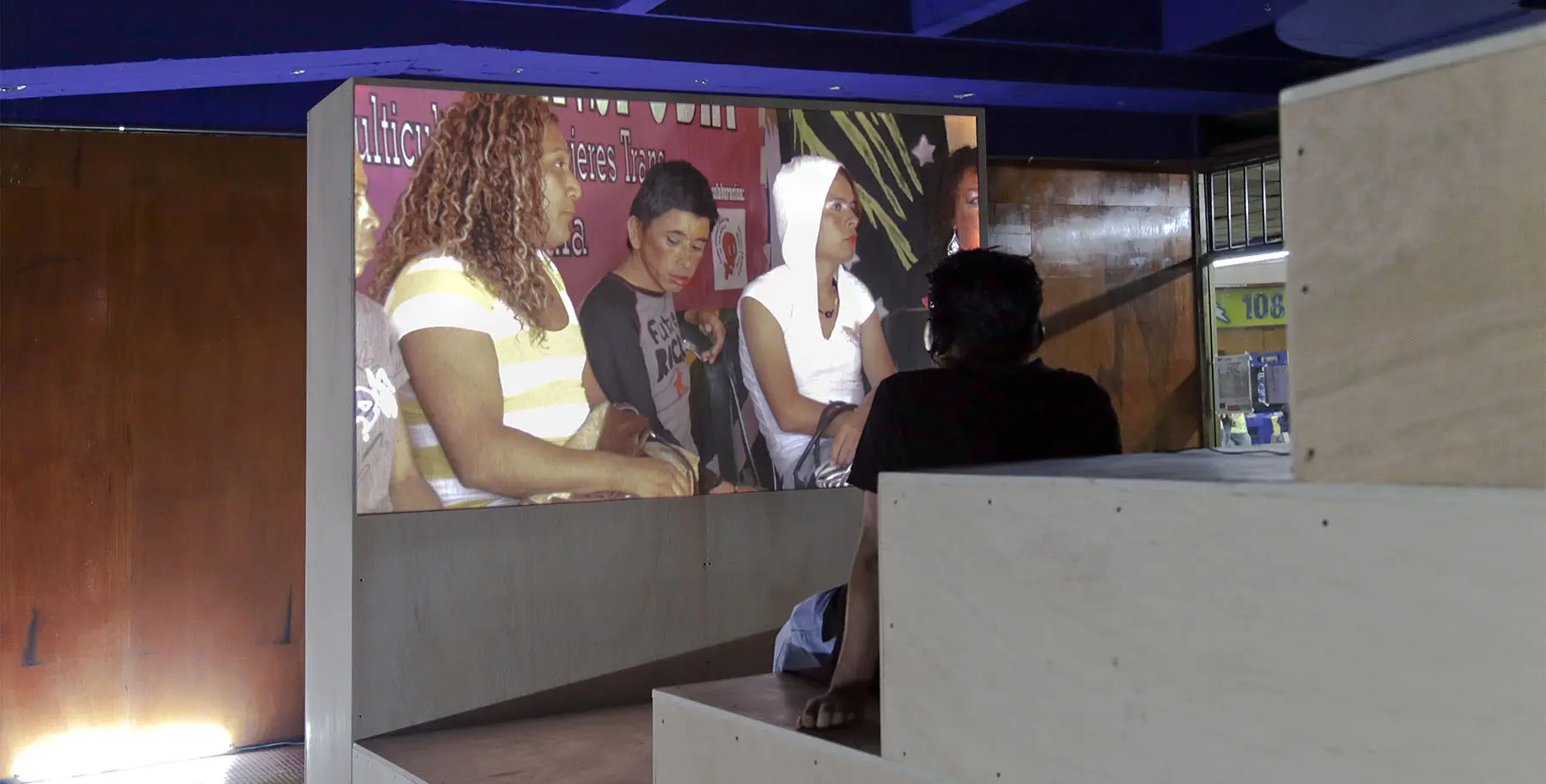
Talentos de Género, Guatemala, a video installation by Colombian artist Carlos Motta, occupied the entire space of Proyectos Ultavioleta, a gallery and meeting space for contemporary art that has energized the local scene. Motta designed a wooden structure that incorporated steps for the audience and a screen for the projection of video portraits of Daniela Lux, Galilea Bracho, Janneth Monterroso, Karla Lux, Marcela Urizar, Niray Velafont, Salma Ruiz, Samanta, and Mayerling. All of them gravitate around Redmutrans, an association for trans women rights in Guatemala, which took Proyectos Ultravioleta as its headquarters for the duration of the Biennial. Although the portraits insist on the singularity of each one of their subjects rather than on the collective cause, Talentos de Género can be read as a choral work that does not erase individualities.
Our reading of many, perhaps all, of the works grouped in this section is blurred by the triad of names it is given. There is a little surprise and less space for critical thought when portraits of trans women are presented under the “Body/Sexuality/Territory” label. It is precise but insufficient. The same happens with the beautiful work presented by Sandra Monterroso, Acciones para abolir el deseo, or Nora Pérez’ photographs of the character named Blondine, or Jorge Chavarría’s portraits. It is possible to imagine many of these works included instead in the Healing and Self-Knowledge section. Isn’t the image of a woman impersonating a transgender male (Blondine) powerful in itself as a form of self-knowledge?
A brief final note
The Paiz Art Biennial in Guatemala has been held uninterruptedly since 1978 under the auspices of a private foundation. The continuity of this project, even during the difficult years of the Guatemalan civil war, is notable and unusual because it reveals the Biennial’s ability to transform itself. A precise history of these changes and their repercussions in the Guatemalan art scene opens the catalog for the 19th Biennial in El estado de la Situación, a brilliant essay by Rosina Cazali, who explored the different exhibition formats employed by the event (from a Salon to a curated show), and how they reflect the reach and limitations of contemporary art in Guatemala. An extraordinary feature of the professionalization of the Paiz Biennial is the complete bilingual catalog that accompanies it, featuring key essays for understanding the debate proposed by the curatorial team, with contributions not only by the curators themselves but also by thinkers, poets, and cultural workers from the region. Among them, Cecilia Fajardo-Hill develops reference frameworks for speaking about the specifics of culture, distancing herself from the multicultural agenda, while Aura Cumes frontally rejects the notion of cultural specificity. Walter Mignolo criticizes some of the curatorial categories, considering them imprecise and foreign, while the poems by Jimmie Durham, Regina José Galindo, and Julio Guerrero offer a counterpoint from the standpoint of language and images. Pablo José Ramírez deploys theoretical tools to think the body under the light (or the shadow) of the works in the Biennial. One characteristic shared by the 19th Paiz Biennial and this catalog that accompanies it and makes it endure is their frank and valiant gambit for dialog.
JOSÉ LUIS BLONDET