
Desvelamientos, an exhibition of
works by Adriana Duque (Manizales, 1968) involves a back and forth between play
and reality, dream and wakefulness, the boundaries of different artistic
supports, and the times they seem to require. In this display of some of the
most recent series of Duque’s photographic oeuvre, we feel invited to spy on the
memory, remembrances, and fantasies of a girl who one day grew up and became an
artist.
Desvelamientos grants us an entry point to a liminal space formed by two inseparable worlds. We walk with one foot in each of them, without either becoming dominant or exclusionary. These two worlds began to take shape thanks to two women of great importance in the artist’s childhood: an urban grandmother who opened doors for her to the history of art, museums, and especially Flemish painting; and a rural grandmother thanks to whom Duque became familiar with traditional country life, homemaking utensils, and female domesticity. Childhood is the point where these two worlds meet; for Duque, childhood is the first journey into the past, which in her work joins other faraway eras filled with Nineteenth-Century romanticism, or the Seventeenth Century, the golden age of Flemish painting, or the Renaissance and its early aristocratic portraits. Through series like Infantes, Retratos negros, Íconos, Antología de una obsesión, or Renacimiento, we enter known but remote spaces. These children depicted wearing period clothes in interior scenes, inspired by the work of Flemish painter Johannes Vermeer, clad in luxurious lace and brocade outfits, refer to a historical time while at the same time evoking fairytales, princesses, and knights, the other side of the coin of the artist’s imagination.
Works like La lechera (from the series Antología de una obsesión, 2013) appropriate the Flemish reference, immediately recognizable, only to deny it all the elements that make it what it is: the light from the window only suffices to make the milk, the girl’s head, and her hand shine. Everything else is covered in black with plays of light and shadow, so that all the elements of the interior scene are transformed into a pure theatrical stage in which, thanks to a spotlight, the artist wants us to see what is highlighted: the figure of the girl, with that tiara often featured in Duque’s work that functions as a wink to the viewer, half princess-like accessory, half adolescent headphones. Blackness acts as a memory box in which the girl has been planted, patiently repeating the milkmaid’s gesture. What we find underneath this uniform tint are the artist’s two worlds: the high-culture world of art and museums on the one side, represented in the girl’s gesture; on the other, interior scenes in rural Manizales, captured by the light beam that allows us to discover the still life and the basket hanging from the wall, both rescued from a reality that Duque has known first hand.
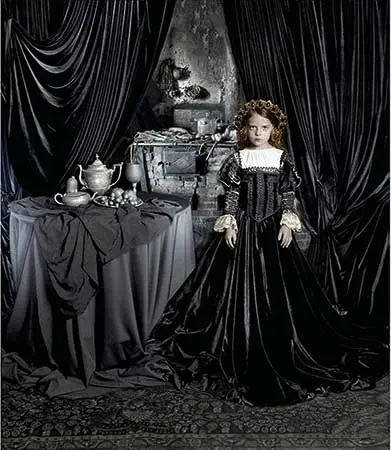
Another example of this strategy by which photography has a foot on painting and another foot on theater, one foot on history and another foot on memory, is María 08, from the Íconos series (2011). A girl, clad like a Renaissance princess, crowned by the same ambiguous tiara, looks directly at us. Accompanying her, arranged with curtains like in a theatrical stage, a still life, and in the background a traditional wood oven. The still life could well be in silver and crystal, like a princess’ teatime set; the rural oven appears as a background and a contrast to the world of supposed nobility. They both comprise the interior scene, in the same way in which both are part of Duque’s memory.
Among the series of photographs, we find two videos, Rosa and La costurera, the exhibition's absolute jewels, which bring images to life. In these videos, time becomes something elastic, more photographic than filmic, altering the rules of the medium. Suspended in the slowness of the image, we arrive almost breathless to the moment when the girl looks into our eyes, only to lower her gaze again, absorbed in her tasks.
As a closing for this experience of nostalgia for history and childhood, Desvelamientos has a final surprise. The series Al otro lado (2010) confronts us face to face with a romantic, gothic Adriana Duque, hand to hand with Edgar Allan Poe, who travels the roads of Toscana in search of a failed love. The series is comprised of mist-filled landscapes photographed from an automobile, as the artist followed that path towards love, and back from disappointment. A reality rather distant from childhood, bringing us closer to the woman she is today. In the end, all the stories and remembrances come from the memory of that adult woman, who, with her camera, situates us at midpoint between the fairytale and the real world.
CARIDAD BOTELLA