
The most delightful
aspect, while at the same time the most irritating, of this well-planned installation performance that deftly negotiates between concept, theory,
physicality, sonority, and visuality is that it is the most fun you WILL HAVE
HAD. It is and was a “future” (or even “conditional”) “perfect” situation. Our
full pleasure and understanding are deferred to a future time through a lack of
considerations we did not know we needed.
This sounds confusing but it is a common fault line in conceptual art, especially here, where the usual problem, the relation between concept and physical spectacle, is well done and proved, once the performers activated the installation, exciting and touching.
Physically, between performances, what the visitor sees on their entrance are ten stone plinths distributed through three rooms (if you count the hallway). Each is marble, all are of various colors, and all have a two-riser construction. Each can be used, by performers at least, as a low seat, or a two-step platform. The stone steps range in size from three to four feet wide and two to three feet high. They are big enough for a child to sit on, lean against, or step up onto in order to feel a bit goat-like. Here the theatrical drama is purposefully staged using juveniles but it refers to a physical performance we all enact at various times in our lives.
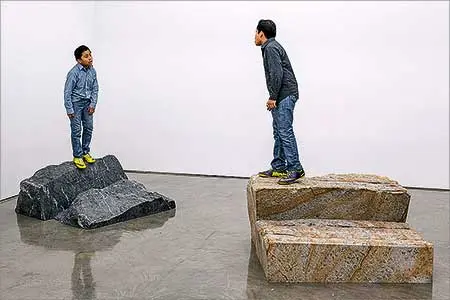
The title of the project, Fault Lines, tries to connect the physicality of stones, some of which retain their quarry marks on otherwise smooth surfaces, to geological fault lines. Unfortunately when you walk in they simply look like, well, pieces of polished stone sitting there, at best rather poor emblems of retrospective minimalism. The attempt to grasp geological time and, by default, to connect the thematic title to topographical faults in the earth is far too vague and leaves open the question as to what faults, what lines, and where? But wait. Their activation and some answers arrive at various times of each day.
At several pre-designated times of day two vocally trained, young males come into the exhibition space to move about and across the stones and sing a cappella to one another in soprano voices using informal poses and gestures loosely choreographed by the artists. The rotating cast of duet singers belongs to local groups: New York’s Transfiguration Boychoir from The Church of the Transfiguration, known informally as “the little church around the corner” and the American Boychoir School from Princeton, New Jersey, which advertises itself as a distinctly American voice within the one-thousand-year tradition of boy school choirs. Chosen from them are those known as “boy sopranos” or (more so in Europe) “trebles.” Their voice range is a temporary physical ability because as they mature their voice deepens and they lose the range more typical of the female voice. But there are two fault lines here; one fault is inadvertent, while the other is a conscious alteration to the choral tradition.
To the great loss of the audience, what they sing is almost unrecognizable given the pitch and acoustic space in relation to the density of the gallery visitors. What we gain when words disappear into vocables is an increase in the aesthetic pleasure taken from the intertwining resonances of their voices. Perhaps that is enough.
But recourse to a printed lyric sheet, whose musical score was developed by the Cuban-born Guarionex Morales-Matos and available only if you ask, makes you realize that the lyrics by Allora and Calzadilla are a wonderful grouping of unrelated and unattributed insults gathered from across a broad spectrum of Western literature: phrases you wish you could have conjured in the heat of life’s moments: “If only you used your brains a little more you could honestly call yourself a half-wit; Knows so little and knows it so fluently; Fine words! I wonder where you stole them?; He loves nature in spite of what it did to him; Are you in great physical pain, or Is that your thinking expression?; You must be the reason for contraception; God gave you a nose so you would keep your mouth shut.”
The taunts are delivered one-on-one as the boys move throughout the gallery spaces and mount the rock steps in various combinations of distance, closeness, and gesture. Several times and certainly at the climax their faces are inches apart, with tonalities locked in point and counterpoint.
Jacques Lacan, the French psychoanalyst so beloved by the art world since the 1980s and cited in the gallery press release as central to the meaning behind the phrase “fault lines,” argues that aggression is a defense mechanism against unconscious recognition that our psyche is fragmented rather than the whole. No wonder young children lash out or easily fall into taunting. But it also suggests that what is so obviously a painful process, taunting developed as a socially useful mechanism for us to learn to live with our damaged selves. Thus the fault line here is not the exterior taunt or anger but points to the interior lie. Sadly, neither the condition nor the conduct is limited to youth.
RICHARD LESLIE