
In Central America, the first point of reference for a regional organization in the biennial format was the 1st Central America Painting Biennial, which opened on September 15th in Costa Rica, at the new National Library across from National Park. This event was organized by the Consejo Superior Universitario Centroamericano (CSUCA), formed by the Presidents of the Isthmus various universities, interested in commemorating the 150th anniversary of Central America’s independence. On that occasion, the criteria of the jurors—José Luis Cuevas, Fernando de Szyszlo, Armando Morales, Oswaldo Guayasamín, and Marta Traba—focused on the notion of art in connection to center/periphery issues, as well as certain parameters for what the art Central America ought to be in terms of its content.
In 1996, an initiative by private businesses in the region emerged to establish the Biennial format based on local entities, for the organization of regional biennials with local sections, with the exhibitions rotating to the different countries.
The first Painting Biennial of the Central American Isthmus opened at the Miguel Ángel Asturias Cultural Center of the National Theater of Guatemala. After 1998 the Central American Biennial went to the following locations: Costa Rica in 2000, Nicaragua in 2002, Panama in 2004, El Salvador in 2006, Honduras in 2008, Nicaragua in 2010, and Panama in 2012.
It was in 2001 that, given the strength of the new trends and with a greater focus on contemporary productions, the event’s name was changed to Visual Arts Biennial of the Central American Isthmus (BAVIC, in its Spanish acronym).
This platform has the organizational support of entities like the Paiz Foundation for Education and Culture, in Guatemala; Promerica Bank, in El Salvador and Honduras; Empresarios por el Arte in Costa Rica; Nicaragua’s Ortiz Gurdián Foundation; and the Alemán Healy Foundation and St. Georges Bank, in Panama.
This year, the ninth edition of the BAVIC was again held in Guatemala, from July 30th through August 24th. Guatemala City’s Zone 4 hosted a circuit of country-specific locations, as the decision this year was to differentiate the selections by their national origin, in the manner of Pavilions, rather than presenting as in previous years a single exhibition featuring all the artists.
The BAVIC wasn’t conceived as a curated biennial, and on different occasions, it has been critiqued for the articulation of the different national proposals in order to present a single show. Each country's delegation arrives at the Biennial through a different selection process, and this has resulted in a divorce between the parts.
The “Pavilion” structure emerged from the decision of the Guatemala organizers to go back to an event from 1889, when Guatemala had its own pavilion at the 4th Universal Expo in Paris, presenting the country’s commercial and industrial products from that era.
At the same time, they went back to the idea of using Zone 4, the old “Exhibition Canton” with the building complex for the Great Central American Exhibition of 1897. In 1890 a government decree dictated the construction of the “Exhibition Canton” on a section of the “El recreo” National Park, intended to hold what had been the Guatemala Pavilion at the Paris Expo.
In this way, the exhibition circuit dispersed through various facilities in Zone 4 presented each Central American country as a national delegation within the Biennial, a format currently under review in many such events around the world in terms of its pertinence.
This exhibition course through the city is interesting in terms of its interaction with the audience and the proposals emerging in the various spaces, not originally conceived as exhibition areas and thus presenting different museographic challenges.
In the case of the Guatemala pavilion, the artists featured, young for the most part, presented both solo and group proposals, situated mostly on local concerns, with works by Andrea Aragón, Hellen Ascoli and Inés Verdugo, Andrés Asturias and Marlov Barrios, Benvenuto Chavajay, Andrea Mármol, and Jaime Permuth.
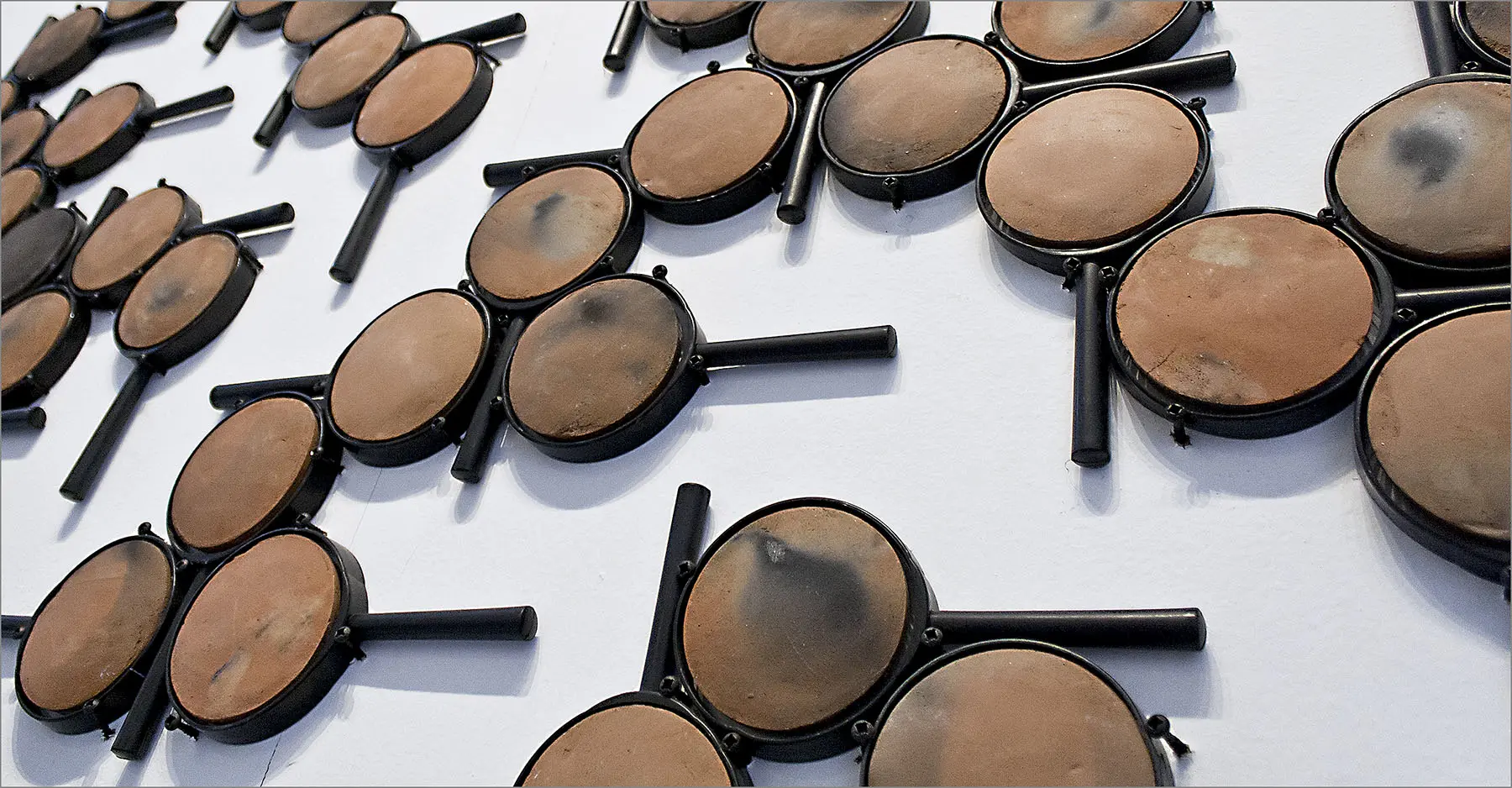
Here, Benvenuto Chavajay’s Comalitos confronts the viewer with a particular vision of his production as a tzutujil artist in San Pedro la Laguna. In this work, 200 magnifying glasses with cooked clay form a kind of installation weaving on the wall, where Chavajay, already since his Congelación series, has been working with frozen, suspended, congealed, nullified objects that in some way relate to the notion of violence.
For Chavajay, the installation alludes to a kind of portal or fence, magnifying glasses with puddles of mud, burnt clay in the shape of a comal. Covering or canceling the glass of the loupes is a way of congealing violence, be it environmental, emotional, or visual. As the artist notes: “The contemporary element is lost in the gray line of the polarized glass… going back and forth, here and now, the outline of life has been lost the landscape has been made opaque as have the city and its inhabitants, you don’t know who is seeing whom. Polarized glass blurred my landscape and my lake.”
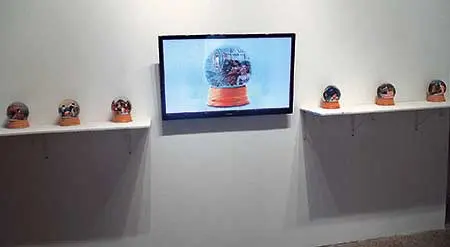
Andrea Aragón’s Souvenirs also harks back to the idea of memory on the basis of a concept of the “Fatherland” that only exists in a reconstructed nostalgic imagination. For Aragon, this proposal combines “what we are with what we will never be. Small fictitious paradises of the country we dream of, paradoxically distant from the country we have. The small snow globes have been reconstructed in their totality with photographs I took, combining unreal scenes with characters and landscapes that only correspond to the imagination.”
Meanwhile, the Honduras pavilion presented a selection of works by César Chinchilla, Sandra Herrera Dean, Luis Landa and Legan Rooster, Jorge Oquelí, Ariel Sosa and Alejandra Vaquero, and Yapci Ramos.
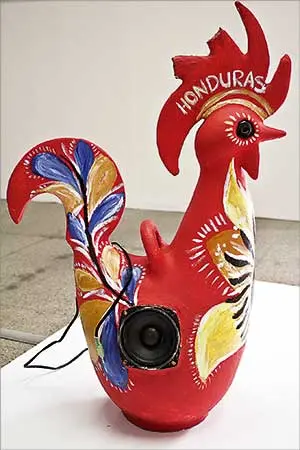
Here, César Chinchilla’s work Souvenir (Retóricas del Llagado) uses a ceramic object in the shape of a rooster along with loudspeakers and drawings for an exercise in the appropriation of symbols with a contextual charge, to make possible their appropriation in a different context. Parody as a tool for critique becomes a metaphorical exercise in decodification.
Chinchilla notes: “I am interested in the interplay of forms, historical loads, contexts, the humor has to do with the context of its language, it is, in the end, a combinatorial structure, a context that is intervened to disarticulate its signs, shift its message, and produce shock, dismantling contexts in order to re-signify, emphasize, parody the generative signs.”
The El Salvador pavilion featured works by Guillermo Araújo, Rodrigo Dada, Natalia Domínguez, Mauricio Esquivel, Jaime Izaguirre and Javier Ramírez-Nadie.
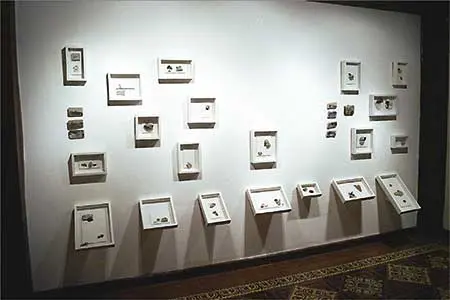
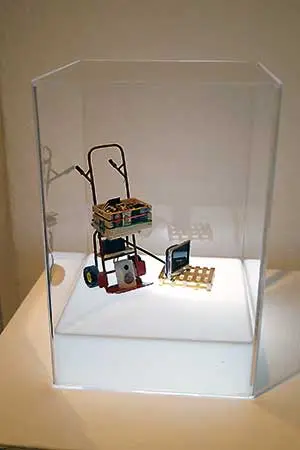
In this context, Mauricio Esquivel’s Estrategias de diseño adaptativo as a process work comprised a series of drawings that take industrial objects adapted by informal commerce in order to generate income. Like utilitarian ready-mades, these objects serve diverse purposes, such as sharpening knives, selling coffee, or displaying fruit. In societies such as El Salvador, the so-called “informal economy” is an alternative to unemployment.
As Esquivel points out: “There are diverse models around the world, for example in Mexico City, specifically in Garibaldi Square, “el toques” will give you an electric shock for $20 pesos, be it for fun or wake you up a bit when you are drunk. This device is a battery-powered energy source and can range from 0 to 100 volts, and is customized with toy figures like Godzilla. In that sense, my work consists of documenting the objects I find in different contexts and inventory them so that in the end we have a manual and prototypes with functional enhancements that will allow anyone to build them using real objects.”
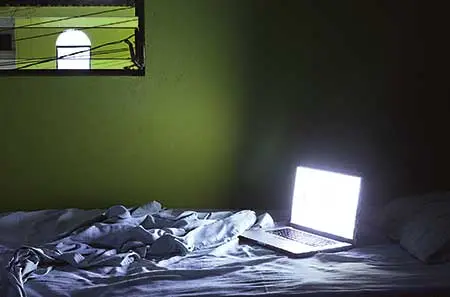
Rodrigo Dada’s Deriva also starts with a Salvadoran reality associated with insecurity. This project emerged from a desire to walk around the city in an unconcerned, carefree spirit. The intention is to reassert the essential right to freedom of movement and the pleasure provided by an aimless stroll in the context of a violent society, aided by Google Street View, which makes it possible to travel virtually through many different cities.
As Dada puts it: “Using this application, I re-frame, photograph, and record scenes from my screen showing streets in different cities. I am reclaiming freedom that is constrained in my country, El Salvador. Walking its streets is no longer safe, due to the omnipresence of violence. In Deriva, I reflect on this frustration of freedom and its consolations provided by technology, a desperate measure. I deal with the impossibility of fully experiencing my city, critiquing the insecurity of Latin American cities from the paranoid enclosure of my bedroom.”
The Nicaraguan delegation featured a varied proposal, with artists like Fredman Barahona and Christian Dietkus Lord, Alejandro de la Guerra, Milena García, Maruca Gómez, Claudia Gordillo, and Raúl Quintanilla.
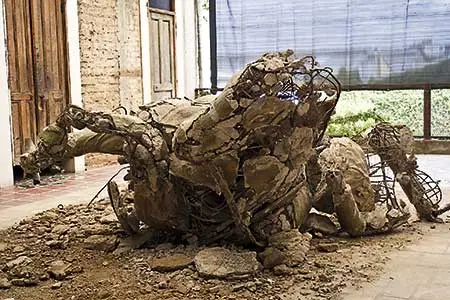
Of significant note here is the theme of power and it's overthrowing from the symbolic field, as is the case of Alejandro de la Guerra’s La Caída. Hovering between fiction and reality, and a relational action, it recreates the fall of the equestrian sculpture of the dictator Somoza García, overthrown in 1979. This action generates diverse emotions and reflections about the new symbols of power, on the basis of interest in the monument as an enduring element associated with power but also, in some cases, to fleetingness.
For the artist, La Caída “is a reference to history, based on the denial of a symbol of power. I wanted to live that experience of overthrowing power, to be part of that history, and I used art to situate myself in a different space and time, recreating new experiences both for myself and for the people who actually experienced them between hallucination and memory. The remainder, the archive, memory is all the reflection of the post-war, and are kept as sacred elements in the reconstruction of an action-memory-object trilogy.”
Featuring Diana Barquero, Javier Calvo, Carlos Fernández, Oscar Figueroa, Priscilla González, and Edgar León, the Costa Rica pavilion also had local interests and proposals that review their imaginaries from a variety of perspectives as its starting point.
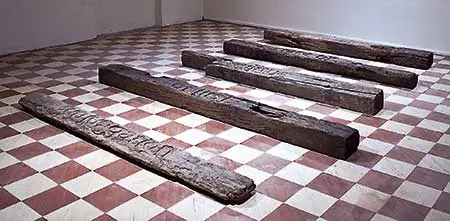
Óscar Figueroa’s Inferior Race by Virtue of [its] Subjugation starts from narratives of travelers in Latin America in the Nineteenth Century. In this case, a fragment by O. J. Victor, a traveler who visited Costa Rica and published an account in Harper’s Monthly Magazine in 1885.
The title phrase, “inferior race by virtue of [its] subjugation,” is hand-carved on railroad ties taken from the Atlántico Costa Rica line, which was built mostly by Chinese, Jamaicans, Italian, and Central American laborers between 1871 and 1881.
Diana Barquero’s Habitando la Catástrofe: el Fragmento y la Memoria also brings forth a shared past at the level of recollection and documentation of materials associated with a specific geographic area that is heavily impacted by earthquake events. The project recovers fragments of an earthquake in Guatemala, the recent one in Nicaragua, and the Chinchona earthquake in Costa Rica, and uses imprints on paper and clay as an element to speak of memory.
The Panamanian selection included works by Darién Montañéz, Pilar Moreno, Ismael Ortiz, Ela Spalding and Sofia Verzbolovskis.
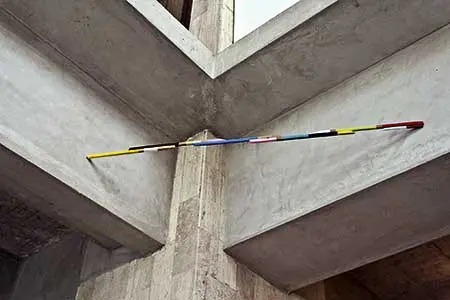
Ismael Ortiz’s Empty Buildings was an installation subtly integrated into the exhibition space, using concrete and small pieces of colored wood which, placed in fragile positions, revisited the theme of skyscrapers and the development of Panama City, where massive construction projects and largely vacant buildings. It analyzes the enormous influence of foreign consumerism in Panama. The materials used in the work are waste products from mega-projects in the country. The interest resides mostly on a quest for transformation on the basis of color, form, and texture as new spaces for “life” through new experiences, the search for and encounter of new “beings.”
Pilar Moreno’s PanAmazing also revisits local themes, via an animation that explores key events and characters for an understanding of what Panama is today. Moreno uses irony and humor to recreate, with collages made with images clipped from magazines and texts, what she considers the country’s main landmarks and efforts in its race to achieve international recognition.
In addition to these “national pavilions,” this edition of the BAVIC also featured, for the first time, and invited country: Spain, supported by the Spanish International Cooperation and the Spanish Cultural Center in Guatemala. Here, an exhibition curated by Imma Prieto presents a selection of works by Eugenio Ampudia, Daniel Andújar, Maria Cañas, Colectivo PSJM, Jordi Colomer, Marta de Gonzalo and Publio Pérez, Chus García-Fraile, Jorge García, Nuria Guell, Matero Mate, Avelino Sala, and Pelayo Varela. The intention was to have proposals from outside the region dialog with local production.
Along with these exhibitions, the BAVIC included an academic event, which for several days explored themes concerning the visual arts as well as issues of interest for a wider audience. Invited presenters referred to contemporary images and artistic production as a space for debate, to the opening of alternative spaces, and to how these are situated as part of the contemporary scene in the Central American region. Also under discussion were the issue of memory and its salvage through artistic proposals; publications and their different formats, both independent and institutional and their relevance today; the role of art in the construction of communities in specific localities; and the recuperation of public spaces via the arts. This edition being held in Guatemala, there was also a roundtable on art collecting in this country, a topic that ought to be revised and professionalized throughout the region.
A wider program, focused on attracting new publics, presented a series of film cycles, workshops, and activities for diverse audiences outside the visual arts realm. This is to say the event intended not only to reach people already interested in the visual arts but to open itself to all.
In this edition of the BAVIC, the biennial format took a turn that deserves wider consideration not only in terms of its congruence not only with the pertinence of a biennial as such but also in response to questions about regionalization in Central America or about national exhibitions… Topics that all become visible in such spaces, which, precisely, make this debate possible.
MARÍA JOSÉ CHAVARRÍA