
Under the suggestive
name Beatriz Milhazes: Botanical Garden,
the Pérez Art Museum Miami (PAMM) offers to the public the first major
retrospective of the work of Beatriz Milhazes in the United States. The
exhibition includes around fifty paintings—most of the large format—and covers
the last 25 years of the artist’s career, allowing the public to examine the
evolution of her personal style.
Throughout her career, the work by Milhazes—heiress to the Brazilian anthropophagic spirit—heir has been characterized by the dialogue and synthesis of cultural traditions from both sides of the Atlantic, particularly, vernacular traditions from Brazil and elements of European modernism from the early twentieth century. The result is this very particular universe in which rhythm, simple patterns, and lush colors coexist in unparalleled harmony.
Beatriz Milhazes: Botanical Garden includes works from the early 1990s in which shapes are still more docile and referents more immediate. From this period viewers can enjoy works such as Santo Antônio, Albuquerque (1994), and Chora, Menino (1996).
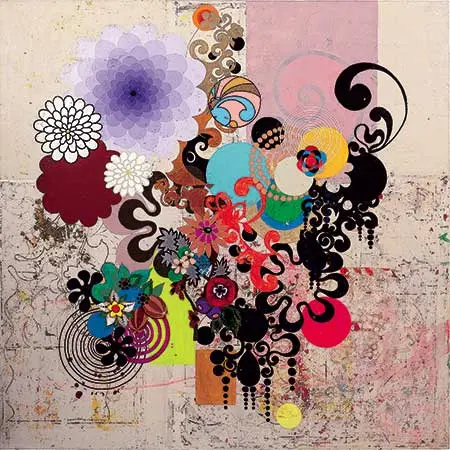
It is precise during that decade that Milhazes discovers and develops the style and technique that will identify her in the art world. Characterized by the fusion of elements from the local popular culture—the world of carnival and Brazilian music, among them—and impregnated by touches of baroque, Milhazes’s work increasingly moves towards synthesis and abstraction.
Dominated by progressive reasons that are organic in nature and that generate that very clear reverberation in Milhazes’s universe, Pop and abstraction come to the fore while the baroque spirit never leaves. Another vital development is the transition from a mastery of the general plane—during her early career—to the current depiction of a narrower and more detailed plane. Suddenly, we are no longer observing the jungle from the outside but from within. The macro-scale gives way to the microscale and the external contemplation of an inner experience.
The discovery of the technique that will seal Milhazes’s personal style in the early 1990s is crucial here. At first, the artist used to print on cotton that she would cut and then glue onto the canvas. However, the process was limited. Milhazes then began to experiment with monotypes using sheets of translucent plastic and, according to her, one day she accidentally discovered that it was possible to transfer the motif on the canvas after the paint had dried.
“This was amazing—explains Milhazes—it was a great discovery. A huge door opened for me because I could finally make my own patterns and motifs. The graphic aspect of my work could finally be fully developed, but without having to abandon painting.”
One of the most fascinating features in the work of Beatriz Milhazes is her ability to weave and seamlessly combine many disparate influences and make them successfully coexist in a new organic entity. We could even talk about completely opposite influences that complement each other in a fascinating way like Malevich and Matisse; or the world of fine arts and design, European modernism and Brazilian modernism and vernacular traditions; abstract patterns and naturalistic references; etc. And all of these are integrated into a magnificent fusion in which there are no hierarchies but, instead, a pleasant sense of flow and progression that is ultimately at the center of Milhazes’s proposals. She is the synthesis and representative of a period when syncretism was a distinctive cultural feature, not only of Brazil but also of the contemporary individual.
In this sense, this exhibition includes some fascinating works such as Mariposa (Butterfly, 2004) and Flores e Árvores (Flowers and Trees, 2012-2013).
In an earlier exhibition in Miami, Beatriz Milhazes exhibited her Aquarium, a sculptural installation made up of over 14,980 carats of diamonds, rubies, emeralds, sapphires, and rare jewels that, commissioned by the Fondation Cartier pour l’art Contemporain, was exhibited at the Collins Building in the Design District during Art Basel 2011. That same year, the Gallery at Windsor in Vero Beach, gave an interesting exhibition centered on the engraving work by Milhazes. The exhibition presented works from 1996 to 2011 and was complemented with archival materials, serigraphies, acetates, and wood blocks for xylography carved by the Milhazes books.
Beatriz Milhazes: Botanical Garden will remain open until January 11, 2015.
JANET BATET