In his first solo
exhibition at the Galeria Nara Roesler in São Paulo, Carlito Carvalhosa
occupies three rooms in the house located on Europa Avenue, where he conceived
a huge installation in which he integrates the exhibition environments by
breaking the dividing walls with giant poles. Lighting poles that once were
trees, objects in a constant process of transformation, used by the artist in
earlier shows, keep the memory of several previously established relationships, as
matter.
Carvalhosa bets on the connections established through memory, even in the house that is now a gallery but that was once a home, where domestic and social uses retain traces of meaning as much as the objects included in the construct of this exhibition do.
The work consists of the union of old light poles made of wood that go through the exhibition space and glasses that, despite having been randomly arranged on the floor and walls, actually give the impression of being displayed symmetrically—a provocation by Carvalhosa. The trunks pierce through the walls that help keep them in the air, causing a visual effect of suspension, an illusory challenge to physics; it is the intersections between two or more of these beams which keep them elevated and cause the impression that they are suspended in the air.
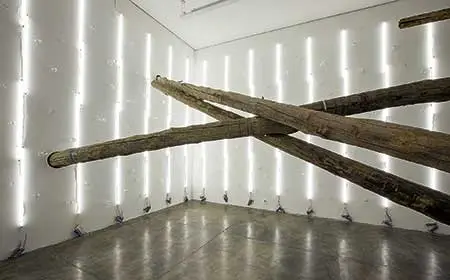
Although the exhibition begins in the display window of the gallery—which establishes a connection between the internal and external space—it is in the main room where the visual impact appears with the combination of wood, glasses, and fluorescent lights. There is no natural light; all lighting was created by the artist as part of the installation. The misplaced objects cause a reversal effect as if the floor were suspended in relation to the walls and ceiling.
In the background, the expographic area includes 16 drawings of various sizes, all made on blue reflective sheets. The abstract forms were made by smoothing down the ink layer. On the opposite wall that occupies the front of the gallery bordering the cabinet, it is possible to observe the surface damaged by the posts occupied by glasses and bulbs on the floor; through the display window, they suggest a sense of continuity in the direction of the street.
By breaking the exhibition space with wooden poles that dialog with glassware and light, Carvalhosa strategically relies on time/memory and human relationships metaphors—as he brings into focus household elements for everyday use and changes their meaning. He exposes these relationships through his continuous endeavor and reliance on otherness, transformation, negotiations, and, most importantly, on the production of meanings.
The delicate objects in contact with the massive elements challenge memory and the constant change of meaning of things and their uses, which are transformed over time in the face of nature and the manner in which mankind orders chaos.
Carlito Carvalhosa imposes the everyday world into the exhibition. To do so he overtly integrates the building, the street, and the apparent way in which the elements are arranged as part of the installation. He makes no effort to conceal the architecture of his creation, for the elements are visible and the process is clearly apparent as if the artist insisted on a dialogue between human interaction and the everyday transformation of things, in a constant relation of the senses.
The elements are chosen by Carvalhosa to execute his work simultaneously involve nature—logs—-and human action—light poles. The tension created by these woods through lighting and the delicate glassware indicates contacts between the state of suspension in the environment—which contains evidence of acts that have aesthetic purposes—and the fragile and ephemeral nature of humanity.
The logs seem to perpetuate the movement with which culture evolves from the natural principles to the complexity of the conglomerate created by mankind, in a sort of timeline.
The installation leads to the perception of human activity. Even its assembly not only kept the original metal rings on the extremes, but it also reveals the large nuts and bolts that secure the clamps of the reeds, as well as the wiring and plugs used for lighting the installation. Everything is shown even the artist’s own doing.
Matter appears not to be subjected to the action of gravity. The exhibition space provokes a sort of suspension of the natural state of things and time. Nature is subverted along with the laws of physics, through the ordering of objects-fetishes as if they were part of a family album. And it is in these elements that the artistic nature of the exhibition is formed; namely, in the articulation of the two poles formed by mankind, on the one hand, and by the perception of the eternal as transitory, on the other.
Glasses and bulbs scattered across the floor cautiously interact in a kind of choreography, in a dance. In this staging, the apparent fragility that contrasts the rigidity of Nature showcases ephemeral and transitory perceptions that are eternized in memory.
HÉLCIO MAGALHÃES