Presented in the main
exhibition rooms of the Museo Savori, the retrospective by sculptor Claudia
Aranovich (Buenos Aires, 1956) showcased thirty years of artistic production
centered on the matter as the key element for the creation of meaning; in a process
where natural and artificial elements are never manifested in an individual or
opposing manner, but interact to complement each other.
Enraizada (Rooted), the work was chosen to go on the cover of Aranovich’s recently published book, creates a poetic image of the force of nature. It consists of a sphere made with broken glass and resin with a wound from which the long and vigorous roots that envelop it spring. The power of these stems that grow and reproduce multiple branches contrasts with the fragility of the cracked geometric body—similar to the powerful roots that break the pavement of the sidewalk in search of space, or the small plants that succeed in blooming in asphalt crevices.
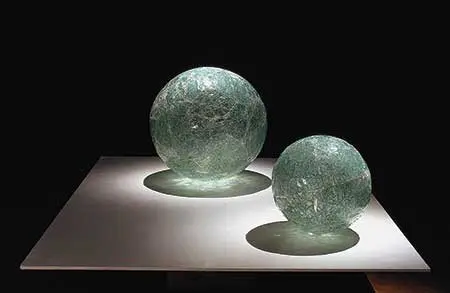
With a sensitive gaze that is attentive to the contrast of natural and artificial elements, Aranovich attains an extremely beautiful and seductive composition. The subtle combination of the transparencies and reflections of the sphere enter into a dialog with opaque lines of the rhizomes.
The splintered glass manipulated with resin becomes a key material in Aranovich’s production. She even used glass from broken windshields to create some of her works. One of her most paradigmatic pieces is De la Patria Mía (Of My Homeland), part of a series of small Argentine flags that she created in the context of social-economic, and political crisis suffered by Argentina in 2001, which, as historian Nelly Perazzo analyzed, are violated, suffering, flags that stand as a metaphor for a fragmented country. Other works also constructed with broken glass are: the sphere Futurama III and the pyramid Natural/artificial. In the mid-90s, Aranovich produced a series of sculptures in which she used polyester resin in combination with roots, leaves, photographs, text clippings, and other materials. The qualities of the resin were very instrumental in her work because they allowed her to develop visual and poetic explorations based on features, transparencies, and the incorporation of light within the sculptural objects. Moreover, another approach to her production can be found in the series of small acrylic boxes displayed at the beginning of the exhibition. She composed several samples of natural elements, like cactus or honeycombs, with an ascetic style reminiscent of a scientific language. He also presented a series of photographs of landscapes printed on stainless steel sheet titled Imágenes de lo Natural (Images of the Natural) that showed other approaches by Aranovich centered on nature that did not rely on the sculptural language. Lastly, she incorporated new technologies as well as a multidisciplinary approach in her most recent project: the work Marea Alta (High Tide), a video installation created in 2013 in collaboration with Margarita Bali—for the choreography—and Gabriel Gendín—for the specialized sound.
When looking at Aranovich’s thirty-year artistic career, we cannot fail to mention the very important role that her performances and outdoor site-specific pieces have had in her body of work, like her performance Noche de San Juan (Night of San Juan) performed in 2004 in Spain, or the installation Esferas de Luz y Agua (Light and Water Spheres), presented at the 1st Biennial of the End of the World in Ushuaia, Argentina. Also noteworthy of mention was her participation in the mid-1990s in several sculptors’ encounters convened by Nelly Perazzo and held at the Museo Larreta for 16 years. These events contributed to the introduction of new public and semi-public spaces—to intervene—into the local art scene. As we have already mentioned, the retrospective exhibition was accompanied by the presentation of the artist book which featured an essay by critic Elena Oliveras, who covered the central aspects of Aranovich’s production, including images of her major works and a foreword by Nelly Perazzo written in 2007 for a solo exhibition of the artist.
AYELÉN VÁZQUEZ