
In Plato’s Timaeus,
matter is explained as negativity, indeterminacy, and constraint. It cannot be
assimilated to “material”, it's opposite, since the latter assumes predetermination
by an idea of form that renders it concrete. Yet there is a third category
connected to this set of opposites: the category of place. Derived from the
Greek term khôra, it is a slippery
concept that has been deployed as a destabilizing factor by deconstructivist
philosophy, since it can’t be defined in the opposition between positive and
negative.
This foundational set of issues between form and place comes to mind as one visits the first solo show of the Barcelona-born, Rio de Janeiro-based artist Daniel Steegman Mangrané (1977) in Mexico. The exhibition, titled _/_____/_/__/________, was presented at Proyectos Monclova gallery in July and August of 2014.
The project materializes in the gallery with elements that intervene in the space is barely visible ways. The shape of the work suggests resonances between them and provides unity for the complete experience of the show. Its configuration is defined by ambiguity: branches that bring to mind insects and vice versa; woven collages and subtle draftsmanship gestures that exchange meanings between the drawn line and the randomness of the natural world.
Thus, “matter” in this exhibition unfolds into “material”, and the latter in turn unfolds into “place”; this generates a fluid disarticulation of space and form that impacts even the opposition between the living and the inanimate. The artist posits a set of problems concerning the aesthetic experience rooted in the unconscious origins of our relationship with form and space, since, according to Gaston Bachelard, “what ties the unconscious in the realm of images is the life in the depths of the material element.”
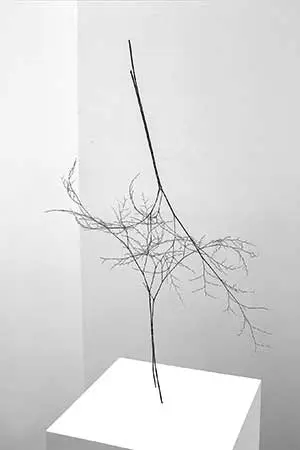
Rama de Avenca (2014) is formed by two delicate branches of the Portuguese fern of that name, known in Mexico as culantrillo. The two branches, joined and superposed, create a geometric shape based on a chiasmus-like crossed, inverted repetition. This rhetorical figure resonates throughout the exhibition space, apparent also for instance in the installation Systemic Grid (2014), two pieces formed by an irregular reticule of laser-cut iron sheets placed next to each other directly on the floor, which seems to repeat with slight variations. A direct reference to the work of Carl Andre, the viewer can walk on them to provoke brief slippages that produce tactile and auditory sensations.
The issue of the origin of form is visible in Morfogénesis Cripsis (2014), a pencil and watercolor drawing that forms a barely perceptible reticule in one of the walls. The title comes from the biological phenomenon known as cripsis, by virtue of which an animal possesses physical adaptations that allow it to hide from other animals’ senses; although different from mimicry, both phenomena are frequently linked.
Phasmides (2012), a 16mm film transferred to HD Video, follows the path of an insect trapped inside the artist’s studio. What seems to be a branch (similar to the Portuguese fern installation) “appears” to our eyes like an animate object with minimalist lines. The insect belongs to the Phasmatodea family, commonly known as “stick bugs”. The term is particularly well used in the work’s title: it comes from the Greek phasma, which means a ghost or an apparition.
Finally, the exhibition is completed with the performance Fólego (2014). Translated as breath, it is performed with the accompaniment of flutist Jona Saraiva and was specifically conceived for the gallery. At certain moments, other flutists located in specific spots around the gallery filled the space with sound vibrations that combine in the disarticulation of visible forms in the show’s works.
If according to Bachelard, the experience of reality as materiality is at the base of all imagination we found ourselves confronted here with activations of space that are achieved through the triggering of imagination by auditory, visual, and tactile sensations, and experience of sustained singularity that gives shape to the project’s Spatio-temporal postulate.
Stegman's work produces slight destabilizations of form by traversing historically determined imaginaries: minimalism, concrete poetry, the history of drawing, biology. The relationship between matter as negativity reflected in the positivity of the concrete form is altered in the artist’s operations, which generate an unstable site of representation and function as practices of the animal existence, observable in phenomena like mimicry and crisis.
OSWALDO RUIZ