Drawing has long held a relevant position in Colombia’s art. From its most traditional manifestations, connected to pictorial language, to its most sophisticated forms, drawing has generated a visual and theoretical discourse that is key even for an understanding of other modes of expression, such as photography, installation, and video.1 This phenomenon, of course, has not been exclusive to Colombia. Drawing and its corresponding material and conceptual uses have invaded the art domain throughout the Twentieth Century and the Twenty-First Century so far. The line, eternal element for reflection, has been and still is reformulated with projects that explore space and time in all their dimensions.
This article focuses—on the basis of a preliminary study—ten Colombian artists2 whose work move between conventional drawings made on some kind of physical support and the acrobatics made possible by digital media. Despite the fact that none of these artists would self-define as a draftsman in the strictest sense, they all acknowledge that it is the essence of this language that gives meaning to their creation. The interpretive reading presented here analyzes coincidences that appear when one studies as a set some of the works by these artists. Each individual case reveals the expanded field where “contemporary” drawing3 takes place and the way in which certain tendencies that make it possible to propose unified reviews of specific phenomena become consolidated.
From the static to the mobile
[Diana Menestrey / Manuel Calderón / Camilo Bojacá]
These three artists signal, with the works, noted here, a line of work where the manual and the digital coexist from the very moment when the idea emerges through the moment when the result is placed in the exhibition space. From different angles, they combine drawing with audiovisual languages. While Manuel Calderón’s and Camilo Bojacá’s drawings revel in technical virtuosity, Diana Menestrey’s are resolved via loose lines that form simple figures; both modes fit well with the resolution they seek for their respective gambits.
“Every drawing I plan is in motion. They are situations rather than fixed images.” With these words, Diana Menestrey explains the fact that animation is the procedure she uses for the development of her ideas. Menestrey currently resides in Cologne, Germany, where she did her graduate studies in audiovisual media, an experience that reaffirmed the importance of interdisciplinarity in her artistic practice. Menestrey describes the character of her works as minimalistic: through the line, she models simple images that enhance the situations represented.
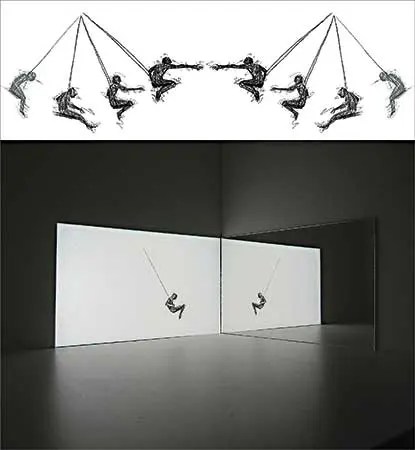
The video installation Obstrucciones (2012) originated when the artist conceived the image of a man swaying. With that premise, she began drawing on paper variations of that act, and in those schematics, she discovered the formal solution for the work. The final product shows the animation of a man in motion—barely sketched—reaching for something with no success. The animation is projected next to a mirror, which reflects it. The effect reinforces the idea of a character struggling to find himself, a goal diluted by the way the repetitive action is animated. This work brings to mind Dist-ansiando (2009), which also pointed to a reflection around the impossible. Menestrey emphasizes that her way of thinking is visual, and, because of that, she feels unconnected to specific theoretical formulations. “Ideas come to my mind in images, and the simplest way to bring them out and give them meaning is by drawing.”
Manuel Calderón’s draftsmanship skills drove him to obsessively explore the human figure. In the majority of his proposals what is represented is his own body, the instrument he uses to understand the multiple relationships of an individual with the spaces he inhabits. Such self-observation, which is also an observation of others, finds support in his work with a mix of media, where photography and video are foundational. In these exchanges of information between different mediums, Calderón has produced images where the times and formats of each language cede space to a struggle between the static and the mobile.
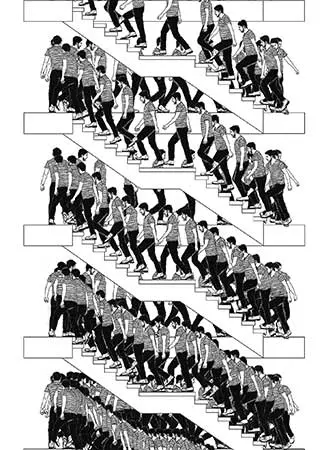
In this kind of laboratory, where the artist moves from paper to digital support, Calderón’s self-representation in drawing reappears in Escaleras infinitas (2012): the repeated image of the character brings forth the essential principle of frame-by-frame animation. Calderón brings us closer to an experiment where handmade and digital drawing become indistinguishable, so that as in the majority of his projects what closes the visual feat behind that the viewer sees is the montage effect. The staging of this drawn, duplicated, reactive—in terms of visual culture—action brings to mind Duchamp’s iconic painting Man descending a Staircase or a contemporary video like Around the World by the musical group Daft Punk.
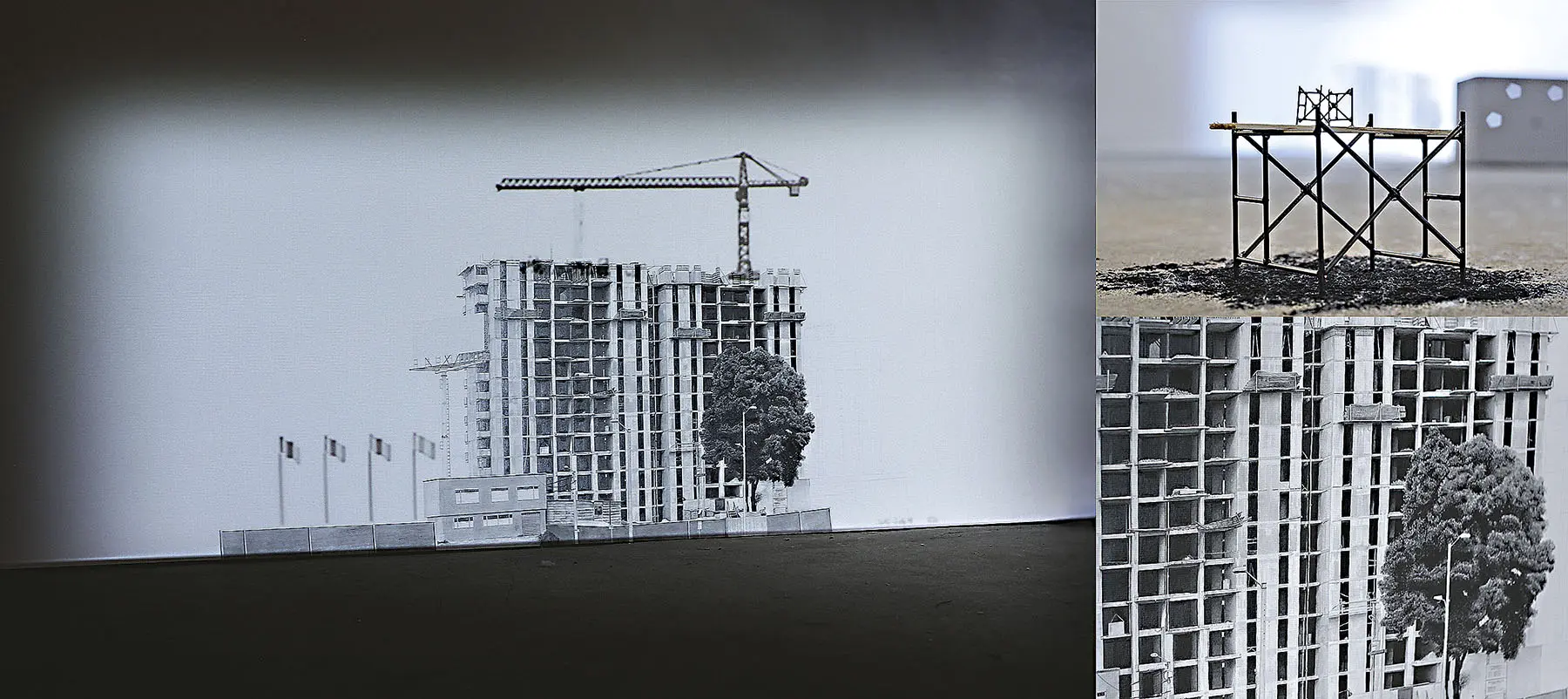
In Camilo Bojacá’s creations, the structural element, both in the physical and abstract senses, is thought on the basis of the language of draftsmanship. The images he builds are critical spaces that subvert reality as we know and experience it, Influenced mainly by sci-fi movies and literature, Bojacá gives his work a political meaning, making sharp-edged statements about contemporary society. The impeccable aesthetics of Bojacá’s pencil drawings dazzles viewers and reveal his technical mastery. In Sin título, 2013, an installation included in the show Andamios y columnas, the artist presents the drawing of a building under construction on which the image of a functioning pen. This work confronts the subtle motion made possible by the video medium with the stillness of the drawing. In this project, Bojacá’s observations are centered on multi-family housing, and his formulations question all continued and finished forms that seem incapable of experiencing any kind of metamorphosis, the uniform ideal of the model house used by construction companies for their sales. The works arranged around this installation reinforce Bojacá’s ideas about the vulnerability of the structures imposed by the city for the subjection of its inhabitants. For him, drawing, more than a medium for representation, is a tool that makes the opening of mental spaces, of active zones ready for critical thought, possible.”
Drawing in the public space
[Luisa Roa / Andrea Acosta]
Here, drawing appears as a language that is inscribed in urban spaces. The exploration of cities and the study of how objects and architecture speak of the life of a given site are the preamble determining the creative act. These two artists, Luisa Roa and Andrea Acosta, pose questions about public space through interventions that do not short-circuit the nature of the environment in which they are set.
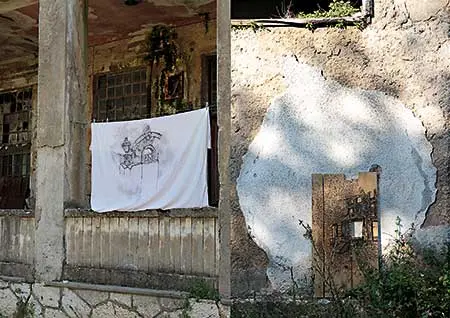
Luisa Roa has developed multi-media proposals where sound and drawing are the protagonists. Most of her ideas are intended to interrogate imposed narratives and generate relational experiences between the space on which the work is set and the viewer. Her most recent project, How to talk about Mostar (2013) originated on a residence in the city of Mostar (Bosnia-Herzegovina), as part of her studies for a Master’s degree from Bauhaus University. After reconnoitering and traversing the city, Roa decided to bring into her studio five found, discarded objects (a wooden plank, a rock, a bedsheet, a film roll, and an umbrella) from locations in Mostar that had a visual impact on her; she also recorded the sound landscape in each location. The artist draws on the surface of each one of the objects, and her task was to reinsert them in the city but switch their placement. She edited the audio and designed a map; these materials were sent out in a mass email and those who decided to seek the works on site had to download the audios and follow the path indicated. The drawings were stolen a few days after their installation.
In this project, Roa reaffirms her intention of having her creations blend with critical zones in a city. Several of her works have debated the monumental character that is attributed to historical discourses, where visual culture plays an important role. Her challenge has been to think of other modes of discourse through her installations of site-specific works.
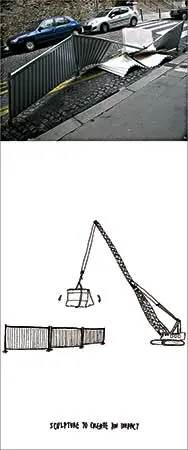
In a similar line, Andrea Acosta who a few years ago completed the same Master’s degree on which Roa is now enrolled has developed works that tense the concepts of public and private. On the basis of this tension, Acosta has attempted to have drawing invade public spaces that appear as minor or invisible, devoured by other parts of the city. Her ideas have materialized in Berlin, Bogotá, Bilbao, Paris, Weimar, and Louvain. On several occasions she has been caught by surprise by how similar cities can be, so much so that in 2012 Acosta decided to record some of these coincidences between Paris and Berlin in her publication There is here with a T, a series of observations and speculations. Another one of her gambits—where drawing and photography both come into play—is Bocetos para esculturas encontradas (Sketches for Found Sculptures, 2006), the result of explorations in Paris, Bogotá, and Berlin. These images emerge from the chance encounter of sculpture situations in the different cities, which Acosta photographed. The artist decided to appropriate these temporal accidents and to create a series of drawings that served as sketches for the montages made possible for the situations. Acosta creates a kind of fiction where the idea of intervention is questioned. It is important to note that Acosta is interested in having drawing connect with other media and also for her work to have a sense of humor, so that a space is opened for the viewer’s suppositions.
Dissections and Taxonomies
[Angélica María Zorrilla / Catalina Jaramillo]
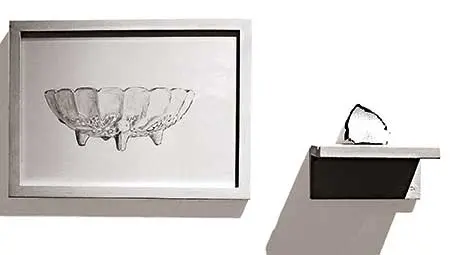
These two artists can be seen as scientists of draftsmanship. In their studios almost laboratories they have small work tables and furniture holding paper samples, small finished works, fragments of texts, unimaginable objects, or schematics for works in progress. Angélica María Zorrilla, anchored on her small formats, seeks to establish a taxonomy of concepts and mental and/or emotional states, whereas Catalina Jaramillo moves between her collections and the maneuvers demanded of her by the digital support. With all their differences, the way in which both Zorrilla and Jaramillo engage their investigations and processes reanimate the presence of a thinker for whom the study of images and their relational-montage power became an obsession: Germany’s Aby Warburg.
Zorrilla’s Albur, visiones del adentro y del afuera (2012) is a project where the artist installs in individual boxes a series of drawings that are the result of her intense study of bodily organs and their relationship with the concept of melancholy. Anatomy is present between a habitable territory that is physical and ethereal at the same time. A series of cryptic landscapes allude to each organ selected for the visual experiment: the brain has the value of a small demon and the spleen, that of a half-empty space where acute physical sensations are concentrated. The artist’s explorations do not have a set boundary; her explorations of the topic have taken her to research in medicine, philosophy, literature, film, and other areas. In general, her projects give birth to a poetic payload that is reinforced by the emergence of a connection between the images Zorrilla creates and the words, the latter acting as disturbing elements for the former. Anatomías de la melancholia and Corazones híbridos are prior works by Zorrilla that reveal the obstinate character of her investigations.
Catalina Jaramillo’s Espacio impropio (2012) embodies her interest in collecting. Like a detective gathering the traces of her own life, Jaramillo traveled to Medellin to revisit the house where she lived as a child. What she found there was a ruin, the consequence of a fire that destroyed her earliest idea of a home. Confronted with the force of that image, Jaramillo decided to begin collecting objects that survived the disaster, key pieces that she reviewed back in her studio and which accumulated into a kind of cabinet of curiosities of such a complex personal episode. What emerges here—as in Zorrilla’s case—is a taxonomic procedure that begins with the object and is reinforced by the drawing that reconstructs it. This move includes another series of works where Jaramillo attempted to represent the sensation of estrangement—unheimlich/uncanny—produced in her by her unfortunate encounter. These images were mounted on a prototype hanging paper of her own design. Her works originate on lists she makes constantly, and function as fragments whose enumerations consolidate a whole that is—above all—an organic entity.
Narratives
[Mónica Naranjo / Catalina Ortiz / Teresa Currea]
What makes it possible to read these three artists in relation to each other is the narrative nature of their visual moves. Teresa Currea constructs scenes where contradictory situations are generated by the superposition of painstakingly hand-made drawings. Mónica Naranjo arranges, on editorial products or on the exhibition walls, blurred images that have been digitally retouched to resemble stills from a film. Catalina Ortiz, for her part, uses techniques like collage or assemblage to present characters or stories that reformulate meanings and modes of language.
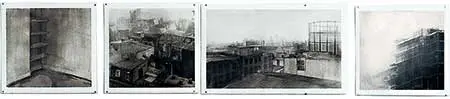
Mónica Naranjo’s editorial and exhibition project Where Here and There Meet (2010), the artist’s graduation project for the Master’s of Fine Arts, Communication and Design (London, 2008-2010), unfurls an exploration of the idea of “being home”, precisely as its author is away from her place of origin, and how in that state there is a constant quest to belong to a place that is not one’s own. The images are the result of a technical process where photography and drawing both are brought into play. In each frame, Naranjo presents atmospheres of uncertainty, vistas of a gray city, somber interiors in which inanimate objects seem to come alive. When the artist mounts these images on the exhibition walls like a storyboard, it is impossible to deny the cinematographic undertones of her ideas. For Naranjo, giving herself enough time to observe a landscape of an everyday circumstance is essential for an understanding of the way a given environment transforms the attitudes and behaviors of spaces and people, phenomena that—according to the artist—photography does not suffice to capture. “Drawing allows me to stay there, to redo the details, to erase. Above all, to think.”
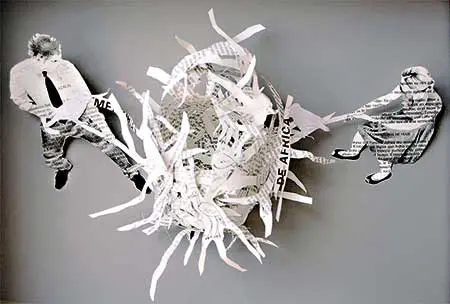
Catalina Ortiz’s series Nidos Literarios (2011-2013) is a challenge to drawing in two dimensions. Using paper scaffolds, the artist sets a different circumstance for the line, making it tangible and malleable in order to give shape to an organic corpus that, despite its lightness, contains the narrative weight of novels Ortiz has read. The aesthetic object emerges as an interpretation, as visual literary criticism. The novels are subjected to a process of destruction when their pages are torn, an act that kick-starts the resignification of written discourse; their total states move towards fragmentation, and then the fragment gives shape to another totality, less stable and concrete. In the end, this is a method for reiterative disassembly, like a continuum. Ortiz says that “nests seem to be made all the time, forms emerge, and the line is like a talking entity”; for that very reason, she sees this experience as derived from thought via drawing. Titles like Saramago’s Memorial do convento, Tomás Eloy Martínez’s Santa Evita, or Álvaro Mutis La nieve del almirante are part of the inventory behind the artist’s work. The basic selection criterion is for the texts to have a strong psychological component. Catalina Ortiz had a long career in the field of photographic production in the publishing industry, and, inevitably, her works reflect the latent traces of that experience.
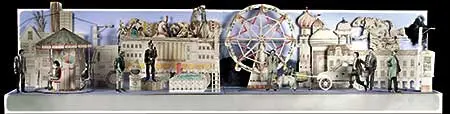
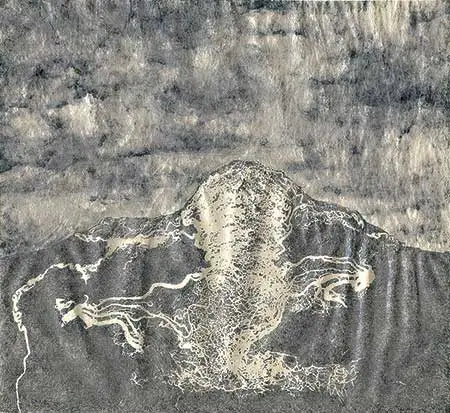
There is nothing in Teresa Currea’s visual constructions that hides their “being drawings”; the scenes she created and the relationships between the characters and the objects she draws sustain a disquieting atmosphere in conflict with the subtle language of her images. Currea’s drawings have escaped the flatness of the plane, have been brought to the fore through layering, with the classic strategy of the diorama. Animals of an unclassifiable species cohabit with humans in everyday spaces of invented cities that evoke, at times, some of Calvino’s Invisible Cities. Currea deploys the resource of irony, her representation of the unexpected touches on the natural and retains a halo of harmony thanks to the way the artist arranges the interaction between characters and things. Currea builds impossible habitats from which to shoot out social critiques dressed up in the aesthetic of her models, which in the end are fictitious worlds where the artist reflects on the techniques used for the manufacture of artificial spaces. In La feria (2012), a horizontal diorama, Currea builds elements of an amusement park and installs characters in paradoxical situations. Her study of machines and devices through drawing exercises has been a basis for the invention of the human-object hybrids inserted in her works, visual metaphors that make it possible to represent other times and other spaces in her non-linear montages.
Thus we come to the end of this attempt to interpret drawing based on the artist’s own disquisitions about their work and the need to bring to the fore the symptomatic nature of a language that, in multiple ways, traverses current artistic practices. Thinking about contemporary drawing and its possible presences (and absences) implies, among other things, a detailed analysis, the cleverness to see the invisible, the revision of obsessive processes, the reinterpretation of the line and the trace, the exploration of the options provided by new technologies, and above all freeing ourselves of simple categorizations in order to open the mind to the seduction of narratives and/or heterogeneous experiences that do not respond, necessarily, to classical forms, even if we ultimately use these forms as the launching platform for the materialization of ideas.
NOTES
1. Since the late 1970s and especially during the 1970s it was common to speak of the draftsman. Artists whose work focused predominantly on drawing. (…) While throughout the Twentieth Century artists worked drawing as an independent language, the resulting works were considered minor and the interest of critics and audiences focused on painting or sculpture. On the contrary, during the period under study (1960-1970), artists like Óscar Muñoz, Miguel Ángel Rojas, Mariana Varela, Darío Morales, Luis Caballero, Santiago Cárdenas, Juan Cárdenas, Óscar Jaramillo, Saturnino Ramírez, Ever Astudillo, Félix Ángel, Alfredo Guerrero, and Cecilia Delgado, among many others, used drawing to unsettle the notion of perception. (…) In this way, withdrawing as an autonomous medium rather than a support for other techniques, they were able to propose a different approach to the image, which in turn allowed them to explore and expand their representational possibilities. Jaramillo, Carmen María. “Desjerarquización” de los medios. In: Fisuras del arte moderno en Colombia (2013). pp. 153-154.
The author notes: the selection of these ten artists is supported by the research work I have carried out over the course of a year on contemporary drawing practices. I have followed closely the process of the works reviewed here and their exhibition in recent shows. Visits to studios, conversations and interviews, the study of references, and interpretative exercises are the main sources for this article.
2. The 1960s represented for modern art a moment of transformation that redefined art and the place of the artistic in complex terms. (…) Drawing is part of this enterprise. The modes of conceptual art and the moments that formed under their influence resulted in greater visibility for drawings, revitalizing its practice as a process of thought, not only a technical display. Installation, minimalism, land-art, even performance, contributed to expanding the boundaries of drawing and made it possible to understand this activity as an independent practice. There is no doubt that the notions of space, simplification, trajectory (motion), and time gave drawing renewed characteristics and a tautological nature, recognizable to this day. Foglia, Andrés. “Sin borrador”. In: Catálogo de Exposiciones. ASAB (2013). pp. 13-14.
3. It is a good opportunity to mention some of the Colombian artists who are indispensable in any understanding of the dynamics of the drawing genre in recent decades, and who complement the names in Note 1: José Antonio Suárez, Antonio Caro, Johana Calle, Juan Mejía, Bernardo Ortiz, Lucas Ospina, Nicolás París, Mateo López, María Isable Rueda, Leyla Cárdenas, María Fernanda Plata, Marco Mojica, Kevin Mancera, Liliana Sánchez, Angélica Teuta, among others.
ERIKA MARTÍNEZ CUERVO
Social communicator and journalist, specialist in history and theory of modern and contemporary art. Researcher, teacher and curator.