Elías Crespín
(Caracas, 1965) ratifies that an artistic discovery is all the more congruent
when it is connected to historical experience.
The Venezuelan artist, who lives and works in Paris, studied computer science in Caracas. His family environment was key: he is the son of mathematicians and the grandson of artists. His grandmother was the German-Venezuelan artist Gertrud Goldschmidt and his grandfather Gerd Leufert, painter and graphic artist.
Crespín’s work harks back to the efforts of several generations to establish and promote on our shores first abstract art and then kinetic art, already accepted in the international arena as one of the greatest contributions to contemporary art.
He moves decisively and without hesitation in the company of his teachers and predecessors.
Crespín began working on his first sculpture in 2003. The second one emerged after a visit to the Museo de Bellas Artes in Caracas, where he encountered Jesús Soto’s Cubo virtual. Thus motivated, he experimented, and two years later came Malla Electrocinética I. Crespín participated in several group exhibitions in Venezuela, and his first solo foray took place at Canal Centro de Producción Cultural in Caracas, in 2006.
In 2008, Crespín visited the workshop of Carlos Cruz-Diez, who prompted him to continue on his path. Cruz-Diez's investigations on color inspired Crespín, who began to insert in his sculptures color-infused Plexiglas elements.
Adding motion and programming, Crespín subjects viewers to an “immersion” in a series of paradoxes of vision and reflection: light and shadow, plane and volume, representation and virtuosity, sound and silence are conjugated.
Complex computer programming produces a rhythmic regularity of motion. The visual experience and the relationship with the viewer maintain a line of continuity with figures such as Calder as well as the already mentioned Cruz-Diez, Gego, and Soto, and the more recent explorations of numerical art.
Crespín sculptures are now in the collections of important international institutions, such as the Museum of Fine Arts in Houston; the Museo del Barrio in New York; the Museo de Arte Latinoamericano, and the Museo Nacional de Bellas Artes, both in Buenos Aires. They are also exhibited around the world.
Crespín has won recognitions like the Artist’s Choice Award, ArtBots 2005, Saints Michael’s and John’s Church, Dublin, Ireland 2005; Armando Reverón, 61 Arturo Michelena Salon, Ateneo de Valencia, Venezuela, 2005.
From a European standpoint, the initial reference has been Life Forms, Kinetica Museum, London 2006.
His work Circuconcéntricos Transparente, 2013 was exhibited in the exhibition Dynamo. Un siècle de lumière et mouvement dans l’art, 1913-2013 at the Grand Palais, in Paris.
Crespín’s works are on exhibit at the Denise René gallery in Paris between October 16, 2014, and January 3, 2015. A large number of visitors filled the gallery on opening day.
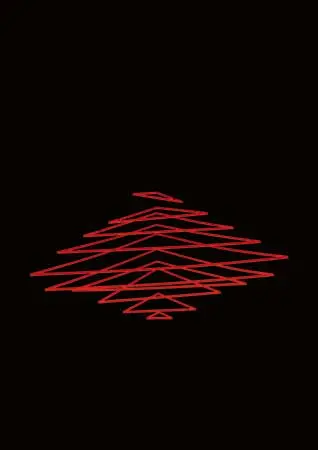
They were able to see Trianguconcétricos flujo rojo, 2014 (Methacrylate, nylon, motors, computer, electronic interface, 86.6 x 75 cm.), with music by Jacopo Baboni-Schilingi, an installation featuring the regular, sustained rhythm of shapes and sounds.
The largest work on display is Gran 16 cubos, 8 x 2, 2014 (aluminum, nylon, motors, computer, electronic interface, 390 x 78 x 26 cm.). And one of the most fascinating: 16 cuboides, 2014, (tin and stainless steel, nylon, motors, computer, electronic interface, 105 x 70 x 10 cm).
Objects that are similar in appearance are infused with magic, seemingly obvious but unimaginable in their variations.
The material elements are simple but captivating. Volumes are created on the basis of simple shapes: constructions on the edge of minimalism. Shadows are also drawn, giving regularity to the motion. The relevance of color, materials, and differences in texture are, in our view, lessened in comparison to the force of the concept. Yet, Plexiglas, aluminum, stainless steel, copper, and tin are an important part of these “pluri-dimensional architectures.”
Soberly motorized, they hide a mathematical reflection where the use of algorithms generates and completes motifs that are random in appearance. This time, with shapes and volumes freely unfolding in space, in a reminiscence of volumes that are virtual yet drawn… A lesson about reality could in this way be assimilated in order to produce a concentric-eccentric rupture. Crespín expresses form in a constructive manner. He ratifies the continuity of the liberation of plastic elements: 2 líneas paralelas (double tapestry), from 2014 (stainless steel, nylon, motors, computer, electronic interface, 230 x 10 cm).
And each moment produces new reminiscences. The interplay of parallel lines in space achieves maximum suggestiveness between the visible, mathematics, and theories of perception. And it paradoxically produces congruence and discontinuity, subtlety and transparency, in a free line or alignment in terms of the autonomy of the artistic resources. Or, better yet, a rhythmic alignment of lines.
Extremely gifted when it comes to the details of the world of numbers, Crespín reformulates the flow and the paradoxes that exist between the vision, tension, and sound. The selection of works expresses, in a latent way, new variations of immersive and totalizing art.
SUSANA SULIC