
The
exhibition Geometría en el espacio
(Geometry in Space), curated by Susana Benko and presented at Centro de
Artes Integradas, featured 14 works by Venezuelan artists Sydia Reyes, Nidia
Delmoral, J. J. Moros, and Luis Millé.
The show prompted a reflection about procedures and solutions assumed by sculpture in the contemporary era, once the academic representation and the self-referential framework dictated by Modernism are set aside. The curatorship explores in this way the role played by emptiness and space in the grammar of today’s sculpture, visualizing the issue from the standpoint of “an inverse relationship: from space to matter.”
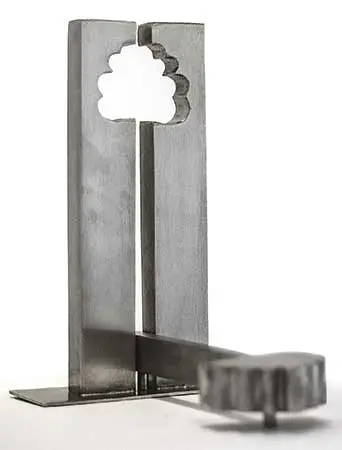
Sydia Reyes (Caracas, 1957) distinguished herself in the 1990s with works in oxidized iron that were inspired by the urban environment. Her twisted drain grilles and pipes, works of an abstract configuration, nevertheless brought forth a “hyper-realist” element that the artist used to express the hardness of our cities. Later, after traveling to the Amazon region and witnessing the extent of deforestation there, Reyes became interested in ecological themes. From there emerged her aluminum sculptures dealing openly with the issue of logging, such as Sketch for a Forest, or those where nature is expressed via the subtlety of a beam of light, as in Nada, nada que hacer (Nothing, Nothing to Do). In these works, spatial relationships and contrasts of empty and filled space are crucially important. In Sketch for Forest, the image is achieved precisely through the schematic outline of a tree formed by emptiness, since what the artist has built as volume is the space surrounding it. In Nothing, Nothing to Do, a work in three modules, Reyes incorporates LED lights into volumetric squares made in aluminum, on the front part of which around the opening has been carved out. The light emanates from it but establishes a subtle interplay with the aluminum circles that, like tops or covers, form slits for the escape of the light inside.
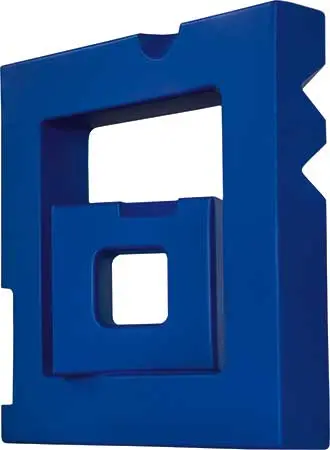
J. J. Moros (Caracas, 1950) has had a long career in sculpture and geometry. In recent years his work has focused on the exploration of the spatial tensions created by the inclusion of segments or simple geometric shapes. In his works Present and Abscent, the artist creates two white squares arranged on a wall of the same color. Both works feature an interior square shape, drawn via the volume, in one case as a relief and in the other as a bas-relief. In the perimeter of these shapes, the artist places small notches in contrasting relief. These are minimalistic works where the sculpture uses only the essential resources needed for the establishment of such tensions basic, and at the same time essential. In Maternity, Moros works with sculpture’s representational tradition by creating a large square containing a smaller square. The pretext of maternity as the re-creation of a simile is presented here through the non-identical repetition of certain features and in the misalignment of the elements in space.
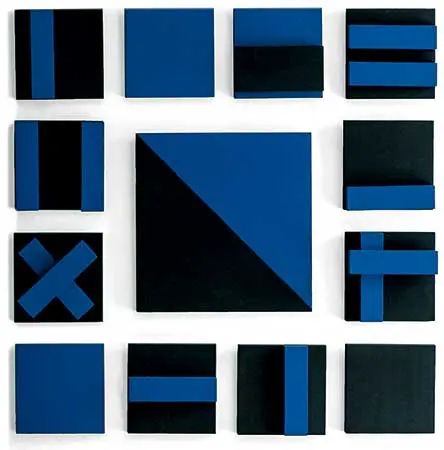
Nidia Delmoral (Maracay, 1950) has developed her oeuvre on the basis of wood carving. Perhaps her relationship with this organic material has permeated her approach to geometry, where what we find is a sensible spirit. The sculptor creates her works in an austere language, with sober lines, where nevertheless we can always see the texture, veins, and colors of wood. The beautiful work titled Territory mineral is part of a series of steles with the same title that Delmoral began in 2000, seeking to give expression to her investigations around the telluric meaning of the Venezuelan land, from which the country’s main riches emerge: mineral and organic elements laying underground. It is a set of three vertical works that unfold in space-like totems. Along with the subtle play of colors that characterizes the material, the artist introduces a light curvature or a barely perceivable incision. In New Territories, from a series-in-progress with the same general title, Delmoral creates modules and arranges them in a grid; these are reliefs created by the superposition of geometric elements that seek to establish a balance between figure and ground. The chromatic scheme moves away from natural hues in order to accentuate the dynamism of the forms.
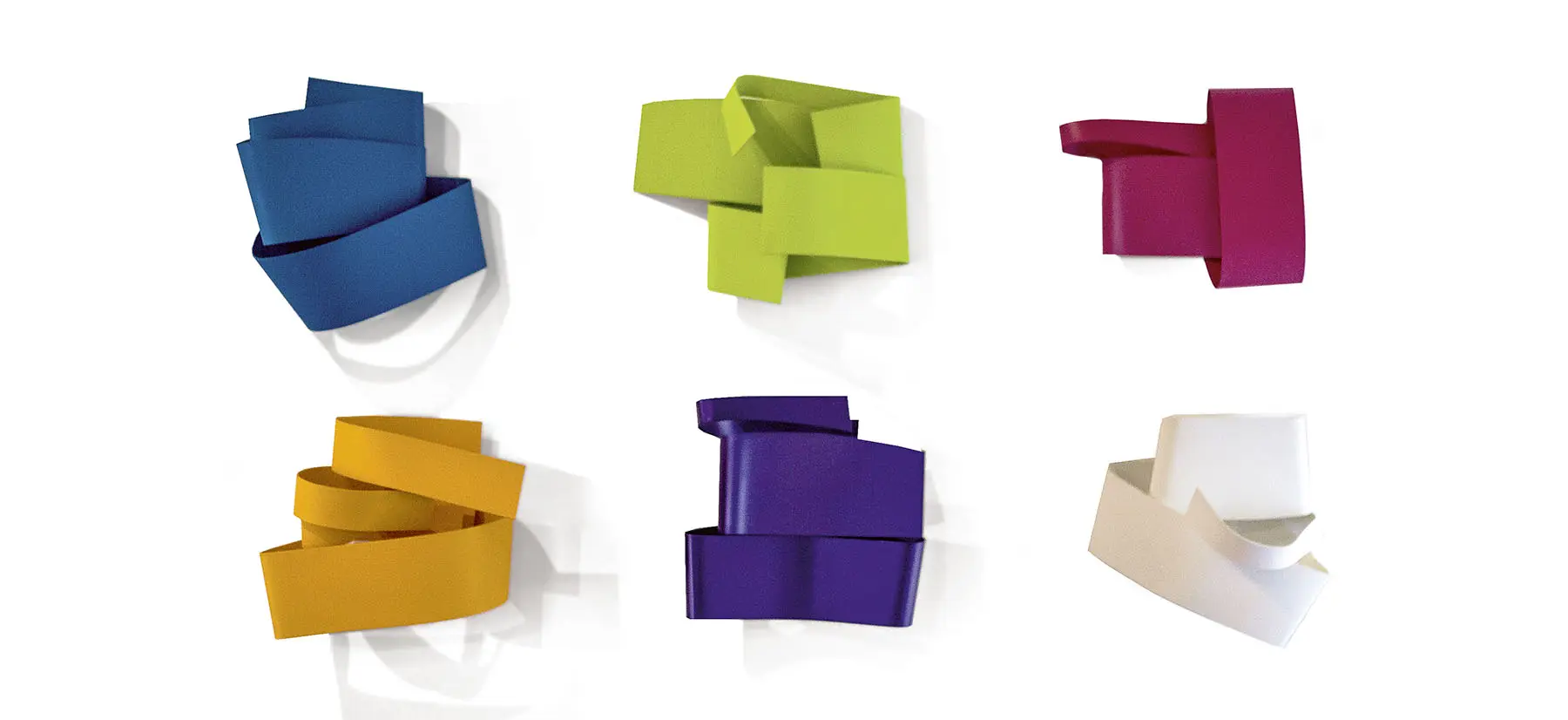
Luis Millé (Caracas, 1967) works his sculptures on the basis of the drawing. The paper as support, and the paper itself as an element, have marked his work, which is characterized by the representation of flexible structures. In his works from the series Flexochromes, the representation of malleability is combined with the introduction of a vibrant color. A whole plot of lights and shadows is thus created, and with it a work of art with multiple tonalities where spatial interplays generate great dynamism. In his series Tensometry, Millé expresses more explicitly his concern for the relationship between concrete form and space. In these works, which are certainly “installations”, Mille includes segments of aluminum with linear folds and twists, and has then “float” in space thanks to the jute ties he places on the walls, ceiling, or floor. In this way, he establishes a domain of lines of force that describe multiple directions and tensions.
Geometría en el espacio formed a coherent whole where the languages of these artists were confronted with their connection to geometry and their individual treatments of space. As Benko correctly points out in the catalog: “In all of them, space is not only conceived as a place; it also embodies the work of sculpture itself, by means of geometry.”
*All pictures illustrating this review: Miguel Hurtado and Laura Lagardera. Courtesy: CIEF, Caracas.
KATHERINE CHACÓN