
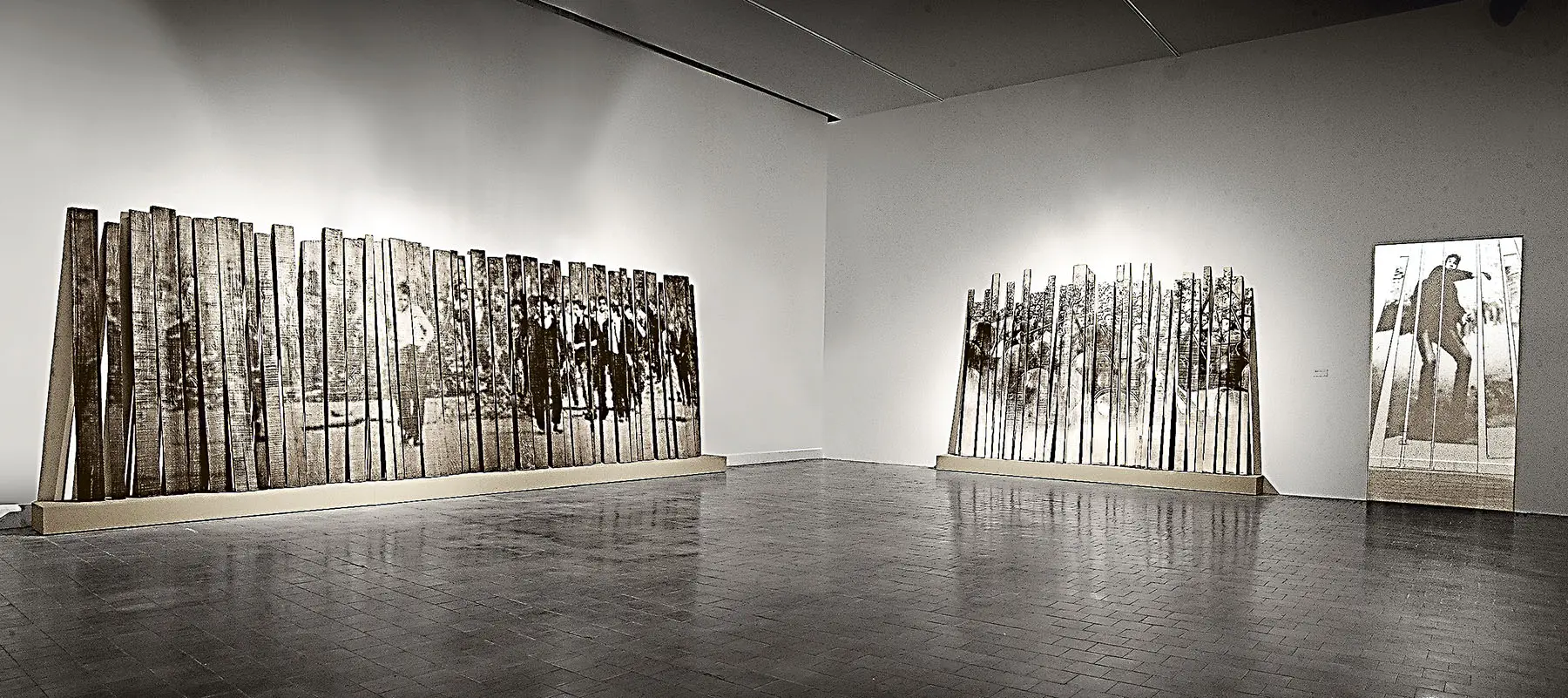
The theater of a certain reality, Nada está donde se cree... (Nothing is where you think it is…), an exhibition of works by Graciela Sacco (Argentina, 1956) revisits and creates new site-specific works that review aspects of the past and the present, both nationally and globally, under a different critical gaze and energy. The works video, photography, silk-screens, objects, installations on exhibit at Centro de Arte Contemporáneo, Museo de la Universidad Nacional Tres de Febrero, are a synthesis of Sacco’s work over the past 20 years.
Given its history and powerful meaning, we must mention the building of the old Immigrants Hotel, on whose third level the recently instituted CAC-MUNTREF is housed. It was the point of entry and residence for a succession of immigrant waves, the largest housing facility for recent arrivals in Argentina. Built in the Beaux-Arts style right on the shores of the River Plate between 1906 and 1911, it was decommissioned in 1953. It now belongs to the government’s Migration Directorate, which uses several of its spaces.
In this way, while in one corner of this large building (the front of which measures at least 200 meters) Sacco’s exhibition speaks to us of the provisional, of excluded immigrants, and of social struggles and victories, at the opposite end recent immigrants (massively arrived from neighboring countries) hopefully process their residence requests, their paperwork for inclusion.
The contradiction is repeated between the complex material Graciela Sacco exhibits at CAC and the show at the Immigration Museum (interconnected by a long corridor) about the history of immigrants in Argentina. Gazing into the future, those then-recent arrivals smile widely in the historical photographs shown; in Sacco’s work, what we see are conflict scenes, the street as a battleground, the difficulties of integration.
Curated by Diana B. Weschler, the exhibition takes excellent advantage of two monumental rooms, with works arranged in non-chronological order. Nada está donde se cree... takes its title from a work in the M2 series, which speaks of territory, motion, and space. M2 poses questions about “the minimum space that an individual needs for living” and about the value of “a square meter of exile.” “Why is it that a square meter in Paris costs what 30 square meters do in La Paz?” the artist wonders, as she prints comparisons between such diverse cities as New York and Managua on a 100 x 100 cm plastic cube, inflated with helium and suspended in the air.
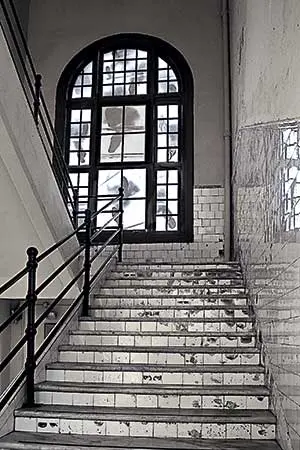
A sensible experience and a site for thought, the exhibition interpellates viewers even before they enter the CAC. The open mouths laid along the street that takes us to the museum, from the series Bocanada, announce a—real and metaphorical—unsatisfied hunger. Set into the steps of the long marble staircase leading to the exhibit, the silent “eyes” of Entre nosotros warn of unending wakefulness, an implacable vigilance. The “steps” of the Migrantes (from the M2 series) are attached to the staircase’s large window.
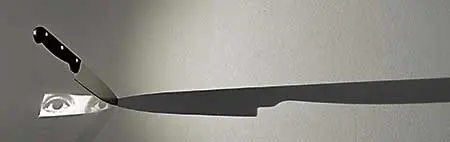
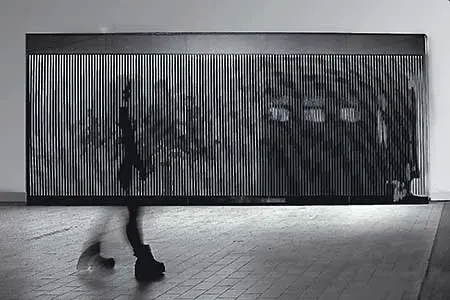
The show begins with a video installation titled Esperando a los bárbaros, with eyes in motion that appear through some rustic pieces of wood. This work brings together allusions to the artist’s early urban interventions in her native city of Rosario, such as Señalización de escuelas públicas (espacios amenazados de extinción), 1994, in front of schools and educational institutions, and the initial series Bocanada. Interferencia urbana, which installed 5,000 political posters in the street, was an action later repeated in Buenos Aires. Almost from the start of her career, Sacco produced heliographic prints based on photographs—taken by herself or clipped from newspapers—processing the surfaces of objects with light-reactive solutions and recording in that way images of mouths, eyes, political protesters, guns, suitcases, knives, wings.
The artist, who in recent years has added new materials and technological elements, puts on display political, economic, and spiritual infirmities in other series as well, originated on El incendio y las vísperas, work from the mid-1990s. It is a sequence of wood strips printed with heliographic images of protesters in the street, some throwing rocks, arranged next to others against the gallery wall as if the wood beams were resting after having carried banners with political slogans. Resembling a fence, these segmented pieces of wood even hide, for example, a video from the series Tensión admisible. With the image of the political rally, Sacco later creates similar prints on narrow acrylic sheets, which are set hanging from the ceiling by transparent lines and, thanks to their arrangement in space and the light shining on them, reflect on the wall: Sombras del norte y del sur. Here, some of the protesters are included in a kinetic work of art, running and trying to reach a train. Sacco’s video installation Cualquier salida puede ser un encierro, using water and water projections, not only has the power of making us lose our sense of space but enters into a dialogue of the neighboring river.
For globalized viewers who already saw Sacco’s work in Rosario, Buenos Aires, Ushuaia, Mexico, Santiago de Chile, São Paulo, Toulouse, Rome, Paris, Prague, Jerusalem, Miami, Washington, Austin, New York, Venice, and more, this presentation can be a guide to remember their own travels and circumstances, because as the artist says, “art is a way to connect with the world.”
VICTORIA VERLICHAK