From July 18 to
mid-November of this year, the Museum of Contemporary Art in Caracas presents
the exhibition titled Scenes by Jesús
Guerreo (Merida, Venezuela, 1965). The exhibition consists of eleven pieces of
varying formats spread across the hallway and into exhibition room number seven
of the institution. Most of the works were created in 2014 with some examples
that, according to the exhibition curator, Luis Velázquez, marked the
culmination of earlier periods. One of these works is Escenario 012-Plano Verde (Scene 012-Green Plane, 2012), the result
of gradual decantation of a series that evokes the game of pool, which
Guerrero undertakes by recycling and visually modifying a discarded pool table.
Through this process, he recreates from a modern perspective the paintings by
Georges Braque that centered on that theme. Inspired by the legacy of the
French painter, Guerrero emphasizes the values of the green cloth
that covers and identifies this type of table—such as color,
texture, and pattern. Thus, Guerrero conceptualizes components taken from the
immediate reality, as this work combines two aspects: a historical-aesthetic
dimension that gives the artistic reference and inference of a present time and
place connected to the industrial fabric now taken to the extreme of visual
austerity.
Interested in the evolution of artistic currents ranging from modern to contemporary, the author reflects and explores the creative act. In this sense, his proposal is part of the critical and revisionist positions that characterize the tendencies of the late twentieth and early twenty-first centuries, which intend to dismantle hegemonic discourses, question the official culture and traditionally established notions associated with the idea of art and the artist’s role in society. Under these considerations, Guerrero rethinks the models that have been icons of abstract-geometric movements, as he reconstructs the basic and primary forms that consecrated the vanguardist languages. His discourse refers to the emblematic works of modern art associated with the Neoplasticism of Piet Mondrian and Theo van Doesburg, the kinetic art of Jesus Soto, and the Suprematism of Kasimir Malevich, just to name a few; references that are suggested in works like New York City (2014), Après de Soto (2013), and Confrontación (Confrontation, 2014), respectively. On this point, the painter says: “I revisit the major movements in painting in an attempt to make history out of history. I appeal to abstraction and eliminate two-dimensionality, illusion, and perspective to flatten the form. It is my way of putting everything in front without the virtuosity that both attracts and deceives the human eye...” On the other hand, the single-color treatment that Guerrero applies in Paisaje amarillo (Yellow Landscape, 2013), Contracción de catorce planos amarillos (Contraction of Fourteen Yellow Planes) or Contracción de planos amarillos (Contraction of Yellow Planes, 2014), is part of monochrome explorations of figures like Yves Klein, Piero Manzoni, Ad Reinhardt, and Robert Ryman, among many others.
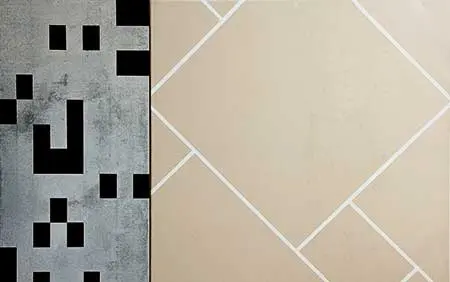
A piece that stands out in the exhibition deserves special attention, both because of its monumental size and eloquent content, is Catorce planos amarillos (Fourteen Yellow Planes, 2014). It was designed specifically to cover the left sidewall of the entrance of the exhibition room. It was supported by a 466 x 466 cm frame whose tonal range appears to expand the length of the table and turns it into something more than a painting; a kind of large installation that dominates the perimeter of the space. Given its qualities, from a distance, the work is perceived as a portal or a large mandala charged with suggestive mystical connotations. Degradation, glazes, and informal trajectories emerge from the silvery background to give the work an ambiguous and almost telluric screen that blurs the entire format. Guerrero draws with mathematical precision irregularities drawn with acrylic fourteen yellow squares of different sizes—large and small, medium. The contrast between the cool and warm tones creates a tenuous but profound shock that attains the fantastic since the squares seem to inexplicably float on galvanized zinc. According to Luis Velázquez: “These are spaces where a series of visual events occur; processes in which the geometry undergoes free interpretations and interventions that reveal an antagonistic duality marked by several binary systems—reality-abstraction, objectivity-subjectivity, single-group, local-universal-reason-emotion—that call for reflection on the crisis of representation shaking contemporary art...” Throughout his career, Guerrero has managed to adopt several approaches with respect to the use of materials and the selection of subjects and techniques, which is the reason that his work supports discursive possibilities that lead to thinking about relativities, certainties, or dogmatisms associated with the positions and practices of art.
GLADYS YUNES YUNES
Under the curatorship of Albeley Rodriguez, the Museo de Arte Contemporáneo in Caracas presented the solo exhibition titled On the Steps of Antigone. A Proposal by Livia Daza-Paris. It was an emotional exhibition that consisted of installations in which evocative and poetic images from projections and videos, along with photographs and personal documents that belong to the artist, were established as vehicles for a narrative based on a selection of memories used to fill the void of a deeply felt absence: Daza-Paris’s father, Iván Daza, who disappeared during the Venezuelan armed struggle of the 1960s.
That absence, the missing body of her father, was evoked as a leitmotif from the very title of the exhibition: Antigone, daughter of Oedipus, decides to challenge the decree of King Creon and bury the body of her brother Polynices, abandoned on the outskirts of Thebes after being declared a traitor.
In On the Steps of... it is through the work of art that the quest to bury a missing body is symbolically presented through the operation of combining historical references connected to the disappearance of Iván Daza—letters, newspaper clippings, revisiting geographic points visited by her father, recreating physical spaces inhabited in childhood—with images created by Daza-Paris inspired by what from her imagination became the fictional narrative to explain her father’s absence.
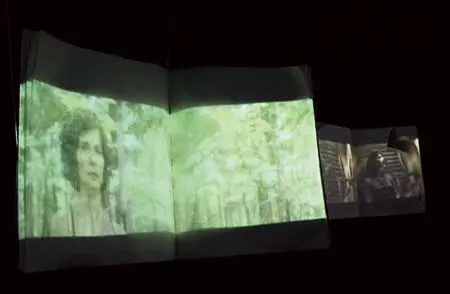
The exhibition consisted of five installations conceived between 2013 and 2014 that took that pursuit as the point of departure. In Libros de espera (Waiting Books), three books-objects made with paper that hung from the ceiling served as support for 3D mapping images: letters from Daza-Paris’s mother explaining to her daughter the disappearance of her father, alongside images by the artist imaginatively reconstructing through performance and dance the representation of the fall of her father in the mountains of Lara. A recreation that, like the rest of the works in the exhibition, sought to provide a physical place to an event suspended in time, awaiting what confronted with a fading presence can only be imagined.
These same letters found after the death of Irma Paris in 1994 were approached as documents in the piece Hombre declarado ni vivo ni muerto. Canto I (Man Declared not Dead or Alive. Canto I): manuscripts encapsulated in a diary-like document in which Paris tells her love for her disappeared husband and the events associated with the recovery of his body. Along with these texts, there were also images of the artist’s hands on a scanner composing posthumous albums of a truncated family history, through the juxtaposition of mother and daughter portraits next to pictures of her father.
Adjacent to this installation, the work titled Relaciones de hallazgos (Correlations of Findings) consisted of documents submerged in water-filled plastic bags intervened with images of fragments of the artist’s body that served as a record of what could be imagined as a report of the found corpse body; a poetic take on the coroner’s report.
In the last two installations in the exhibition room, the evidences connected to spaces anchored in Daza-Paris’s experiences and those of her father, detonate the reconstruction of history through the physical and metaphorical recreation of memories.
On the one hand, in Un cuento antes de dormir: Lejos, a la orilla del fin (A Bedtime Story: “Faraway at the edge of the end”), the staging of a bedroom with fabric recreates the room in which Irma Paris told her young daughter, as if it were as a bedtime story, the disappearance of Iván Daza. The airiness of the textures that envelop the projection of audio and video of newspaper clippings and places linked to the death of Daza, appear to be a metaphor for the fragility of memory. And, on the other hand, the piece Antígona, diario de rituales (Antigone, Dairy of Daily Rituals), consists of the video projection of a duplicated image—one projected on the fabric and another that filters through it and ends on the wall—centered on the journey that Livia Daza-Paris made following the steps taken by the leader of Brigade 21 in the locations associated with his disappearance. It is a journey in which her body—in search of that other body never recovered—became the link between the geographical spaces and their natural elements—water, earth, and fire—to develop a series of rituals alongside persons close to her and residents of the area to pay tribute to the memory of her father.
History and fiction are indistinctly intercalated in the works of On the Steps… to fill the voids, the unresolved interruptions of a personal story that is actually part of a larger story: that of forced disappearances and claimed bodies never found, of stories never acknowledged and hidden by the state that in many cases are still not properly grieved.
CONSTANZA DE ROGATIS