
Affective Alphabet: José Morales - Installations, is a passionate poiesis
that unveils transformative memories, imaginations, and experiences between the
artist and objects related to his personal and professional life. Morales,
whose career spans more than forty years, has led thousands of individual items
(both found and made) into being three striking gallery installations--Arte-sano, The Wall, and We Loved You So Much. Each room is a
powerful statement, and together they speak to the difficulties of negotiating
a place where traditions are formed and a space whose ruthlessness demands
creativity for survival.
Arte-sano (1998-2013) is a collaborative project between Morales and his uncle, Manuel Rivera Ripoll, a Puerto Rican fisherman, net-maker, and craftsman who lived in the United States for a while, and then returned to the island. The transparent and solid sculptural objects in space become a kind of “alphabet”--“basic elements in a system that combine to form complex entities.” Rivera’s skills, knowledge, and aesthetic sensibilities had a profound impact on Morales, and Arte-sano is a tribute to creative insight, formal integrity, and making works that nourish one’s mind and spirit.
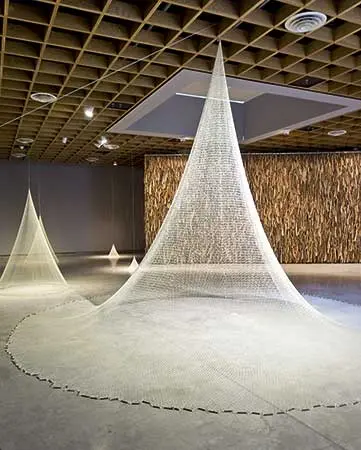
One of the complex entities in Arte-sano is a curtain of nearly five thousand wooden knives and machetes. This mass of humble sculptures made by Rivera is like an enormous school of fish. Slivers of light pass through the objects and fall onto a wide shadow on the floor behind the curtain and give the sensation of lightning-fast movement underwater. Rivera made nets of various sizes also, which Morales suspended from the ceiling, and they fall to the floor like graceful trumpet flowers. In another reciprocal act of learning and sharing with his uncle, Morales made ten drawings of net designs on various skin-toned papers. Just like memories, some of the artist’s delicate and exacting lines are complete and perfect, some are fragments and shadows, and others suggest torn nets.
Joining these exquisite monochrome forms in space (white nets and brown machetes and knives) is a rack of royal purple clothes made mostly from the same bolt of polyester fabric. Hanging on another rack next to the clothes are more wooden machetes and knives, perhaps representing a worker’s dream. Synthetic fabric becomes a natural, noble material, and the monotony of working with patterns and following trends is replaced by creative freedom.
Directly across from Arte-sano is The Wall (2013). Whereas Arte-sano presents the organic, the personal, and the handmade related to nature in Puerto Rico, The Wall presents New York City’s urban environment with its mass-produced flyers, art gallery walls, and art world discourse. It has an anonymous and generic feeling with the exception of a few poignant handbills. The Wall is actually three walls placed one inside the other. Around the periphery of the museum, the gallery is one continuous line of flyers that give the viewer a snapshot of what’s on the mind of Morales’ East Harlem neighborhood, and how it connects with Puerto Rico. In the gallery is a three-sided, temporary wall that shows its backside to the viewer as they enter the space with exposed gypsum-boards, sandbags, and metal studs with buttresses. On the other side are brightly lit, pristine white walls with a grid of thousands of colorful rectangles, the size of business cards, cut out of art magazines. Black rectangles combine to form three large Spanish words, “Bla” “Bla” “Bla.” A third wall on the floor, low and long, is made of art magazine cut-outs arranged like bricks. It appears that the arbiters of taste and those who assume the role of determining and rewarding artistic genius are just another brick in the wall.
In between these two galleries is We Loved You So Much (2013), the most puzzling and curious of the three installations. The walls are painted a Pepto-Bismol pink and in the middle of the room is an awkward industrial swing for a toddler. Two large fans, like proud parents, cause the swing to vibrating slightly when visitors trigger a motion sensor. Morales made two paintings for the room: one of a black baby shoe, and the other a dull olive-green monochrome, that reads like a window. High on the museum gallery wall are raised letters that say Tanto que te queríamos (We Loved You So Much) like a donor name. The multi-layered metaphors in this cloying scene shift back and forth between the art industry’s fleeting fetishes and unsettling childhood memories, absence, and loss.
Juan Flores’ book, The Diaspora Strikes Back, discusses the importance of counter streams and cultural remittances by Puerto Ricans who leave the island and return. Affective Alphabet involves two such cases: Rivera’s life and work back in Puerto Rico and Morales’ exhibition in San Juan. Affective Alphabet spells a tale of learning and turning that generates a collective form of re-imagining the world.
CHERYL HARTUP