Space and time,
respectively the third and fourth dimension, are two constants required for the
occurrence of any phenomenon, and even for its contemplation. The correlation
between them is the support for life itself, and a consequence of everything
that is present, has been, or will ever be. Art, as is natural, is not exempt
from this reality; it by force plays with these two substances in each
operation, each voluntary or accidental movement executed by an artist. There
are, however, artists who become aware of this fact and use it in their favor
by means of strategies that start by recognizing the grammar of motion, which
is at the same time the grammar of volume that references space. As a result,
there appear plastic, corporeal, and visual proposals that, adopting as one of
these two elements as their theme, question our relationship with space and
time, or even our innate and naïve capacity to ignore them, precisely because
they have always been there and it would be entirely useless to even think of
freeing ourselves from their immanence.
Along these lines, one Colombian artist has been exploring in emphatic ways the multiple connections between time and memory, time and nostalgia, time and existence, in a body of work that opens up in different directions, with special emphasis on drawing, to achieve certainly moving results. On August 30 at Espacio Odeón (an old mansion in Bogotá’s historic downtown where the Teatro Popular de Bogotá—TPB—used to be housed, now the headquarters of a foundation devoted to the promotion of the arts), Kevin Simón Mancera finished reading aloud the last word in the last line of the last paragraph in the last volume of the seven that comprise Marcel Proust’s masterpiece, In Search of Lost Time. This was the performance work that this young artist presented as a result of his exploration and staging, in the exhibition that closed the prize he received in October of 2013 as the winner of the first edition of the Sara Modiano Prize.
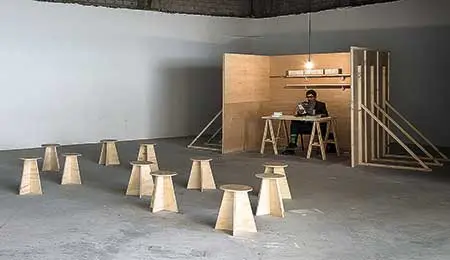
Espacio Odeón, abandoned for more than fifteen years, intentionally maintains a memory-laden atmosphere thanks to small interventions that have transformed the site into a center for cultural activities. Mancera, who knows how to read time, capitalized this potential, allowed it to speak, and installed himself in the third floor, reachable only through the decayed structure. A cubicle whose size is similar to that of a small office, one of its faces entirely open, built using common wood planks and lateral strips as buttresses, was the space and recording booth from which the artist performed his reading. Inside: a desk and a chair for the reader, a recording device, and a microphone; a lightbulb at the center of the space, just above the desk; two shelves containing recordings of the readings. Outside: a dozen chairs for visitors to sit down to hear the live reading or a reproduction of the reader’s voice, which was the same as the artist’s. Finally, two graphic elements, a framed ink portrait of Marcel Proust and an editorial item where Kevin Simón presented, transcribed by hand, drawn, Proust’s 1905 essay On Reading, originally published in the journal La Renaissance Latine.
Reading is a way of running, but it does not imply motion in the sense of physical displacement describing a trajectory. Even so, when we read, we engage in a Grand Tour, faster and more expedite than the conventional journeys governed by the laws of nature. It is precisely here that this work centers its reflection, as it plays with the notion of time from its most intimate condition, even for its direct correlation to the content of the reading made by the artist. Undoubtedly, what we have here is a kind of draftsmanship, supported by the pitch line of the voice as it emits words that become phrases (points that become lines). The superposition of these phrases-lines generates a grid that allows us to see a complex drawing on a plane, which in the end is Marcel’s own story: a story that brings the narrator through along the paths of Charles Swann, exploring his experiences and traversing memories in a kind of labyrinth that combines intimacy, remembrance, and nostalgia.
Farewell Forever
Not too far from the Odeon, at Nueveochenta gallery, and almost in an alternate way, Mancera presented a monographic show. Featuring a series of drawings that reminds us of a catalog of objects, plants, or animals with taxonomic criteria, characteristic of the Enlightenment era and the Encyclopedia, the artist brought to memory extinct animals and plants; culturally influential men and women who opted for suicide. The dead pets of his friends and acquaintances, ships remembered for their wreckage, fallen airplanes, totaled cars famous for the celebrities who died in them.
The atmosphere was complemented by the audio of popular songs of longing, loss, and farewell, and a series of portraits of their singers: Chavela Vargas, the Calle Sisters, Bola de Nieve, and Genaro Salinas (to whose song Adiós para siempre, or “Farewell forever,” the show owes its title). They were all present to speak to us of the pain of remembering something that will never return.
The two exhibitions are clearly evocative and melancholy, two experiences connected through the reiterated question about existence and our relationship to time, and relationship that is never the same and which, precisely thanks to this quality, makes us see with past-freighted eyes, in a kind of paradox that we use to construct our present.
OSCAR ROLDÁN ALZATE