
Visitors coming to
Galeria Paralelo in São Paulo for a better acquaintance with the recent work of
Luiz Hermano were immediately surprised by an encounter with the unexpected,
with everyday stuff reinvented by the artist for his show O batedor e a concha, which closed last October.
For the occasion, the artist redeployed a strategy that has governed his visual poetics for a long time: detouring our habitual understanding of the life of everyday objects. Thus, the selection of works on display in this exhibition established a dislocated invention of the common uses of our domestic imaginary in order to create a fictional universe that, between playfulness and functionality, guaranteed for visitors the possibility of interacting with an environment conceived for capturing the senses.
With this exhibition at Galeria Paralelo, curated by Kátia Canton, Luiz Hermano commemorated decades of ceaseless production directed towards the discovery of a possible world, in the midst of the jumble of visual and tactile prompts, so often hollowed of meaning, that is the complex weave of life in contemporary societies.
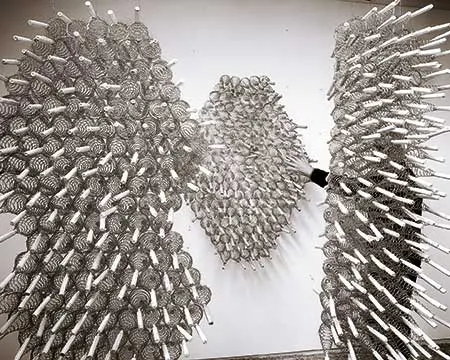
For those who have followed Hermano’s career, the show offered an intimate environment, relationships woven by the naturalness of the conscious posture of a traveler attentive to the itinerary of all that resides in oblivion. His objects, his selections for the composition of unique works of art, are real strategies to enhance the visibility of unremarkable utensils fated to disappear by virtue of their common and routine use, our intense cohabitation with them.
In fact, the egg beater from which the exhibition and the sculpture took their title—that noisy metal object, molded in its original shape, built for functionality and so present in our imagining of food preparation—was notably evident in the work occupying the center of the exhibition space, the show’s protagonist.
Impacted by the presence of Batedor—180 x 105 x 40 cm, in iron, wood, and wire, with almost two hundred egg beaters suspended from the ceiling—visitors touched the opposite ends of the work, free for manipulation, in order to activate it with a minimal push; this also set the gallery space in motion, as the shadows projected by the work expanded in waves through it.
Luiz Hermano is interested in registering the material expressions of culture, and builds his position, his particular way of looking at the world, on that very basis. Throughout his career, he has accompanied the motions of every forgotten material existence, attentive to the silences of every socially obliterated object and to what is invisible in their gestures.
Recognizing the social expression of his objects as signs of energy and force, we see in every one of his works—his egg-beater compositions, his aluminum soup ladles, his wire mesh—the formulation of a field of meaning created by the artist for the re-encounter with the simplest things in life.
In Hermano’s two-dimensional works, be it his aerial vistas of wire structures for household furnace-starters, or his drawings in China ink and watered coffee (the latter featured in the São Paulo show), there was a cast of images constructed by the experience that reconciles the everyday with a complex grid of social interactions, always active in the material elements of popular culture.
Among the works in China ink and watered coffee, Farol and Parabólica, both from 2014, incorporated the registers of a meticulous formal arrangement, composed by the painstaking tracings of a draftsman who is capable of reinventing his practice and returning to past strategies, decades of gazing at the chaotic space of the city.
Luiz Hermano knows how to capture the temperament of every object he utilizes in his works, resizing their tensions, admitting each necessary interference in our lives. Handling each work, shifting our expectations, we become aware of the fact that what interests him is to understand our relationships with the objects that surround us, this is to say how is it that the mediation between the secret life of objects and our own existence takes place.
Each one of these domestic objects—specifically, from the restricted universe of the kitchen, so present in Hermano’s recent work—traces social realities that the artist interprets and pushes towards different worlds, distant from their material function and their generative statements, of their immediate, restricted functionality.
The exhibition of drawings and objects made it possible for us to recognize, in Hermano’s tactile/visual poetics, a symbolic dimension that is firmly internalized in a man whose conscience was determined as the essential condition for the materialization or artworks as expressions of ancestral experiences, as artifacts of life, as signals.
Among various signals, among wire structures, among metal ladles, among the dust and watered coffee that Luiz Hermano uses as pigment for his drawings, in the middle of the luminous circular effect of each metal arc of a single egg beater, there resides the force of an intimate call to the most trivial nature of each gesture that, renewed, reinterprets the possibilities of a more humane conviviality with the other.
CLÁUDIA FAZZOLARI